

Making retail data AI-ready for health and beauty (HBC) brands
Health, Beauty, and Personal Care (HBC) is where sheer SKU diversity – across brands, formulas, pack sizes, and seasonal launches – scales the complexity of retail data operations tremendously. According to Databricks, a beauty brand moving from weekly summaries to daily, store-level granularity across 350 SKUs and 2,000 stores represents a 505x increase in data volume. Live streaming is also now driving roughly 22% of U.S. beauty commerce sales, meaning viral moments are triggering demand spikes in hours rather than quarters.
To keep pace with today’s demands, CPG brands need to make decisions grounded in real-time intelligence. The challenge is that their data lives across dozens of retailer portals and distributor systems, each with its own formats, definitions, and reporting timelines. Retailers face the same challenge on an even larger scale, multiplying every data problem across thousands of CPG suppliers and localized assortments at each store.
When enterprise CPG and retail teams operate from different data sets and siloed portals, the disconnect reaches across the business. Sourcing, localized assortment planning, promo spend, pricing, and OTIF all suffer, eroding tight margins and pulling innovation budgets away from the market opportunities that drive profitable growth.
IT leaders across the HBC industry are looking to their substantial cloud investments for a centralized approach to data democratization and AI adoption – purpose-built platforms that can embed retail-specific intelligence where the data already lives, governed by the teams who own it. This guide covers how Health and Beauty Care brands can effectively ingest, model, and leverage retail data sets with vertical retail AI for an end-to-end view of operations, store planning, and execution, spanning:
- Planogram data
- Point-of-sale (POS) data
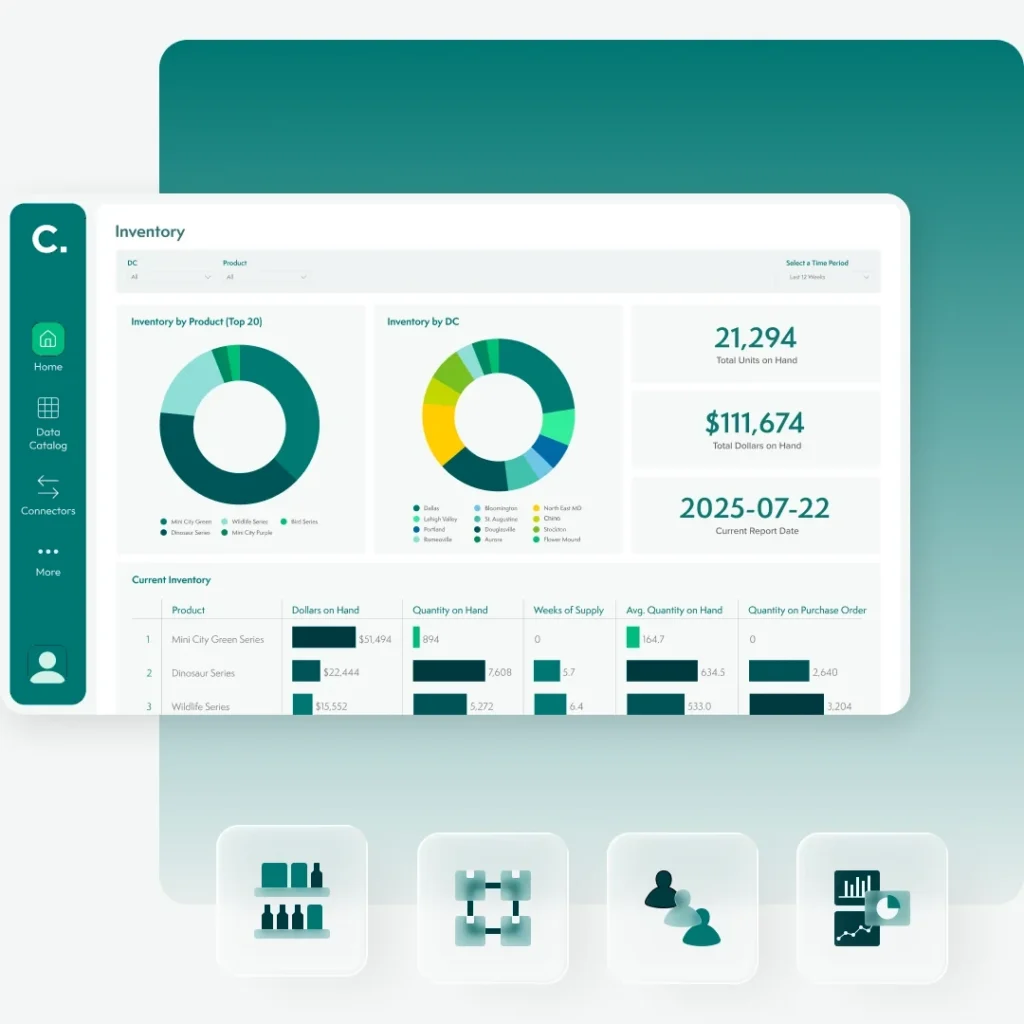
- DC and store inventory data
- POs
- Retail media
- Syndicated data
- Bring-your-own data sets
A beauty brand moving from weekly summaries to daily store-level data faces a 505x increase in data volume.
Why generic LLMs fail at HBC retail data (the vertical AI imperative)
Companies across the health and beauty industry adopt AI tools, run pilots, and see promising results at the individual level. Scaling those wins across the organization is where most stall. General-purpose AI platforms are useful for everyday tasks, but they don’t understand the nuances of HBC retail – fill rates, retailer-specific scorecards, promotional calendars, or how to identify the root cause of an out-of-stock across a seasonal product line with dozens of SKU variations.
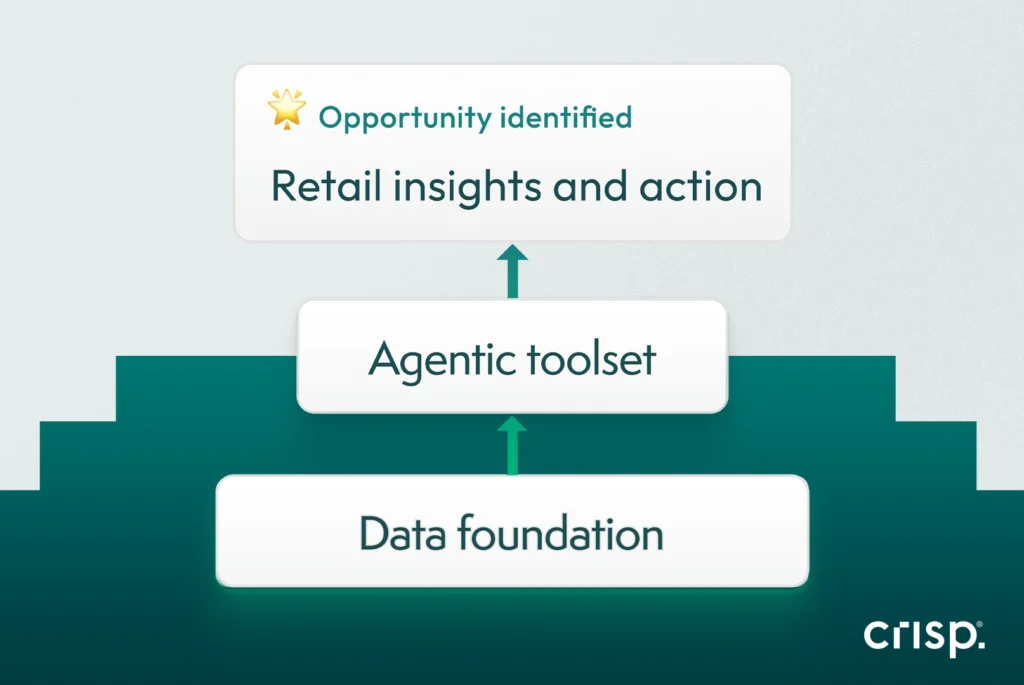
The companies using AI successfully across retail operations share a common foundation. Structured data pipelines connect their retailer and distributor sources into a consistent view. Industry-specific semantic modeling puts that data in the language of the business. And workflows map to how retail decisions are actually made – by account, category, or store cluster – rather than inferred by the model.
When AI is built vertically – on a foundation of data that’s contextualized through industry-specific modeling – outputs arrive with a nuanced understanding of the retail metrics HBC teams find valuable. A category manager reviewing hair care performance at a specific retailer gets targeted recommendations tied to that retailer’s fixture constraints and seasonal reset cadence. Every output connects back to the underlying data with logic chain technology so teams can confidently act on what AI surfaces. Over time, the system builds a continuous learning loop that stays responsive to real-time signals.
General-purpose AI can summarize and analyze, but it doesn’t understand fill rates, retailer scorecards, or how to trace the root cause of an out-of-stock.
Why vertical AI for CPG and retail brands
Seven core HBC retail data sets and how to make them AI-ready
- Planogram data
Category management in HBC is uniquely demanding. Makeup alone can include hundreds of shades per brand, each subject to retailer-specific fixturing rules that vary by store format. Planogram automation helps category teams build and revise modulars (MODs) at scale, by connecting planogram software with real-time POS data and purpose-built AI.
Coty’s Nail Care team leveraged AI to reduce planogram production from two weeks to less than a day, freeing time for the assortment and localization decisions that actually win resets.
Crisp was recognized with the 2026 Blue Yonder Category Management Partner of the Year award, for its integration between planogram data and POS performance where HBC brands see the fastest return on their data investment.
Building planograms is only half the equation. Field execution determines whether the strategy actually reaches the shelf. Near real-time data gives in-store set teams visibility into whether modulars are built correctly at each location, and allows them to communicate adjustments while still on-site. HBC categories are especially sensitive to execution gaps because assortments, fixtures, and signage are often store-specific. When set compliance data feeds back into the platform that produced the planogram, category teams can measure the link between execution quality and sales performance down to the store level.
Coty reduced planogram production from two weeks to less than a day using AI-powered space planning.
- Point of sale (POS) data
POS data is the backbone of HBC retail analytics. It tells brands what sold, where, when, and in what volume, which provides essential context in a category where scents, shades, and seasonal innovations shift constantly.
Coty’s approach demonstrates what becomes possible when POS data is clean and structured, with the team driving 20% Nail Care category sales growth by tying daily POS insights to assortment planning and execution.
- DC and store inventory data
Inventory visibility across distribution centers and stores is critical for health and beauty brands managing high-SKU portfolios, some with short trend cycles. AI-powered monitoring surfaces allocation gaps and flags when inventory at specific DCs trends below safety stock. Additional monitoring – including signals tied to Google Trends data – can also help brands respond to viral demand spikes. Brands that see inventory positions in real time with a pulse on downstream production and inventory can convert viral moments into sell-through while shelves are hot. - POs
Order management in HBC involves constant adjustments. EDI-based purchase order data, when structured and connected to inventory and sales signals, gives supply chain teams earlier visibility into what’s shipping and where bottlenecks are forming. AI can flag discrepancies between POs and expected demand, helping teams catch issues before they become missed delivery windows, ensuring OTIF excellence. - Retail media
RGM and promotional teams at HBC brands are increasingly managing campaigns across retailer media networks – a growing line item that requires the same analytical rigor as trade spend. When retail media data is connected to sales and inventory performance, AI can compare campaign spend against actual lift at the store and SKU level. Teams can redirect budget mid-flight to the accounts and products where investment is paying off, and pull back where spend is going toward out-of-stock items. - Syndicated data
Many HBC companies already license syndicated data reports and house them in their cloud environments. When retail AI runs in the cloud alongside this data, it can connect syndicated market trends to a brand’s own POS and inventory signals – without a data vendor needing to manage or see the proprietary data at all. This is especially relevant for enterprise beauty and care companies that treat syndicated intelligence as competitively sensitive. - Bring-your-own data sets
Every HBC organization has proprietary data that doesn’t fit neatly into standard retail categories. Consumer panels, social listening feeds, clinical study results, and in-house demand models are all valuable investments, and become far more revealing when combined. When retail AI runs in the brand’s own cloud environment, these data sets can be layered into the same analytical framework alongside POS, inventory, and planogram data. The result is a more complete picture of what’s driving performance, tailored to how the organization actually operates.
Crisp Halo capabilities for CPGs and Manufacturers
High-impact HBC AI use cases
Vertical retail AI pays off where HBC decisions move fastest – formula swaps, viral-driven stockouts, and launch windows that close in weeks. When AI is connected to clean, modeled retail data, it moves beyond reporting what happened to recommending what to do next, surfacing optimization scenarios before teams have to ask. Retail analytics become fully responsive, continuously learning from each decision to deliver sharper insights over time. Here are six high-leverage applications.
When AI is connected to clean, modeled retail data, it moves beyond reporting what happened to recommending what to do next.
- Diagnosing out-of-stocks (OOS) across thousands of variations
HBC brands manage thousands of SKU variations, and every out-of-stock has a different root cause. Vertical AI traces each stockout to the SKU variant and correlates it with DC inventory and recent POS velocity so CPG and retailer teams can see within minutes whether a specific item is selling through faster than planned, lost to shrink, or stuck in transit.
- Responding to viral demand in real time
When a product trends on TikTok, physical shelves can empty across a region in 48 hours. Vertical AI watches sell-through against planned demand and surfaces which stores and DCs need replenishment first. Combined with external signals, teams can shift allocation before the moment passes.
- Automating planogram resets
Reset season is where category teams win or lose the shelf. AI connects planogram software with real-time POS data and retailer-specific fixture rules, drafting MODs that already account for performance, assortment localization, and facing depth. That frees analysts to focus on the localization calls that actually drive lift.
- Measuring retail media ROI by SKU
Retail media spend is only efficient when it maps to products that are actually on shelf. Vertical AI compares campaign spend against sell-through at the store and SKU level, then flags where budget is going toward out-of-stock items or underperforming accounts.
- Tracking new launch velocity
Seasonal launches and limited-time offers give HBC brands weeks, sometimes days, to prove a concept. AI benchmarks each new SKU against a comparable historical launch, flags accounts where sell-in isn’t converting to sell-through, and identifies the retailers where early reorder signals mean it’s time to expand. The faster that signal reaches merchandising, the higher the odds of a second chain-wide buy. - Monitoring set compliance and fixture maintenance
In HBC retail, fixtures, POP signage, and promotional displays are frequently store-specific, tied to particular assortments and seasonal campaigns. Reorders and upkeep on these specialized materials can fall through the cracks, and when presentations degrade, so does sell-through. AI Agents can monitor for declining sales trends at stores where fixtures or signage are due for maintenance, and flag the correlation so teams can quantify revenue at stake.
Crisp Halo capabilities for Retailers and Distributors
Bringing AI built to run retail into the cloud
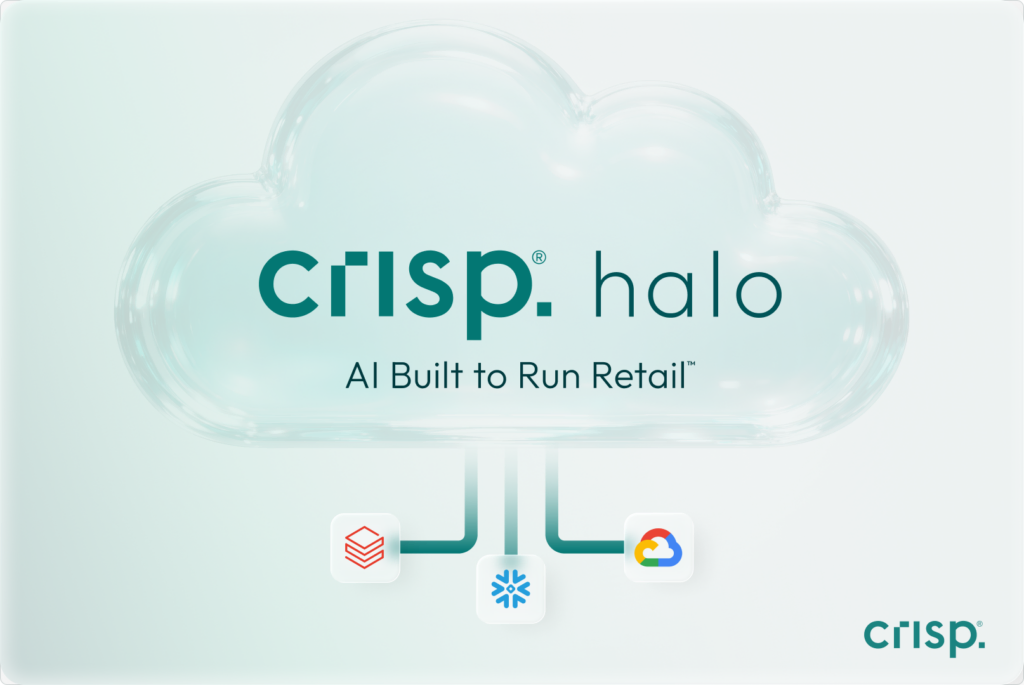
Enterprise HBC brands have invested heavily in cloud data platforms, but building retail-specific data pipelines internally remains complex. Crisp Halo deploys natively within Databricks, Snowflake, and Google Cloud, embedding purpose-built retail AI where the data already lives, and can be governed by IT. Data ingestion, modeling, and AI all run inside the customer’s environment. Crisp supports the platform with ISO 27001, ISO 27017, and SOC 2 compliance, without needing to access private data.
Data ingestion, modeling, and AI all run inside the customer’s cloud environment. No proprietary data needs to leave.
Activating retail AI in your cloud environment for full-spectrum business applications
Vertical AI built to run retail
Crisp Halo is the leading vertical AI platform built to run retail. It installs directly in a customer’s cloud environment for secure, embedded retail AI with built-in industry expertise across departments.
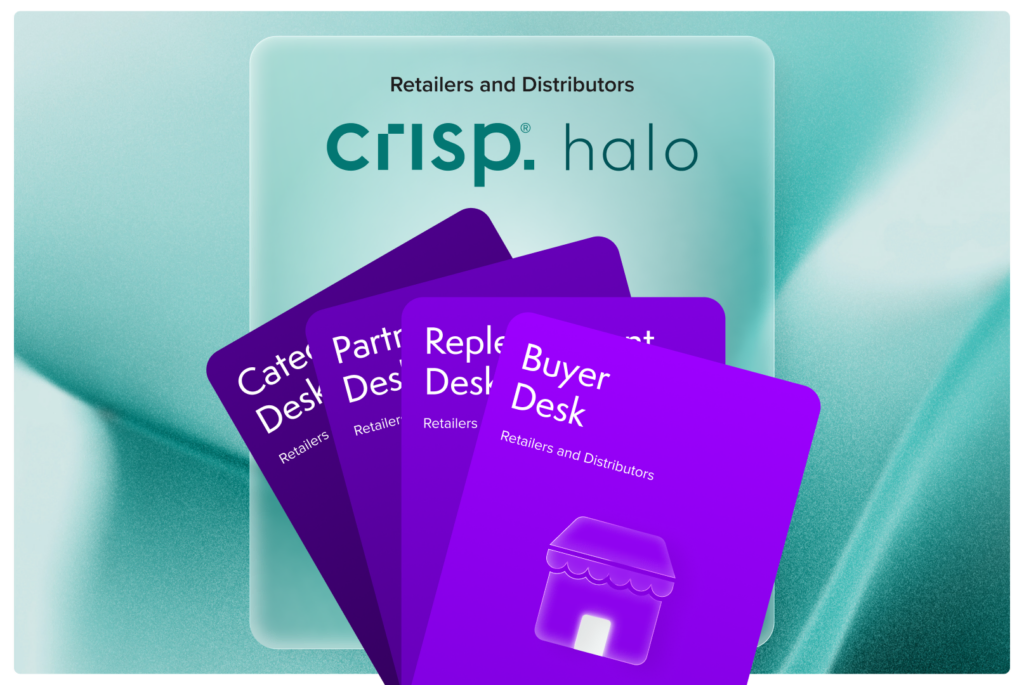
Customer Desk delivers retailer-specific intelligence tailored to the nuances of each major retail partner. Category Desk powers planogram automation, shelf planning, and strategic groupings, with native Blue Yonder CKB integration( Crisp was recognized as 2026 Blue Yonder Category Management Partner of the Year). Central Desk gives HQ teams a single operating view across the full portfolio. Replenishment Desk provides real-time inventory monitoring and proactive supply chain management. And Partner Desk enables retailers and distributors to activate supplier data into actionable intelligence for their supplier bases.
Crisp Halo installs directly in a customer’s cloud environment for secure, embedded retail AI with built-in industry expertise.
Get started with a vertical retail data strategy to create the foundation for scalable AI. Speak with an expert today.
Get insights from your retail data
Crisp connects, normalizes, and analyzes disparate retail data sources, providing CPG brands with up-to-date, actionable insights to grow their business.