
Supercharge CPG sales with AI-powered ...
May 29, 2025
What separates retail-grade AI from general-purpose tools – and why the difference matters for CPG brands.
AI has arrived at a turning point for retail. The models are capable, the infrastructure is maturing, and 58% of retailers now actively deploy AI solutions. Three-quarters call it a top strategic priority. Yet so far, only 16.5% of these companies can quantify a true return on their AI investments.
The pattern is familiar to anyone working in CPG. Companies adopt AI tools, run pilots, see a few promising results at the individual level, and then struggle to scale those wins across the organization. General-purpose AI platforms are useful for everyday tasks, but they don’t understand the nuances of the business, from fill rates, to retailer-specific scorecards – or how to identify and analyze the root cause of an out-of-stock (OOS).
These are the gaps purpose-built retail AI was built to close. Increased adoption across the industry – leading to Crisp being ranked as the #11 fastest-growing AI and Data company on the 2026 Inc. 5000 – underscores that when AI is built on the right foundation, teams actually adopt it, and continue finding helpful new ways to leverage it.
Over the past decade, the retail industry has been full of digital transformation projects with big goals, but often questionable outcomes.
As Crisp co-founder and Chief Product Officer Dag Liodden wrote in The AI Journal, “Raw intelligence is not what is holding industries like retail back. Instead, it’s the lack of specialized agent infrastructure for vertical AI. AI agents cannot run a business on slide decks and scattered text documents in shared folders. While the AI models are smart enough, the retail industry needs to build a solid foundational infrastructure to unlock AI’s full potential.”
The organizations that have been successful adopted many of the most important components of an AI stack – structured data pipelines, industry-specific semantic modeling, and workflows that map to how retail decisions are actually made.
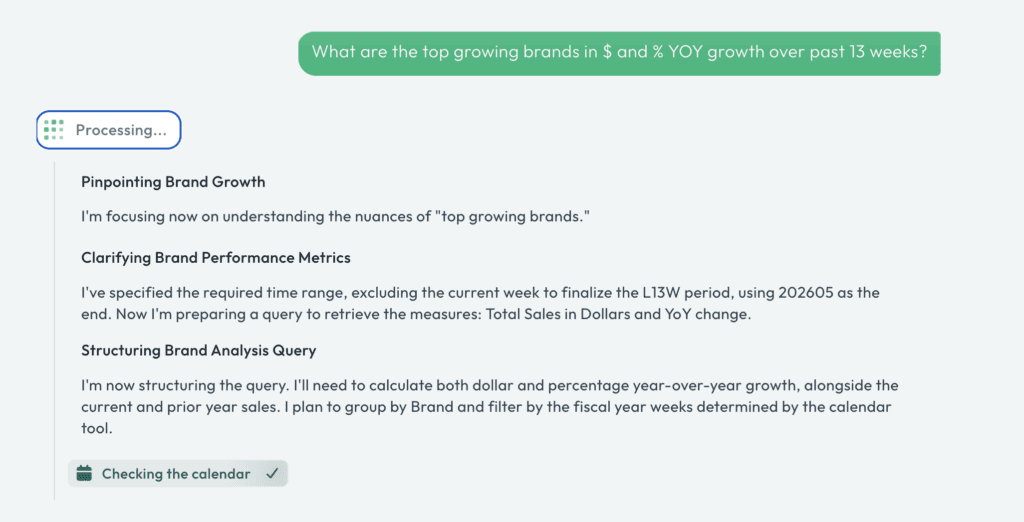
When AI is built vertically – on a foundation of data that’s contextualized through industry-specific modeling – actions don’t just arrive faster. They arrive with a nuanced understanding of the retail metrics you find valuable, with targeted recommendations you can act on. Every output connects back to the underlying data, business context, and logic behind it. Enterprises can establish a continuous learning loop that stays responsive to real-time signals across stores, channels, regions, and more.
“Raw intelligence is not what is holding industries like retail back. Instead, it’s the lack of specialized agent infrastructure for vertical AI. AI agents cannot run a business on slide decks and scattered text documents in shared folders. While the AI models are smart enough, the retail industry needs to build a solid foundational infrastructure to unlock AI’s full potential.”
Dag Liodden, Crisp Co-Founder and Chief Product Officer, in The AI Journal
Crisp’s path to vertical AI started with solving the most fundamental problem – getting all of a brand’s retail data into one place. The Crisp Data Platform connects to hundreds of retailers and distributors, normalizing and structuring incoming data so brands can see their full business in a single view.
That data foundation made it possible to build AI Master Data, which unifies SKUs across sources using a Retail Knowledge Graph and layers on a brand’s own custom hierarchies and classifications like “Trial Size” or “High Protein” that reflect how teams actually think about their portfolios. Award-winning semantic layer technology gives AI the structured, enriched context it needs to recommend actions tied to real ROI.
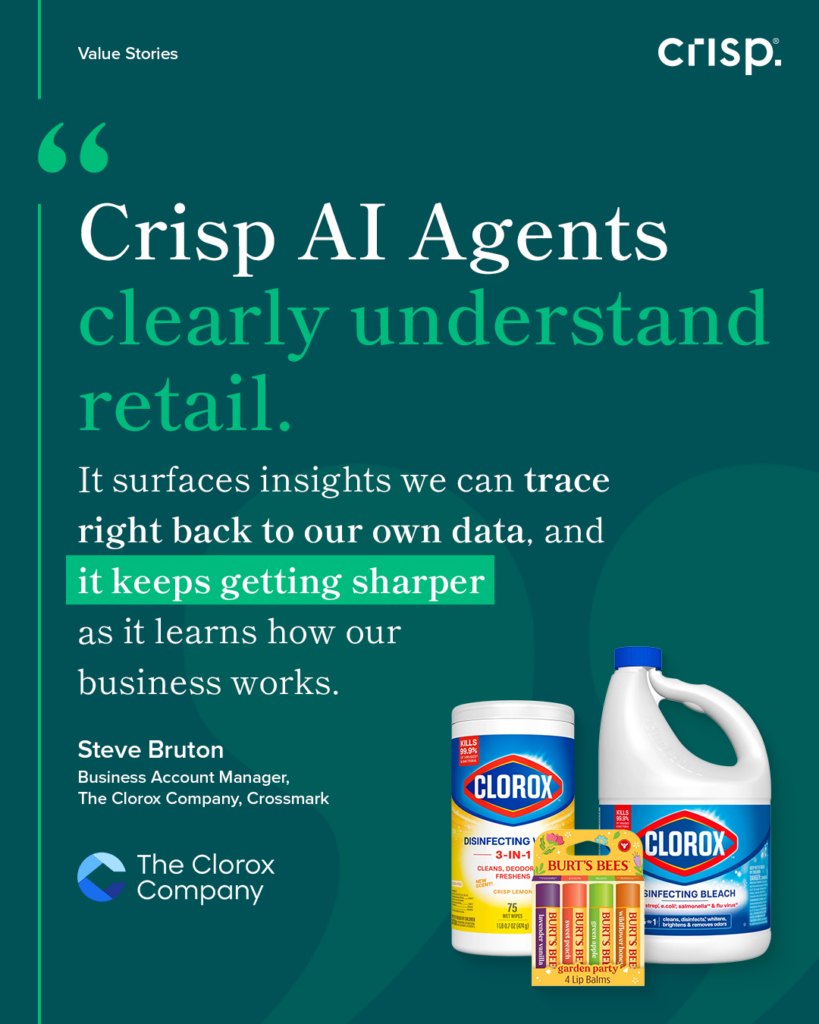
And from that foundation came Crisp AI Agents. Enterprise customers are already seeing what retail-grade intelligence looks like in practice. Steve Bruton, Business Account Manager at The Clorox Company, Crossmark, describes the shift: “AI Agents will be a real asset for holiday planning and execution. For seasonal performers like Burt’s Bees, we can propose strategic assortments based on localized insights, then see what’s working in real time as demand spikes.”
“Crisp AI Agents has saved hours out of my workday,” says Allie Schmidt, Customer Sales Manager for Specialty Distributors at B&G Foods. “Thanks to this tool, I am able to spend less time on the day-to-day fire drills and more time building out long-term strategies to strengthen partnerships and sales.”
“Crisp AI Agents has saved hours out of my workday. Thanks to this tool, I am able to spend less time on the day-to-day fire drills and more time building out long-term strategies to strengthen partnerships and sales.”
Allie Schmidt, Customer Sales Manager, B&G Foods
Speed without accuracy introduces significant risk, and in commerce, wrong decisions can quickly affect revenue, inventory, and critical partnerships. This is why logic chains sit at the core of Crisp’s vertical AI approach.
Every recommendation is traceable back to its data inputs, algorithms, and applied business rules. Outputs reflect retailer-specific constraints, product portfolio hierarchies, and operational realities – rather than general pattern recognition. Without logic chains, AI becomes a black box, which demands teams to spend extra labor validating outputs and connecting them to actions.
“A Category Manager can’t walk into a meeting with a major retailer and suggest a $100,000 inventory shift ‘because the AI said so’,” shared Crisp VP of Customer Development and AI scholar Lis Zhang. Verifiable logic chains handle the heavy lifting of surfacing insights. Human experts oversee the strategic work that requires relationship nuance, negotiation skills, and market intuition.
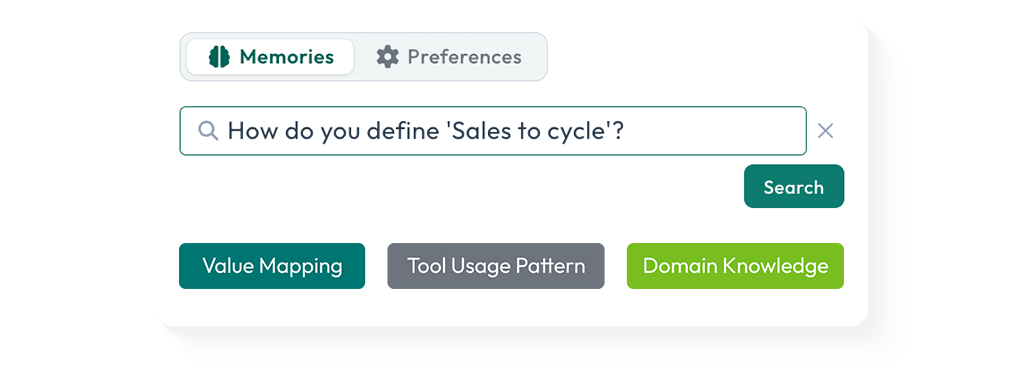
AI without memory or an understanding of user preferences is limited to one-off analysis and difficult to scale. From day one, vertical AI prioritizes learning your industry and company language, terminology, KPIs, and how success is measured.
Retail, category, and channel nuances are captured alongside how teams make and act on decisions. Over time, these collective memories become building blocks that lead to insights faster, in a way teams can share and collaborate around effectively.
AI without memory or an understanding of user preferences is limited to one-off analysis and difficult to scale. From day one, vertical AI prioritizes learning your industry and company language, terminology, KPIs, and how success is measured.
The current phase of retail AI is making teams comfortable with its capabilities. After working through the “first day” feeling, comes the testing phase, followed by implementation at scale.
The supply chain use cases already emerging with Crisp AI Agents show what that progression looks like. Teams are running root cause analysis on out-of-stocks, mapping paths back to in-stock across DCs and warehouses, enriching product data for sharper recommendations, and connecting internal data sources for fully responsive intelligence.
Ben Martel, Category Manager at Schwan’s, described that “AI Agents have streamlined my reporting process, saving significant time each week, while delivering advanced insights through interactive visualizations.” Martel went further: “Crisp AI has enabled me to quickly identify high-performing items with low distribution as potential growth levers – as well as spot low-performing items that are at risk.”
What comes next is that AI will begin surfacing too many problems and opportunities for teams to act on manually across stores and SKUs. This is where agent-to-agent communication will build a bridge, with continuous learning and tangible ROI gains to follow.
The retail industry is defined by fierce competition, and that competition will only continue to evolve. Extreme responsiveness across the supply chain is essential. The future of retail can become a prosperous greenhouse of innovation and consumer delight – with the right vertical AI foundation in place.
The retail industry is defined by fierce competition, and that competition will only continue to evolve. Extreme responsiveness across the supply chain is essential.
Get started with a vertical retail data strategy to create the foudnation for scalable AI. Speak with an expert today.