












Supercharge CPG sales with AI-powered ...
May 29, 2025
Across thousands of stores, DCs, and SKUs, AI Agents surface gaps and opportunities that human teams alone can’t reach.
Retail supply chains are grounds for continuous optimization. They produce enormous amounts of data, and only recently has it been well-connected enough to deliver true actionability at the SKU- and store-level. Metrics like On-Shelf Availability (OSA%), Walk-In Purchasability (WIP%), and Digital Transactability are becoming more important as CPG brands work to meet the rising expectations of AI-driven retail partners.
Are your products on-time, in-full, and available across every touchpoint where they’re expected to be? Human processing alone can surface some gaps, but not all of them, across thousands of store locations daily.
With clean data and the right retail context, AI Agents can help supply chain teams spot issues earlier, understand root causes faster, and take action rooted in logic chains. Here are five ways CPG supply chain teams are putting vertically integrated Crisp AI Agents to work today.
Identifying an out-of-stock (OOS) issue is one thing. Understanding the root cause – and recovering at-risk sales – is another. In addition to time-savings with automation, AI can leverage millions of data points to perform in-depth analytics that would take a busy employee hours.
With a flow of daily shelf and inventory data, AI Agents can surface the most urgent supply chain gaps each morning, and compare service levels, forecasts, and other reports to help teams understand what actually caused the issue. Supply chain teams can go deeper into root causes to move from insight to action – and back in stock – faster.
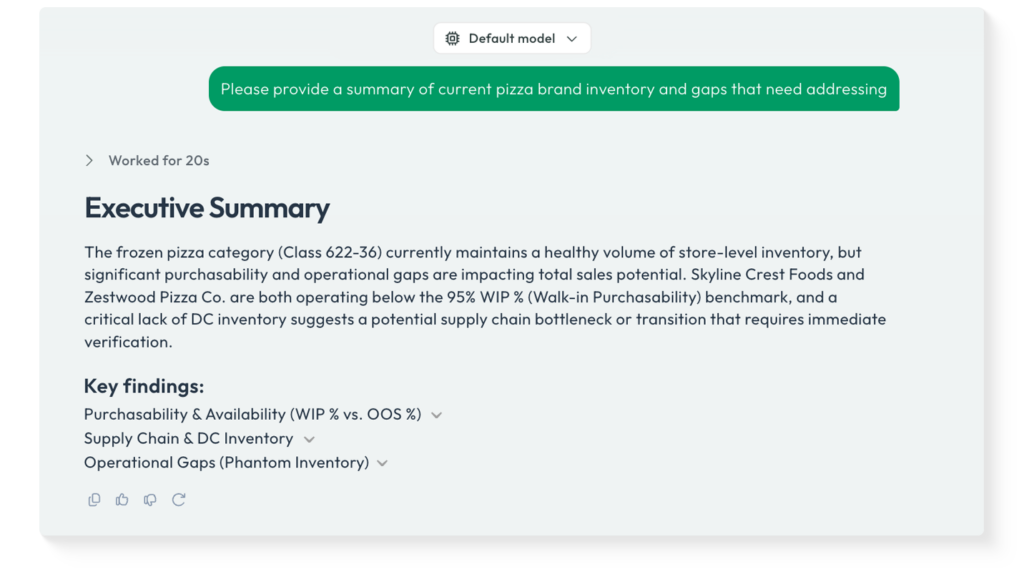
Once a team understands what happened, the next question is how to get back in stock as quickly as possible.
The advantage of using AI Agents is their ability to maintain a constant pulse on your inventory across DCs and warehouses, including current on-order details. Teams can see whether there’s enough inventory in the pipeline, write new orders where needed, and uncover actionable paths to restore availability the fastest.
For example, Safe Catch seafood’s COO shared that the company recovered over $1M in previously lost sales by using Crisp to match DC inventory levels with store-level demand. As customers like global toy and homegoods supplier ZURU have shared, Crisp’s AI solutions are helping them become “even more responsive and resource optimized.”
Safe Catch seafood’s COO shared that the company recovered over $1M in previously lost sales by using Crisp to match DC inventory levels with store-level demand. As customers like global toy and homegoods supplier ZURU have shared, Crisp’s AI solutions are helping them become “even more responsive and resource optimized.”
Agentic action is a powerful force that takes on more value with more brand and business context. For supply chain teams, that means AI can understand not only how inventory is flowing, but how products fit into the larger portfolio and operational strategy.
This is where data enrichment becomes critical. Crisp AI Master Data takes what is already a formidable retail data foundation and layers on a brand’s own custom hierarchies and taxonomies built around how each business actually thinks about its products. Teams can apply classifications like “High Protein” or “Trial Size” across retail data sources, and track the performance of these groupings at the nationwide, regional, or individual store level – including with natural language analysis – on the AI Agents platform.
Master data management (MDM) was previously a highly manual process, requiring tedious enrichment across sprawling spreadsheets. But consumer buying trends have grown too fast and too varied for traditional demand forecasting models to keep pace. As GLP-1-driven shifts or viral flavor trends accelerate category volatility, supply chain teams need structured ways to keep their underlying data aligned to real-world demand signals. When this enriched data flows into AI Agents, it improves the quality and relevance of surfaced insights, resulting in more accurate and actionable recommendations.
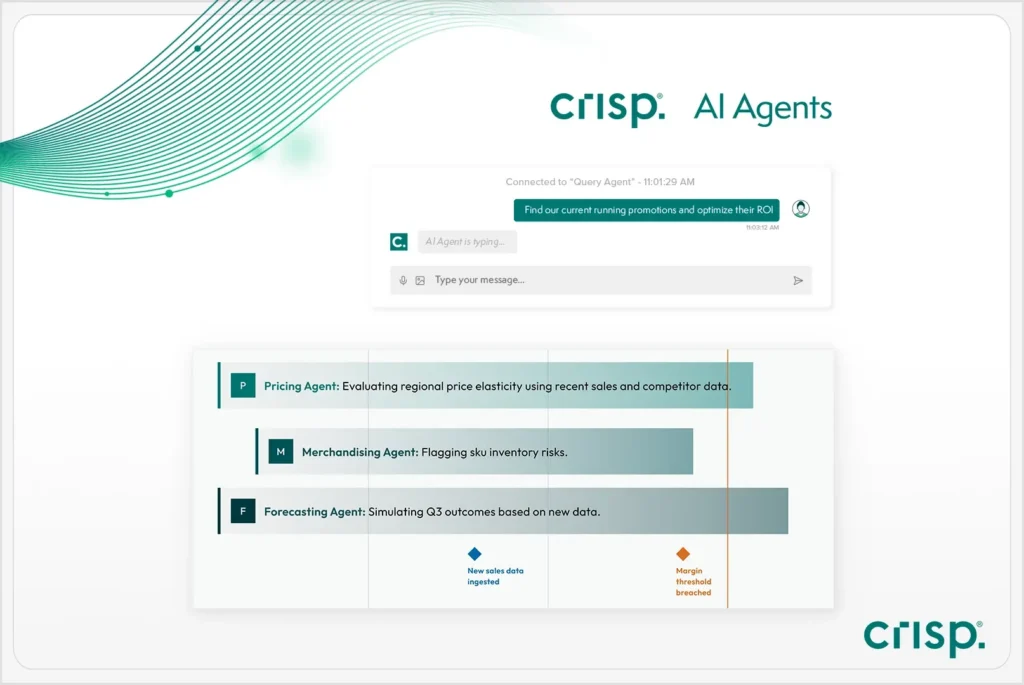
Not every supply chain question fits into a standing report. New product launches, promotions, and inventory strategy comparisons can all require ad-hoc analyses. Waiting for manual reporting can mean the insights you need arrive too late to act on.
Present Crisp AI Agents with these pressing questions to receive immediate answers and visualizations. Logic chain technology means teams can explore the data for accuracy, and connect it back to its retail data source for confidence in the decision.
Scheduling and automation extend this further. Teams can set up exception reports to run automatically and alert the right people when inventory dips below a threshold or a key metric shifts course.
“Having data is just the starting point. Real value comes from turning it into insights and action. Crisp helps us do that faster and more efficiently,” shared Rachael Peot, Senior Director of Category Strategy at Schwan’s Company.
“Having data is just the starting point. Real value comes from turning it into insights and action. Crisp helps us do that faster and more efficiently.”
Rachael Peot, Senior Director of Category Strategy, Schwan’s Company
The retail data Crisp connects is a critical foundation and starting point. But AI Agents get more useful as the data feeding them gets richer – and for supply chain teams, some of the most valuable context lives inside the organization.
Production schedule data is a good example. When AI Agents can see when products will actually roll off the line and be ready to ship, in-stock ETAs get meaningfully more accurate than what PO data alone can offer.
Planogram data is another strong data input. Before a shelf reset, AI Agents can cross-reference the POG against current sales velocity and inventory data to flag capacity mismatches. If the shelf configuration can’t support demand – or would push product to the backroom rather than to the shelf – teams become aware and can plan before the next reset, not after. The Crisp AI Agents platform is built with a vertical AI approach that helps teams achieve fully integrated intelligence.
What emerges from this new precedent is a shift in what “good” looks like for supply chain teams. As competition intensifies, disruptions arise, and retail partners update their expectations, the ability to act quickly is no longer differentiated – the quality and context behind those decisions is what drives advantage. What AI Agents actually deliver is the ability to stay responsive, and catch issues before they compound to make better, more profitable decisions, faster.
Ready for AI that surfaces accurate and actionable supply chain insights? Get started by speaking with an expert.