

Making fresh meat, dairy, and produce data AI-ready
Perishables live or die by shelf life. Temperature compliance and rapid sell-through make daily or near-real-time POS, inventory data, as well as weather and demand signals, far more consequential than weekly averages. Demand for fresh and prepared foods is accelerating as GLP-1 adoption, heightened nutrient focus, and evolving SNAP eligibility bring perimeter categories into sharper focus – and the stakes for getting fresh right are high. Recently, 35% of consumers reported switching stores because they were dissatisfied with fresh food options, making meat, dairy, and produce primary drivers of shopper loyalty across both traditional grocers and expanding formats like dollar and convenience stores.
Yet meeting fresh demand profitably puts immense pressure on supply chain and store operations. Today, 88% of retailers report increased costs – including shrink – as a primary barrier to expanding their fresh offerings. Across reporting U.S. Food Waste Pact retailers alone, nearly 3.90 million tons of food went unsold in a single year, representing $26.9 billion in lost retail sales value. Shorter shelf lives mean that spoilage and last-minute markdowns quickly erode margins whenever assortments shift or localized demand spikes, from holiday grilling weekends to sudden heatwaves.
To keep pace, fresh CPG brands need to be driven by real-time intelligence into what is selling and what is approaching code, store by store. The challenge is that this data lives across dozens of retailer portals and distributor systems, each with its own formats, definitions, and reporting timelines. Retailers face the same challenge on an even larger scale, multiplying every data problem across thousands of fresh suppliers, regional cold-chain networks, and localized assortments at each store.
When CPG and retail teams work out of siloed portals, execution and perishable margins suffer. IT leaders are closing that gap by embedding purpose-built vertical retail AI directly into their cloud environments to activate core data sets across fresh operations:
- Planogram data and perimeter, case data
- Point of sale (POS) data
- DC, cold-chain, and store inventory data
- POs
- Retail media
- Syndicated data
- Bring-your-own data sets (such as weather, harvest forecasts, and shelf-life data)
Meeting fresh demand profitably puts immense pressure on supply chain and store operations. Today, 88% of retailers report increased costs – including shrink – as a primary barrier to expanding their fresh offerings. Across reporting U.S. Food Waste Pact retailers alone, nearly 3.90 million tons of food went unsold in a single year, representing $26.9 billion in lost retail sales value.
Why generic LLMs fail at fresh and perishable retail data (the vertical AI imperative)
Companies across the fresh meat, dairy, and produce category adopt AI tools, run pilots, and see promising results at the individual level. Scaling those wins across the organization is where most stall. General-purpose AI platforms are useful for everyday tasks, but they don’t understand the nuances of perishable retail, from fill rates and retailer-specific scorecards to how to identify the root cause of an out-of-stock across a code-date-sensitive category with tight replenishment windows.
The companies using AI successfully across retail operations share a common foundation. Structured data pipelines connect their retailer and distributor sources into a consistent view. Industry-specific semantic modeling puts that data in the language of the business. And workflows map to how retail decisions are actually made, whether by account or store cluster, rather than inferred by the model.
When AI is built vertically on a foundation of data that’s contextualized through industry-specific modeling, outputs arrive with a nuanced understanding of the retail metrics fresh teams find valuable. A category manager reviewing dairy performance at a specific retailer gets targeted recommendations tied to that retailer’s cold-chain requirements and seasonal demand patterns. Every output connects back to the underlying data with logic chain technology so teams can confidently act on what AI surfaces. Over time, the system builds a continuous learning loop that stays responsive to real-time signals.
The companies using AI successfully across retail operations share a common foundation. Structured data pipelines connect their retailer and distributor sources into a consistent view. Industry-specific semantic modeling puts that data in the language of the business. And workflows map to how retail decisions are actually made, whether by account or store cluster, rather than inferred by the model.
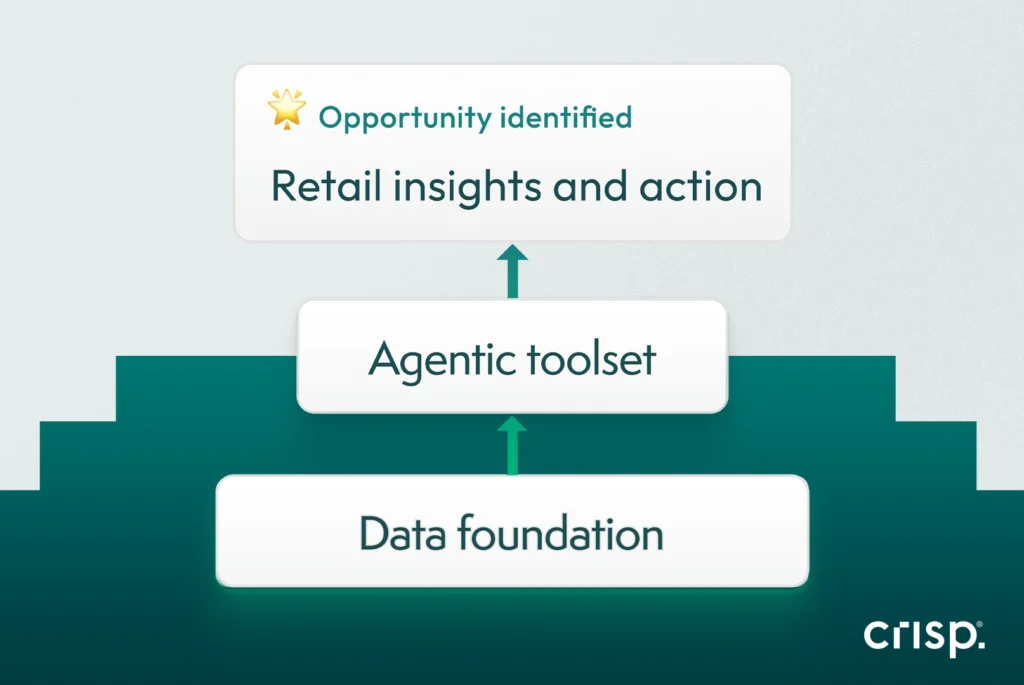
Why vertical AI for CPG and retail brands
Seven core fresh and perishable retail data sets and how to make them AI-ready
- Planogram data
Category management in fresh is uniquely demanding. Produce departments alone manage dozens of seasonal rotations and regional sourcing variations, each subject to retailer-specific cold-case configurations that vary by store format. Planogram automation helps category teams build and revise perimeter layouts at scale, by connecting planogram software with real-time POS data and purpose-built AI.
Brookshire Grocery achieved an 85% reduction in time to draw and 90% faster planogram updates, freeing time for the assortment and localization decisions that actually win resets.
Crisp was recognized with the 2026 Blue Yonder Category Management Partner of the Year award, for its integration between planogram data and POS performance where fresh brands see the fastest return on their data investment.
Brookshire Grocery achieved an 85% reduction in time to draw and 90% faster planogram updates, freeing time for the assortment and localization decisions that actually win resets.
- Point of sale (POS) data
POS data is the backbone of fresh retail analytics. It tells brands what sold, where, and in what volume, providing essential context in a category where regional preferences and seasonal availability shift constantly. When POS data is clean and structured, teams can connect daily sell-through to assortment planning and execution, identifying which protein cuts move fastest in specific markets or where organic dairy is outperforming conventional at the store level.
- DC and store inventory data
Inventory visibility across distribution centers and stores is critical for perishable brands managing temperature-sensitive products with strict code-date windows. AI-powered monitoring surfaces allocation gaps and flags when inventory at specific DCs trends below safety stock. Additional monitoring through weather forecasts and seasonal demand signals can help brands anticipate shifts before they hit the shelf. Brands that see inventory positions in real time alongside downstream production data are the ones who can convert seasonal peaks into sell-through before product approaches code. - POs
Order management in fresh and perishable involves constant adjustments. EDI-based purchase order data, when structured and connected to inventory and sales signals, gives supply chain teams earlier visibility into what’s shipping and where bottlenecks are forming. AI can flag discrepancies between POs and expected demand, helping teams catch issues before they become missed delivery windows, ensuring OTIF excellence. - Retail media
RGM and promotional teams at fresh CPG brands are increasingly managing campaigns across retailer media networks, a growing line item that requires the same analytical rigor as trade spend. When retail media data is connected to sales and inventory performance, AI can compare campaign spend against actual lift at the store and SKU level. Teams can redirect budget mid-flight to the accounts and products where investment is paying off, and pull back where spend is going toward out-of-stock items. - Syndicated data
Many fresh and perishable companies already license syndicated data reports and house them in their cloud environments. When retail AI runs in the cloud alongside this data, it can connect syndicated market trends to a brand’s own POS and inventory signals, all without a data vendor needing to manage or see the proprietary data. This is especially relevant for enterprise fresh food companies that treat syndicated intelligence as competitively sensitive. - Bring-your-own data sets
Every fresh and perishable organization has proprietary data that doesn’t fit neatly into standard retail categories. Weather and cold-chain sensor data alongside proprietary demand models are valuable investments, and become significantly more revelatory when combined. When retail AI runs in the brand’s own cloud environment, these data sets can be layered into the same analytical framework alongside POS and inventory data. The result is a more complete picture of what’s driving performance, tailored to how the organization actually operates.
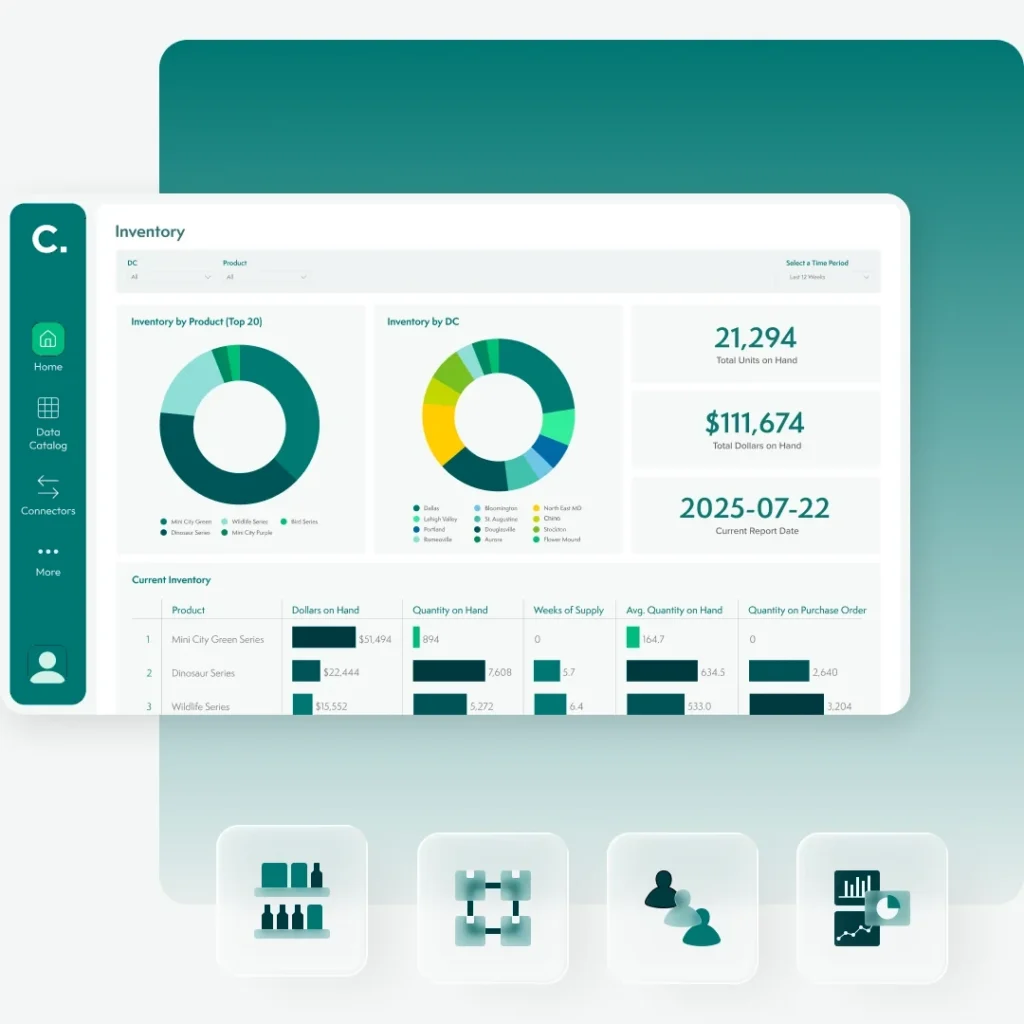
Crisp Halo capabilities for CPGs and Manufacturers
High-impact fresh and perishable AI use cases
Vertical retail AI pays off where perishable decisions move fastest, from code-date windows to weather-driven demand swings that shift weekly. Here are five of the highest-leverage plays.
When AI is connected to clean, modeled retail data, it moves beyond reporting what happened to recommending what to do next.
- Diagnosing out-of-stocks (OOS) across perishable assortments
Fresh brands manage hundreds of SKU variations across cuts and sourcing tiers, and every out-of-stock has a different root cause. Vertical AI traces each stockout to the specific item and correlates it with DC inventory and recent POS velocity so CPG and retailer teams can see within minutes whether product is selling through faster than planned or approaching code at an overstocked DC.
- Responding to weather-driven and seasonal demand shifts
When a heatwave spikes grilling demand or a holiday weekend drives a run on specific proteins, shelves can empty across a region in days. Vertical AI watches sell-through against planned demand and surfaces which stores and DCs need replenishment first. Combined with weather and seasonal signals, teams can shift allocation before product approaches code at the wrong location.
- Automating planogram resets
Reset season is where category teams win or lose the perimeter. AI connects planogram software with real-time POS data and retailer-specific fixture rules, drafting layouts that already account for performance and assortment localization. That frees analysts to focus on the regional calls that actually drive lift.
- Measuring retail media ROI by SKU
Retail media spend is only efficient when it maps to products that are actually on shelf. Vertical AI compares campaign spend against sell-through at the store and SKU level, then flags where budget is going toward out-of-stock items or underperforming accounts.
- Tracking new launch velocity
Seasonal launches and limited-time offers give HBC brands weeks, sometimes days, to prove a concept. AI benchmarks each new SKU against a comparable historical launch, flags accounts where sell-in isn’t converting to sell-through, and identifies the retailers where early reorder signals mean it’s time to expand. The faster that signal reaches merchandising, the higher the odds of a second chain-wide buy. - Monitoring set compliance and fixture maintenance
Seasonal launches and limited-time offerings give fresh brands weeks, sometimes days, to prove a concept. AI benchmarks each new SKU against a comparable historical launch and flags accounts where sell-in isn’t converting to sell-through. It also identifies the retailers where early reorder signals mean it’s time to expand. The faster that signal reaches merchandising, the higher the odds of a second chain-wide buy.
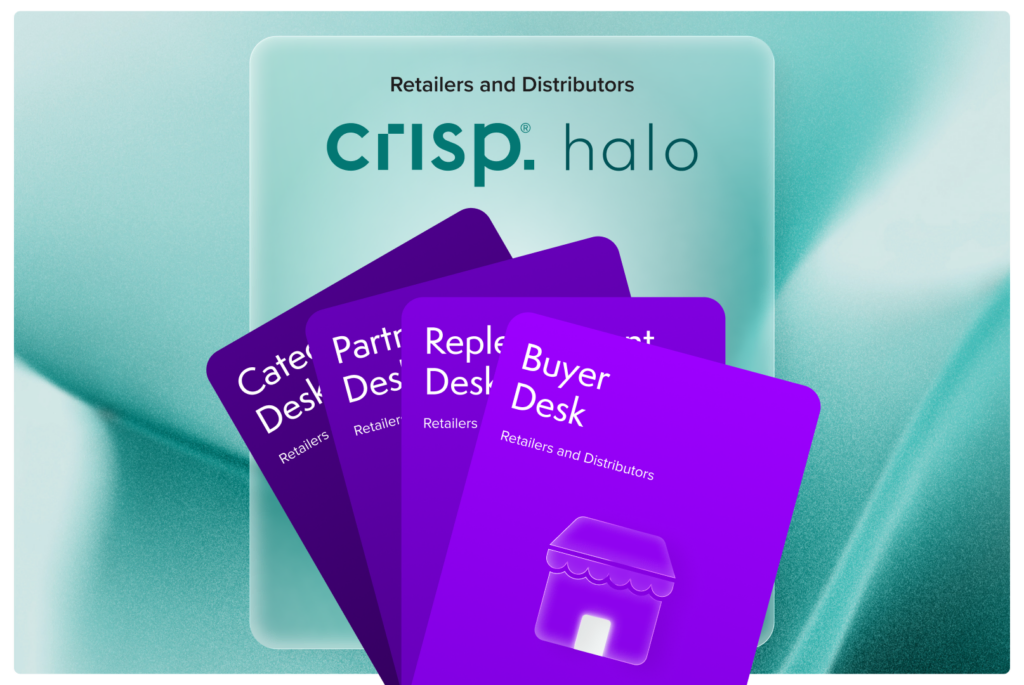
Crisp Halo capabilities for Retailers and Distributors
Bringing AI built to run retail into the cloud
Enterprise fresh and perishable brands have invested heavily in cloud data platforms, but building retail-specific data pipelines internally remains complex. Crisp Halo deploys natively within Databricks, Snowflake, and Google Cloud, embedding purpose-built retail AI where the data already lives, governed by IT. Data modeling and AI run entirely inside the customer’s environment. Crisp supports the platform with ISO 27001, ISO 27017, and SOC 2 compliance, without needing to access private data.
Data ingestion, modeling, and AI all run inside the customer’s cloud environment. No proprietary data needs to leave.
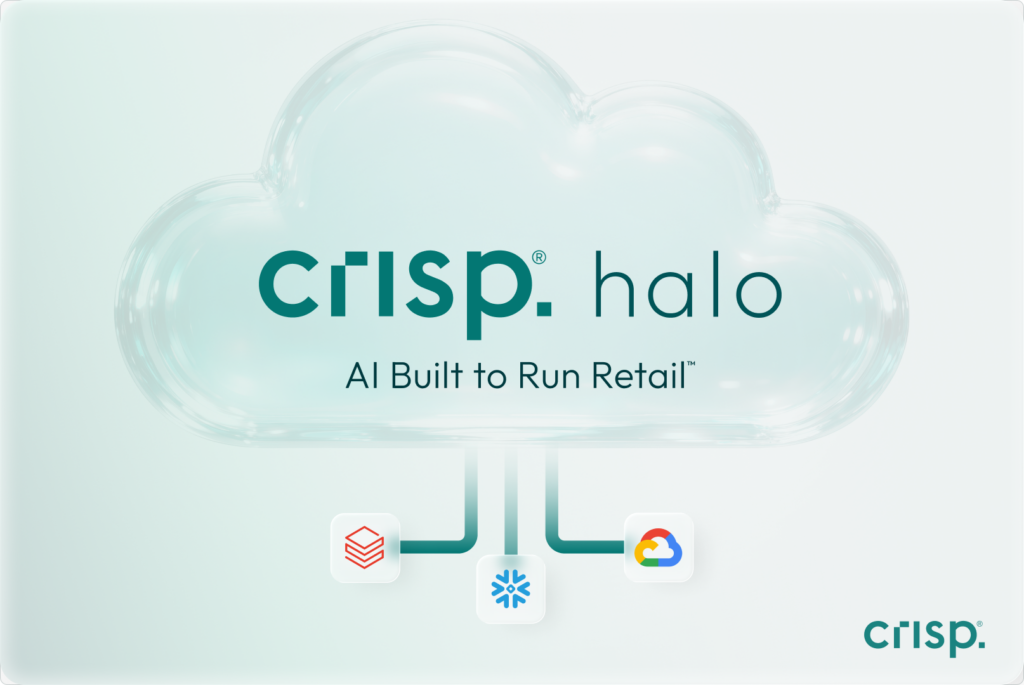
Activating retail AI in your cloud environment for full-spectrum business applications
Vertical AI built to run retail
Crisp Halo is the leading vertical AI platform built to run retail. It installs directly in a customer’s cloud environment for secure, embedded retail AI with built-in industry expertise across departments.
Customer Desk delivers retailer-specific intelligence tailored to the nuances of each major retail partner. Category Desk powers planogram automation, shelf planning, and strategic groupings, with native Blue Yonder CKB integration( Crisp was recognized as 2026 Blue Yonder Category Management Partner of the Year). Central Desk gives HQ teams a single operating view across the full portfolio. Replenishment Desk provides real-time inventory monitoring and proactive supply chain management. And Partner Desk enables retailers and distributors to activate supplier data into actionable intelligence for their supplier bases.
Crisp Halo installs directly in a customer’s cloud environment for secure, embedded retail AI with built-in industry expertise.
Get started with a vertical retail data strategy to create the foundation for scalable AI. Speak with an expert today.
Get insights from your retail data
Crisp connects, normalizes, and analyzes disparate retail data sources, providing CPG brands with up-to-date, actionable insights to grow their business.