

Agentic commerce: autonomous AI in retail
AI Agents uncover complex insights, make recommendations, and alert team members to the day’s priorities.
Key takeaways:
- Agentic AI goes beyond traditional AI by taking independent actions with pre-defined boundaries.
- Four critical components that power agentic commerce are AI agents, a clean data foundation enhanced with a semantic layer, integration points, and feedback loops.
- Top retail applications include automated and customized reporting, sales decomposition, root cause analysis, and anomaly detection.
What is agentic commerce?
Let’s break it down. Agentic commerce is a type of advanced AI. “Agentic” means functioning like an agent, with the ability (or agency) to understand an environment, make decisions, and take actions. For humans, agency can mean choosing what to have for breakfast, based on what’s in the fridge, or mapping out the next best career move based on market conditions. In the world of AI, agency refers to AI-powered solutions that can oversee themselves day-to-day and even interact with each other, without consistent human intervention. Agents are emerging in commerce, and can help CPG companies and retailers scale operations and grow revenue through instant insights and better customer experiences.
AI agents:
- Understand environments
- Interact with data in environments
- Interact with other agents
- Make decisions
- Take the next best actions
How is agentic AI different from other types of AI?
Traditional, generative, and agentic AI each have different capabilities. Traditional AI can recognize patterns and analyze data. Newer, generative AI can create new data based on learned patterns. The newest agentic AI can recognize and create, plus take independent actions, informed by deep learning algorithms and sophisticated programming parameters.

Components to power agentic AI
Agentic AI is powered by AI agents, data foundations, integration points, and feedback loops for continuous learning.
AI agents are trained to handle manual data-based tasks, automatically. For retailers and CPG brands, AI agents can track inventory levels, monitor pricing across competitors, and analyze customer behavior patterns, for example. Based on this information, the agents can take autonomous actions within pre-defined boundaries.
The decisions AI agents make are only as good as the data they’re based on. The data foundation must be secure, accurate, and consistently formatted. A semantic layer adds business and industry context, translating raw data into business logic that systems can process and respond to with natural language. For retailers and CPG brands, the data foundation may include order records, sales data, inventory levels, market intelligence, marketing insights, and more.
Integration points across operations are critical for agentic commerce to work effectively. In retail, these points can span POS systems, warehouse management systems (WMS), inventory management platforms, pricing tools, and CRM. As with generative AI, feedback loops for continuous learning are important in agentic AI. This enables the outcomes of decisions to be automatically analyzed and optimized for ongoing improvement and accuracy.
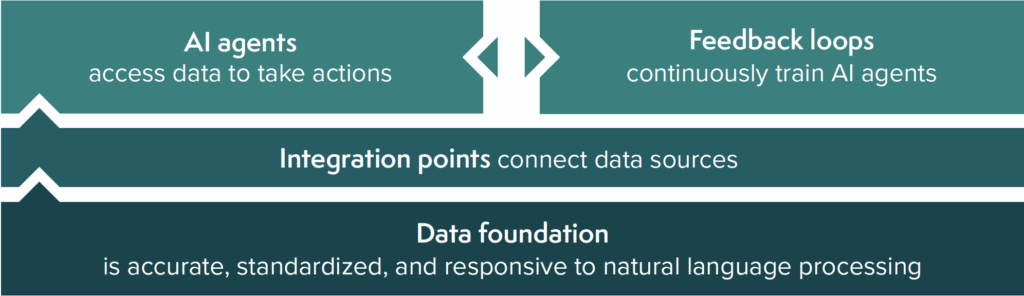
The decisions AI agents make are only as good as the data they’re based on. The data foundation must be secure, accurate, and consistently formatted.
Imagine what’s possible for agentic AI in commerce
- Supplier operations: Streamlined reporting and analysis that goes beyond metrics to provide narrative insights about performance drivers and recommended actions.
- Retailers: Enhanced decision-making support through AI agents that not only surface data but also provide contextual analysis and proactive recommendations.
- Customized performance snapshots, with your key metrics, delivered automatically each Monday
- Automatic adjustments to inventory allocations triggered by velocity, promotion, or competitive signals
- Responsive digital advertising that adjusts budgets and bids based on store-level availability
Most exciting retail applications for agentic commerce
As with all things AI, agentic commerce is advancing fast. Some exciting applications for retail and CPG sector companies to watch out for are, for example, sales decomposition, root cause analysis, and anomaly detection.
Sales decomposition and root cause analysis can revolutionize how retailers and CPG brands understand performance drivers. Instead of simply tracking what happened, AI agents can automatically dissect complex sales patterns to identify why changes occurred – whether due to promotional lift, competitive actions, seasonal factors, or supply chain disruptions. The agents can build meaningful narratives around the findings and recommend specific actions based on their analysis.
Trade promotions are notoriously challenging for retailers and CPG brands to get right. The smartest strategies fail without the right tools and data to predict and measure ROI. AI agents can optimize promotional spend by proactively pulling, analyzing, and modelling ROI data, including specific “what-if” scenarios and, once the promotion is in flight, monitoring performance in near real-time. This eliminates the surprises of traditional trade-lift reporting that lags. Instead of waiting for news, action can be taken. Spend can be re-allocated to protect margin and preserve the profitability that was forecasted.
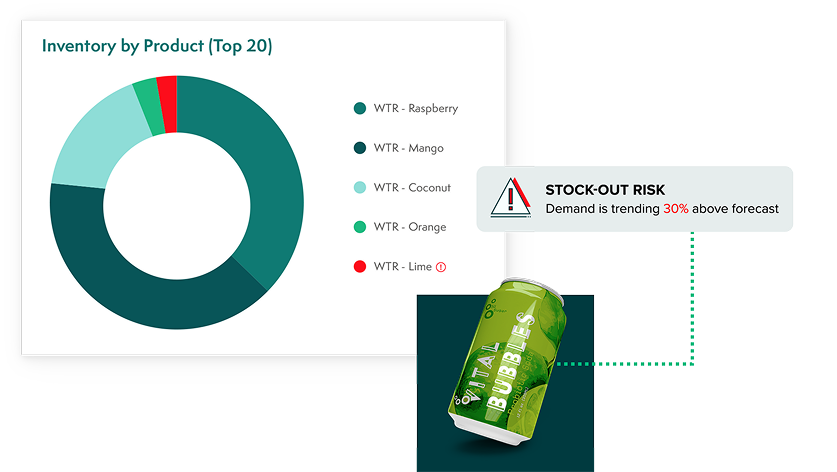
With agentic commerce, data is democratized and seamless to access, reimagining repetitive tasks such as Monday morning reporting. Employees gain access to customized reporting and alerts they need in their role to see around corners. Category managers, for instance, can spot unexpected changes in sales volume more quickly with agent-delivered insights at any preferred cadence. Supply chain teams can receive alerts of stockout risks, and sales can uncover weekly expansion opportunities.
With agentic commerce, data is democratized and seamless to access, reimagining repetitive tasks such as Monday morning reporting.
The biggest barriers to adopting agentic commerce
Data challenges are at the heart of what’s stopping retailers from forging ahead with the next AI breakthrough. Many have extensive discrepancies in data quality, accuracy, completeness, and structure across disconnected systems.
Fragmented systems and silos keep vital information buried in departmental databases. Without unified data across systems, AI agents are left operating with incomplete information, perpetuating existing problems, instead of solving them efficiently. At the same time, the complexity of systems integration may be time- or cost-prohibitive for some companies.
AI agents also need access to clean, real-time data to make the right decisions in real-time. Historical data isn’t enough to take confident actions in highly sensitive retail markets.
What clean data looks like to agentic AI
Agentic AI relies on data that is structured and standardized at every level, including:
- Product attributes
- Product hierarchies
- Store classifications
- Promotional data
- Performance metrics
With a unified data infrastructure, AI agents can consider multiple factors simultaneously and make sophisticated decisions about pricing, promotions, and inventory management. They can understand relationships among all the parts and model options based on the greatest business impacts.
Best agentic commerce practices to begin with
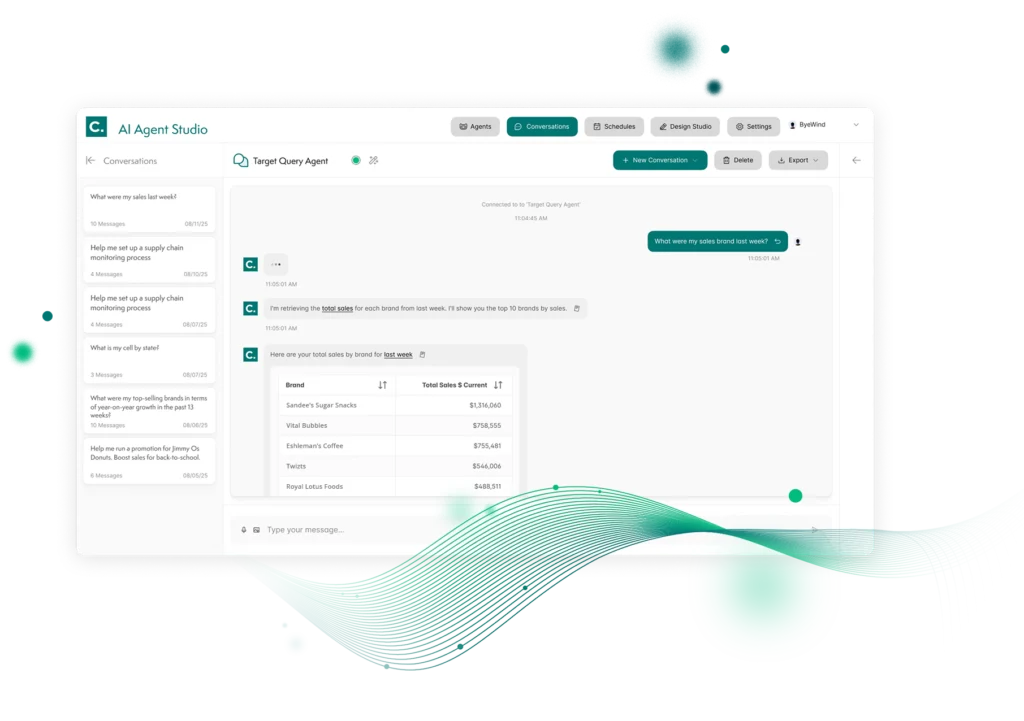
The earlier data problems are identified, the better, including gaps in quality, standardization, and integration. Once the ingested data is clean, a semantic layer can be implemented to harmonize data from the disparate sources, applying consistent business logic and enabling natural language processing (NLP). With this foundation, retailers and CPG brands can work to identify use cases and test pilots.
- Category managers may begin with performance monitoring that flags unusual sales patterns or competitive activities.
- Supply chain teams could implement predictive inventory alerts for stockout risks.
- CPG sales teams could generate ROI models ahead of buyer meetings.
As agentic AI evolves, retailers and CPG brands that take steps toward it are investing in a well-positioned future where competitors play catch-up.
For a deeper dive, speak with our experts at Crisp. Let’s discuss your data challenges and how we can get AI-ready data flowing in your organization.
Get insights from your retail data
Crisp connects, normalizes, and analyzes disparate retail data sources, providing CPG brands with up-to-date, actionable insights to grow their business.