

How to optimize retail assortments: a step-by-step guide for CPG brands
A step-by-step guide to find and rank store-item opportunities using POS, planograms, and category benchmarks.
Consumer packaged goods (CPG) suppliers and retailers both win when they nail the optimal assortment. That means the right mix of products on the right physical and digital shelves, always available, and aligned with consumer expectations for a seamless shopping experience.
The smartest category leaders are continuously optimizing their assortment strategies, recognizing that not all products warrant equal investment in the competitive retail environment. J.M. Smucker, for instance, developed a targeted cluster strategy for its pet dental products by leveraging detailed SKU and store-level sales data. The team identified high-demand store groups best suited for new dental innovations and adjusted shelf space in lower-performing clusters accordingly, seeing incremental sales growth as a result.

What is a retail assortment?
A retail assortment is the mix of products planned for shelves at stores and clusters. The aim of the assortment is to maximize profit margin and sales. Finding the right mix to provide options and drive profitable sales is the core goal. Category managers also aim to grow the category as a whole while minimizing overstock and markdowns.
The optimal retail assortment can be measured by:
- Shelf location
- Facings
- Units per facing
- Nearby items that influence purchase decisions
The nature of each category is also relevant, with some retailers breaking them down by those which are traffic drivers; categories with routine and stock-up products; High profit margin categories; and seasonal and experimental. This influences the SKUs which retailers will consider for expansion.
Optimizing assortments also takes omnichannel considerations into account, with important channels including:
- Online pick-up orders
- Local deliveries (via retailer app, Instacart, DoorDash)
- Online ordering (via website, social media)
Execute space plans at scale, from approval to in-store reality
How does assortment optimization work across in-store and online channels?
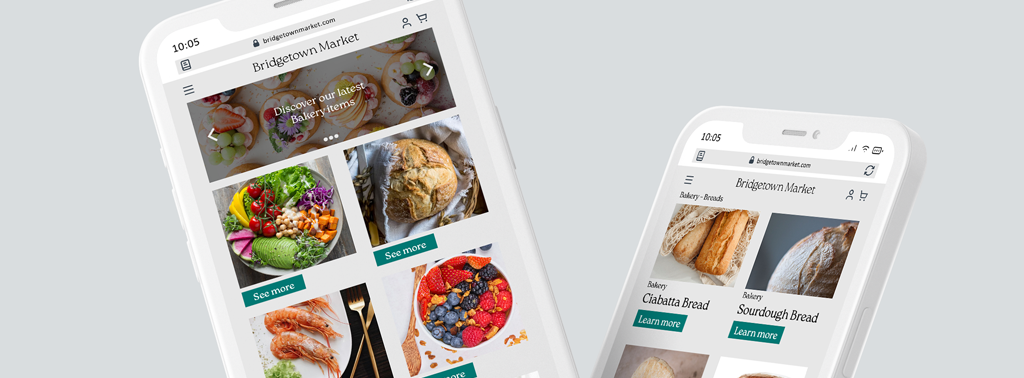
An omnichannel approach recognizes that today’s consumers have many ways to shop. At every touchpoint, they expect a seamless, convenient experience with options that keep them engaged. Some product lines can perform stronger in one channel over another. For example, shoppers may purchase heavy bulk kibble for their pets online – for effortless pick-up or delivery – and prefer to explore treat options in stores.
Often, local pick-up and delivery orders are fulfilled – or ‘picked’ – from the same shelves shoppers visit in stores. So that means suppliers will want to adequately stock assortments with products to meet in-stores and online demand.
Key assortment optimization terms to know
Shelf location = strike zone
Units per facing = depth
Adjacencies = Nearby items that influence purchase decisions
Omnichannel = all shopping channels where a customer can interact with an assortment, including physical stores, online stores, mobile apps, and social media
Incrementality = Retailers aren’t only interested in high velocity – they want categories that grow total basket spend.
How do CPG teams find and rank store-item opportunities?
Assortment work used to mean combing through spreadsheets, pulling static planograms, and relying on instinct. A modern data-driven approach surfaces where products should be – by store, by cluster, by channel – based on the real signals coming out of POS and category benchmarks. Below are a few practical tactics that CPG teams use to find (and validate) store-item opportunities, along with simple examples that mirror real-world scenarios.
Spot distribution gaps – Store-item ranking makes it easy to see where high-performing SKUs don’t have distribution. Instead of scanning hundreds of stores, teams can filter by clusters and pull actionable expansion lists.
Example: A brand sees that its gluten-free snack product is a top-quartile performer in suburban stores but missing from 300 urban stores with similar demographics. The opportunity list becomes a clean, data-backed pitch to the retailer.
Compare velocity to category benchmarks – Velocity alone doesn’t tell the full story. Benchmarking a SKU’s performance against its segment or category helps determine whether it’s earning its space.
Example: A frozen brand learns its family-pack waffle SKU is only performing at 60% of the category’s dollars-per-facing in the Midwest. Meanwhile, a chocolate chip flavor is 30% above benchmark but under-faced. The reset proposal: pull back on the slow mover and expand the winner.
Test swaps with what-if scenarios – Automated what-if modeling lets teams preview the impact of replacing low-velocity items with stronger candidates.
Example: A sparkling water brand compares a declining pineapple SKU with its newer blackberry SKU. Modeling shows the blackberry option lifts weekly dollars and doesn’t cannibalize its best sellers, creating a case for a targeted item swap.
Use adjacency insights – Planogram data highlights where adjacencies support stronger sales, especially in seasonal or promotional windows.
Example: A coffee brand sees its winter roast sell best when shelved near flavored creamers. The team uses this insight to build a seasonal adjacency plan for Spring.
Build data-ready visuals for the retailer conversation – Generate clean visuals, velocity callouts, and per-foot productivity metrics to make resets easier to approve.
Experience Crisp AI Master Data for CPG and Retail
What are the benefits of assortment optimization?
Assortment optimization serves as a growth lever for both suppliers and retailers. Clean, data-driven assortments influence how categories perform, how easily shoppers find what they want, and how quickly teams can respond to change. A strong assortment strategy delivers benefits across:
Higher category productivity – By right-sizing assortments to protect from underperforming products, leading to better dollars per facing, fewer slow movers, and more predictable performance.
Faster, smarter item expansion – Instead of pitching every SKU everywhere, CPG teams can approach item expansion with precise store-level recommendations.
Improved on-shelf availability (OSA) – By modeling store-level demand and adjusting depth accordingly, teams can reduce stockouts and support both in-store shoppers and omnichannel pickers. Stronger planograms also equate to stronger in-store execution.
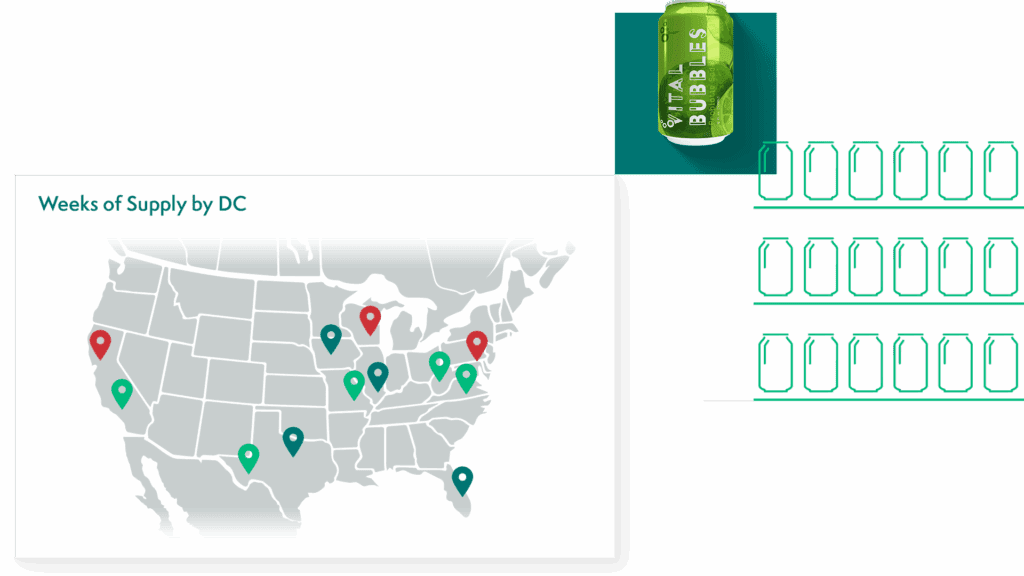
Resilience during supply shifts – With cleaner data and automated insights, teams can quickly reroute demand, adjust shelf space, and swap items when supply chain disruptions hit.
Other benefits of improved retail assortment plannings includes:
- Reduced overstock and markdowns; Higher profits
- Improved retailer collaboration
- More seamless shopping experiences
Instead of pitching every SKU everywhere, CPG teams can approach item expansion with precise store-level recommendations.
How does planogram software improve assortment optimization?
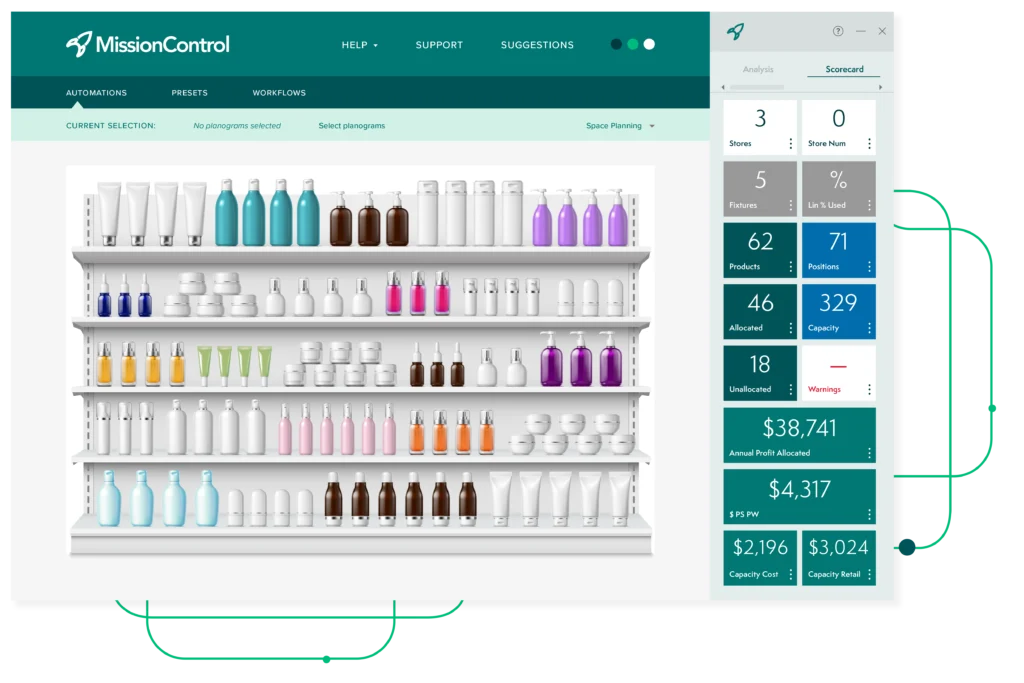
The power of automated planograms is extraordinary. In minutes, they can pinpoint under-earning space, high-performing product candidates, and cannibalization risks for product swaps.
Unlike traditional manual planograms, automated planograms make it easier to:
- Stream in point-of-sale (POS) data without manual data entry, for granular product performance insights
- Layer in syndicated data for valuable industry and competitive context
- Rank sales velocity by product, store, and cluster
- Calculate product cannibalization risks
- Model what-if scenarios for confident swaps
How AI accelerates assortment and merchandising decisions
Equipped with automated planogram software and clean data, CPG teams can perform ‘what-if’ scenarios ‘on paper’ before taking risks in the real world. It’s easy to check and project revenue for product candidates, identifying those that have the slowest velocity, typically the slowest 25% of SKUs (or bottom quartile.) It’s just as easy to prioritize products that lift total category sales or margin.
AI strategies for assortments and merchandising
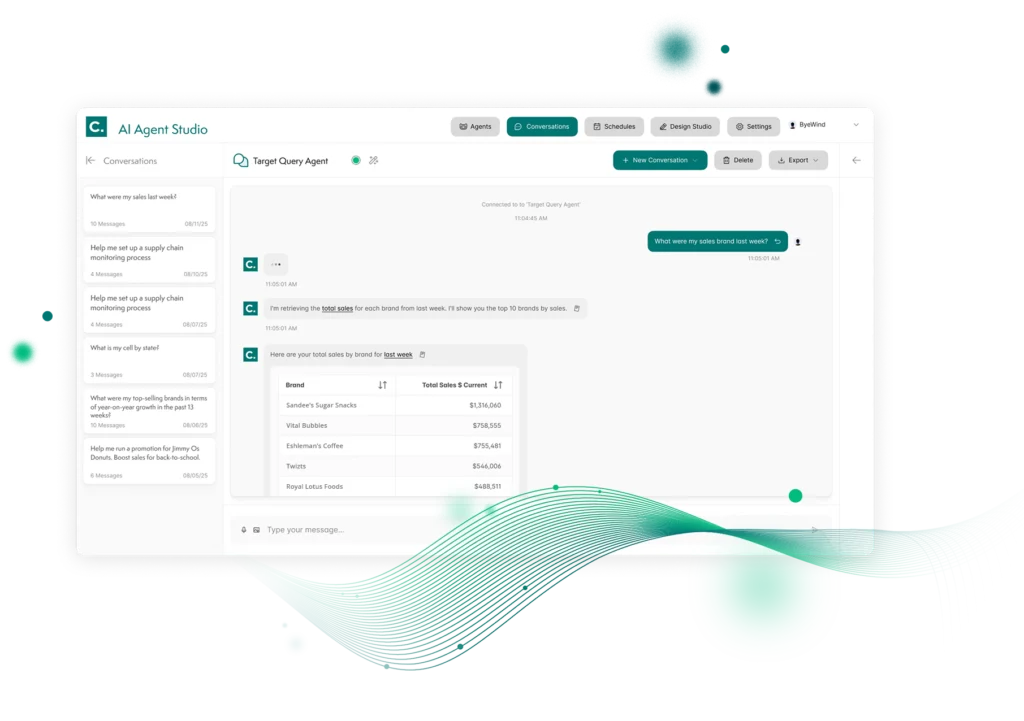
CPGs process millions of rows of data every day – by store, item, location, and more. Making sense of it all can feel impossible for teams, but not for AI. For category management teams especially, daily AI-driven insights enable more powerful assortment and strategy optimization than ever before.
- Assortment Optimization: Reveal where your product mix is underperforming to fine-tune assortments by store and grow sales.
- Price Elasticity Estimation: Understand how price changes affect demand to fine-tune pricing strategies, maximize revenue, and protect margins.
- Store Clustering: Visualize trends, act faster: Group stores by location, customer demographics, and behavior to uncover hidden sales patterns.
Furthermore, conversational AI has the potential to answer complex business questions in seconds. Imagine not just asking questions like, “What were the regional drivers of our spring assortment performance?” figuratively, in querying data, but literally, leveraging your large language model (LLM) of choice – for instant, actionable insights. By referencing a well of structured real-time and historical data, LLMs can deliver business-friendly responses that fuel curiosity and accelerate decision-making in assortment optimization and merchandising. These tools make it easier than ever for category managers to analyze seasonal performance, refine assortments, and prepare for resets or annual reviews.
Discover Crisp AI Agents for Retail
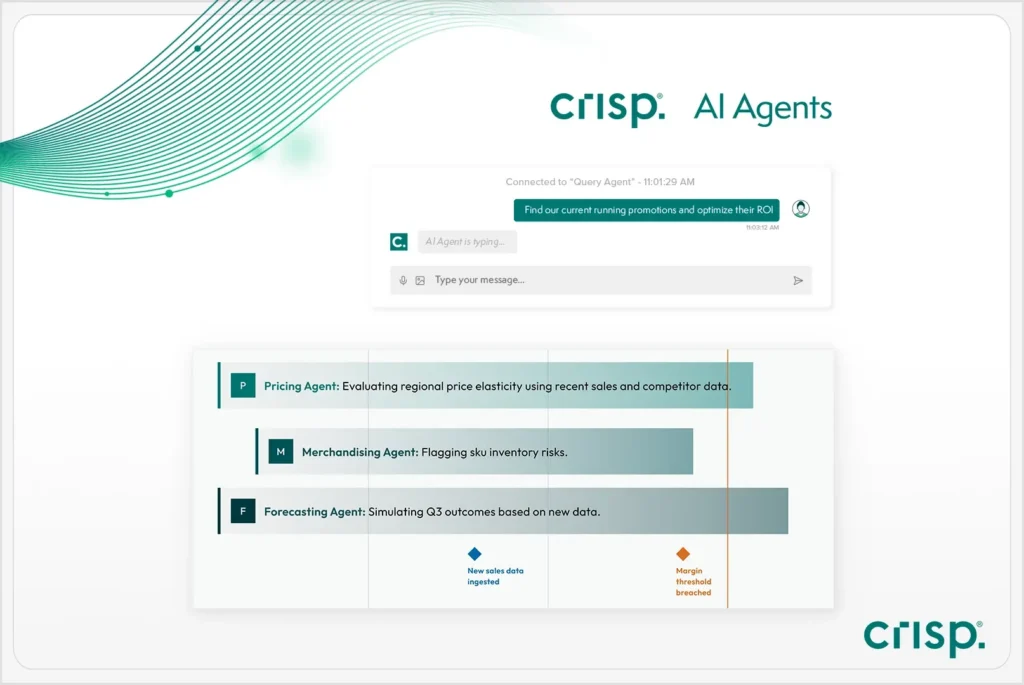
Crisp AI Agents help category teams analyze millions of rows of store-item data and surface actionable insights in seconds – from identifying underperforming assortments by store, to modeling price elasticity, to clustering stores by performance patterns. Get started with AI Agents for assortment recommendations.
Retailers and suppliers win with assortment optimization
Automated planograms help CPG teams sell in their assortments because they lead with data. They show incremental value, tailored to the retailer’s goals. They set up collaborative conversations where what/if? scenarios can be further explored, visualized, and bought into. By embedding space planning in a robust data ecosystem, automated planograms close the gap between insights and implementation and get rid of the gray area to build retailer trust.Ready to learn more about how automated planograms can optimize assortments for retailers and CPG? Speak with our experts today.
Questions?
-
What is assortment optimization?
Assortment optimization is the process of deciding which SKUs to carry, in which stores, and at what depth to meet goals like sales growth, profit, or category performance within real constraints like shelf space and planogram rules. The core challenge is separating items shoppers actually want from those that take up space and face numerous substitutions, then localizing that mix by store cluster and channel. Crisp supports this work through daily store-level POS data, Retail Analytics for velocity benchmarking and distribution gap analysis, AI Agents for modeling and what-if scenarios, and AI Master Data for consistent product attributes across retailers. Cantactix offers planogram automation and shelf intelligence for continuous space optimization.
-
What are the challenges of assortment optimization?
Assortment optimization can often break down at nearly every stage, starting with the data. Brand and retail teams routinely stitch together POS, inventory, and syndicated data that refresh at different cadences and use inconsistent schemas, which is why Crisp centralizes and harmonizes those feeds to a store-SKU level before any analysis begins. Mismatched UPCs and retailer item codes compound the problem, and Crisp’s AI Master Data and its underlying Retail Knowledge Graph address identity reconciliation directly. Stockouts and phantom inventory skew demand reads, causing teams to mislabel low-velocity items as poor performers; Crisp’s Voids dashboards use ML to flag likely shelf gaps before line reviews. Long-tail SKU proliferation, substitution modeling, space constraints, and omnichannel complexity add further layers, and governance across category, sales, and supply chain teams remains a persistent hurdle. AI Agents help teams move from fragmented insights to traceable, repeatable decisions.
-
What retail KPIs are most relevant for assortment optimization?
The most useful assortment KPIs build from a single identity: Sales = Distribution × Velocity. From there, teams track %ACV to measure reach, then units or dollars per store per week to gauge true sell-through strength, with velocity calculation methods in Crisp letting users control how zero-sales weeks are handled. Space productivity metrics like dollars per facing and per linear foot determine whether a SKU earns its shelf position, as outlined in Crisp’s assortment optimization guide. Availability KPIs matter equally: voids dashboards and weeks of supply catch execution gaps before they erode sales. Incrementality rounds out the picture by confirming whether an item adds net category volume or just cannibalizes neighbors, and Crisp’s AI Agents support store clustering and price elasticity analysis to localize those decisions. For more on connecting shelf KPIs to execution, see How category teams can create The Ever-Perfect Shelf.
-
What are the benefits of SKU rationalization in assortment planning?
SKU rationalization cuts portfolio complexity to sharpen margin, improve on-shelf availability, and redirect space toward items that actually drive category growth. Research from Bain shows categories growing sales 17–19% after reducing SKUs by up to 42%, and McKinsey documents 2–4% gross margin gains from eliminating value-destroying variants. The key is measuring incrementality, not just velocity, which means building on clean, unified data across retailers before making cuts. Crisp normalizes item masters across sources for exactly that foundation, while assortment optimization workflows support what-if modeling and bottom-quartile pruning. AI Master Data surfaces duplicative SKUs automatically, and Cantactix ties rationalization decisions directly to planogram execution.
-
How does assortment planning impact supply chain management?
Assortment choices directly influence supply chain efficiency. A fragmented product mix increases complexity, raises forecast errors, and inflates safety stock requirements. Conversely, a governed, data-backed assortment improves inventory turns and service levels. Before changing your product mix, use Crisp to cross-reference sales with On-Shelf Availability data to ensure you aren’t misinterpreting “supply gaps” as a lack of consumer demand.
-
What strategies would you recommend for optimizing shelf space allocation?
Start by unifying your store-level POS, inventory, and order data. With Crisp, you can identify voids and inventory issues first, then size facings based on actual store-level velocity. For execution, Crisp Cantactix bridges the gap between these analytical insights and your actual planograms, ensuring that your space planning matches the reality of store demand, and the data can connect directly into Blue Yonder management workflows.
-
What are the steps to identify opportunities in product assortment optimization?
Start with clean, connected data: ingest daily POS, inventory, and distribution feeds through Crisp’s data integrations, then use AI Master Data to reconcile SKU attributes across sources. Baseline velocity and distribution using Retail Analytics, and clear voids before touching the mix. Poor availability mimics poor assortment. AI Agents surface whitespace and distribution expansion opportunities by store cluster, and incrementality validation keeps teams from swapping in SKUs that cannibalize. Package findings using harmonized dashboards and assortment optimization strategies to build retailer-ready sell-in narratives.
-
What are the main challenges in assortment optimization for consumer goods and retail companies?
Assortment optimization breaks down in predictable ways. Data fragmented across retailers, distributors, and e-commerce channels arrives too slowly to support confident SKU-level decisions. Crisp’s unified data integrations remove that friction by standardizing feeds and delivering them to tools like Snowflake. Even with clean data, teams wrestle with incrementality versus cannibalization, local complexity, and planogram noncompliance that quietly erodes planned outcomes. Crisp’s Voids Dashboard catches execution gaps in near real time, and unified retail data solutions give category teams a single view across stores and digital channels. AI Agents built on that foundation help teams act faster across their retail footprint.
Get insights from your retail data
Crisp connects, normalizes, and analyzes disparate retail data sources, providing CPG brands with up-to-date, actionable insights to grow their business.