

How does AI change retail demand forecasting?
Gartner predicts that 70% of large organizations will adopt AI-based supply chain forecasting by 2030. AI responds faster to market shifts, enables better inventory decisions, and removes manual steps in the planning process that everyone hates.
Here comes the “but.” Even the latest and greatest algorithms can’t do the job on their own. Clean, unified retail data that can be continuously processed in real-time is the fuel that drives accurate and trustworthy outputs.
Key takeaways:
- AI turns demand forecasting from reactive to real-time. Legacy forecasts rely on historical reports. AI-powered demand forecasting ingests daily, store-level sales, inventory, weather, and calendar signals to sense shifts as they happen instead of weeks later.
- AI separates true demand from stockouts. Traditional models mistake zero sales for zero demand. AI corrects stockout censoring by distinguishing empty shelves from weak demand, protecting revenue and improving replenishment accuracy.
- Probabilistic forecasts enable smarter inventory decisions. Instead of a single “best guess” number, AI delivers demand ranges and confidence levels. Teams can weigh margin, shelf life, and risk to make better ordering decisions.
- Automation replaces spreadsheets – but only with clean data. AI removes manual overrides and exception chasing, but only when powered by harmonized, governed retail data. Clean inputs determine whether demand forecasting AI drives results or just dashboards.
- Measure impact in availability and inventory health. Look for stronger on-shelf availability (OSA), fewer stockouts, and healthier on-hand.
When it comes to AI, even the latest and greatest algorithms can’t do the job on their own. Clean, unified retail data that can be continuously processed in real-time is the fuel that drives accurate and trustworthy outputs.
Real-time data legacy forecasts lack
With legacy forecasting, reports show up days or weeks after transactions are made. Demand is calculated by category or region, but the store-level is buried. The SKU-level is buried deeper beneath this.
Planners waste hours reconciling spreadsheets, overriding system outputs, and explaining why the numbers are different across partners and vendors. Layering advanced statistical models on top of this bad data won’t solve the problem.
In less digital, more predictable markets of the past, a data disconnect wouldn’t present the biggest concern. In today’s markets, it’s deadly. Outdated and disorganized doesn’t hold up in the current climate of omnichannel behavior, promotion intensity, supply disruptions, and rapid assortment changes.
Layering advanced statistical models on top of disorganized supply chain data won’t solve the problem.
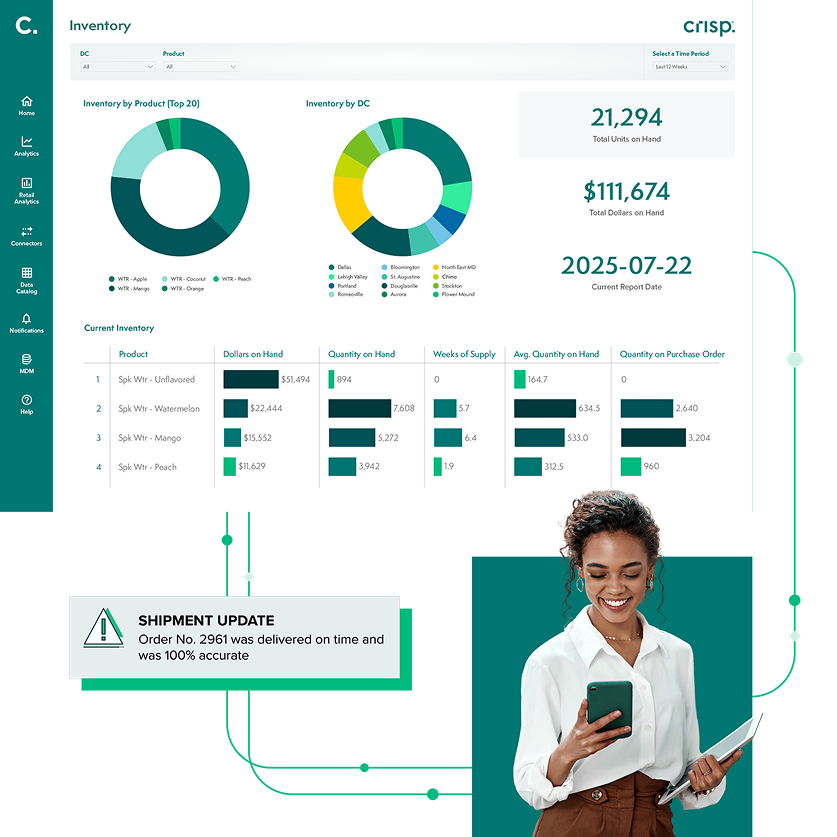
Accurate inventory tracking with real-time and AI-ready retail data
Deeper insights that get ahead of sales dips
Traditional time-series analysis predicts that today or tomorrow’s demand will look like yesterday’s or last year’s demand. The theory doesn’t hold up in today’s climate. Consumer behavior and the markets they buy in is volatile and changeable for the foreseeable future.With good data and the power of AI, you don’t have to wait a month to know sales are down. Data is processed quickly and efficiently, and teams are alerted, so you can adjust the plan to stop the downtrend before it keeps dropping. You also get a much better idea of “the why” – or root cause – so you can account for it going forward:
- Holidays
- School schedules
- Local events
- Weather patterns
Example: A retailer sees unexpected foot traffic spike in coastal stores ahead of a holiday weekend – favorable weather is driving it. The AI folds local weather and calendar signals into daily forecasts and bumps demand projections for affected SKUs before sales reports can catch up.
Stockout censoring finally corrected
It has happened to every retailer and CPG brand with traditional demand forecasting. A product goes out of stock. Sales drop to zero. The forecasting model reads the zero sales and decides “nobody wanted this.” It recommends ordering less next cycle, which leads to another stockout, which leads to another misguided forecast cut, and so on, leaching revenue.
AI breaks the cycle by modeling the difference between sales and demand. It assesses POS data with inventory levels to figure out when a zero-sale day was really caused by empty demand or empty shelves. The difference is critical for reducing out-of-stocks (OOS) and making sure replenishment orders reflect what shoppers actually want and don’t want.
Example: A top-selling SKU shows zero sales at several stores. Inventory data confirms the shelves were empty. The AI flags it as a stockout along with its root cause – not a demand drop – and recommends adjustments to the forecast upward. Replenishment orders go out, on-shelf availability (OSA%) recovers, and the revenue goes up.
AI breaks the cycle by modeling the difference between sales and demand. It assesses POS data with inventory levels to figure out when a zero-sale day was really caused by empty demand or empty shelves.
All the numbers you need to decide
Most planning tools give you a single number: “We’ll sell 1,000 units next week.” It sounds precise, but it isn’t. If demand hits 1,200, you’ll have a stockout. If demand falls short at 800, you’ll have waste. This kind of traditional forecasting is called “deterministic.”
With AI, advanced planning tools give you more than one number. They give you a range. “There’s an 80% chance demand will fall between 900 and 1,100 units.” This kind of forecasting is called “probabilistic.”
With probabilistic forecasting, you can weigh the cost of lost sales against the cost of waste and apply a more thoughtful strategy. If the SKUs in question are high margin with long shelf lives, you may want to order aggressively. If they are perishables with short shelf lives, you may want to dial back.
With AI, advanced planning tools give you more than one number. They give you a range. “There’s an 80% chance demand will fall between 900 and 1,100 units.” This kind of forecasting is called “probabilistic.”
Improve supplier performance with automation
Break up with spreadsheets
Advanced AI models are touchless, meaning they generate forecasts for you and run replenishment models automatically based on the parameters you define in advance (and can always adjust).
You don’t have to dig through spreadsheets anymore. No one does. Planners get flagged when sales aren’t tracking as expected, and they only have to step in when it matters. Not every. Single. Time.
Example: A supermarket’s inventory manager opens a short exception list. A cereal promotion is selling twice as fast as expected. One store is running low after a delayed truck. The manager stocks up easily and without having to ask a cast of thousands.
With the busywork gone, you can focus on work that actually moves the business like supply chain analytics for new product launches and high-stakes promotions that have to deliver.
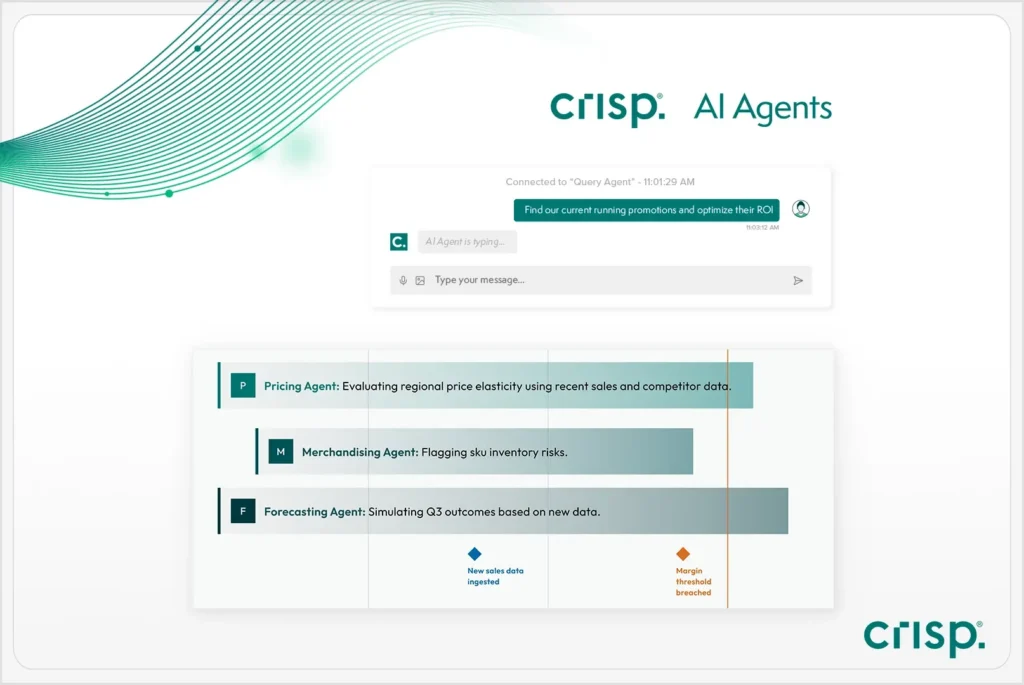
Agentic AI takes the capabilities even further. AI agents don’t just generate a report and wait for someone/everyone to look at it. They monitor retail data continuously, spot supply chain risks, and recommend specific actions. Adjust this order quantity. Escalate that distribution gap. Look at this out-of-stock risk.
With the busywork gone, you can focus on work that actually moves the business like supply chain analytics for new product launches and high-stakes promotions that have to deliver.
AI plus good data won’t disappoint you
AI amplifies whatever you feed it. Inconsistent data across retailers, delayed inventory feeds, product hierarchies that don’t match from one partner to the next – it all compounds.
Even the most sophisticated model can’t produce a coherent forecast when it’s reconciling three different names for the same granola bar. AI-powered master data management (MDM) solves it once and for all. It uses AI-driven mapping to align retailer and third-party data to your internal standards, unifying product classifications across accounts so your forecasting models get clean, consistent inputs instead of confusion.
Plenty of AI forecasts look impressive on a dashboard but don’t get results. If the output can’t flow into ordering systems, replenishment workflows, and partner collaboration tools, it’s a waste of money, time, and hope for a brighter tomorrow in retail.
A harmonized data model sets your AI investment up for success. It standardizes entities across the supply chain with:
- Clean product hierarchies
- Consistent definitions of sales and inventory
- Unified views across partners
- Reliable daily POS feeds
Get the data right and AI will do what it’s supposed to do.
Plenty of AI forecasts look impressive on a dashboard but don’t get results. If the output can’t flow into ordering systems, replenishment workflows, and partner collaboration tools, it’s a waste of money, time, and hope for a brighter tomorrow in retail.

Grow retail revenue with real-time data plus AI
What we’re talking about here is Crisp
Crisp’s retail data platform feeds daily, store-level sales and inventory data into the forecasting process. AI models pick up real patterns, not lagging reports. Everyone across the value chain works from the same demand signals. No mismatches. No arguing over whose numbers are right or trying to convince retailers the data is reliable when it isn’t.
Forecasting and order automation generates probabilistic, SKU-and-store-level forecasts and turns them into replenishment recommendations based on actual demand on the daily.
Crisp AI Master Data harmonizes product classifications across every retail partner. What used to take weeks of manual mapping now takes minutes.
Crisp AI Agents go beyond reporting. They monitor performance continuously, surface supply chain risks, and recommend specific actions – flagging emerging stockouts, suggesting order adjustments – all grounded in governed, traceable data.
Clean data and advanced AI transform forecasting from “we think” to “we know.” Teams stop guessing. They start responding. When demand volatility is the norm – and it is – this transformation isn’t optional.
Get started with your AI-powered supply chain strategy by speaking with an expert.
Get insights from your retail data
Crisp connects, normalizes, and analyzes disparate retail data sources, providing CPG brands with up-to-date, actionable insights to grow their business.