

Retail supply chain challenges: 6 risks CPG suppliers must manage
Retail supply chain challenges can lead to stockouts, order delays, forecasting errors, and missed sales. For many CPG suppliers, those problems do not start with a truck delay or port disruption. They start earlier, when store-level data is late, inventory records are inaccurate, EDI transactions fail, or reporting is fragmented across systems. In this article, you’ll learn six common retail supply chain challenges and what suppliers can do to reduce their impact.
What are retail supply chain challenges?
Retail supply chain challenges are the operational problems that make it harder for suppliers to keep products flowing through retailer systems and available at the shelf. These challenges usually affect inventory visibility, order accuracy, forecasting, logistics, and the exchange of retail data.
Key takeaways
The most common retail supply chain challenges include:
- Delayed or incomplete store-level data can hide phantom inventory and stockouts.
- EDI failures can disrupt orders, shipments, and invoicing.
- Delayed retail reporting can weaken forecasting accuracy.
- Fragmented data systems can slow reporting and limit automation.
- Logistics disruptions can increase lead times and shipping costs.
- Third-party cyber incidents can interrupt orders, shipment visibility, and data flows.
Many retail supply chain problems do not begin with transportation disruptions. They start earlier, when sales, inventory, and order data arrive late or do not align across systems. Without clear visibility into retail activity, suppliers are slower to detect stockouts, planning errors, and service risks.
Supply chain challenges CPG suppliers face
For CPG suppliers, these challenges usually affect inventory visibility, transaction flow, forecasting, logistics, and connected systems.
Delayed or incomplete store-level data and phantom inventory
Delayed or incomplete store-level data makes it harder to catch stockouts, phantom inventory, and local demand shifts early.
A common example is phantom inventory, where a retailer’s system shows units in stock even though the shelf is empty. When store-level sales and inventory data arrive late or are incomplete, suppliers may not detect the problem until sales stop or an inventory check reveals it. That reduces on-shelf availability (OSA) because the item appears available in the system, no reorder is triggered, and shoppers still cannot buy it.
Inaccurate inventory records remain a common retail problem. Research from ECR Retail Loss has found that they contribute to phantom inventory, overstocks, and out-of-stock situations.
Why this matters
Over 60% of inventory records in a retail store have been found to be wrong. Correcting those records can increase sales by up to 11%. Source: ECR Retail Loss
Suppliers can catch phantom inventory earlier by comparing store-level POS data with reported inventory. If a SKU suddenly stops selling in a store that still shows units on hand, it may point to phantom inventory or a shelf execution problem.
Inventory visibility is only one part of the problem. Suppliers also rely on retailer systems to move orders, shipment documents, and invoices accurately. That is where EDI failures create another common source of disruption.
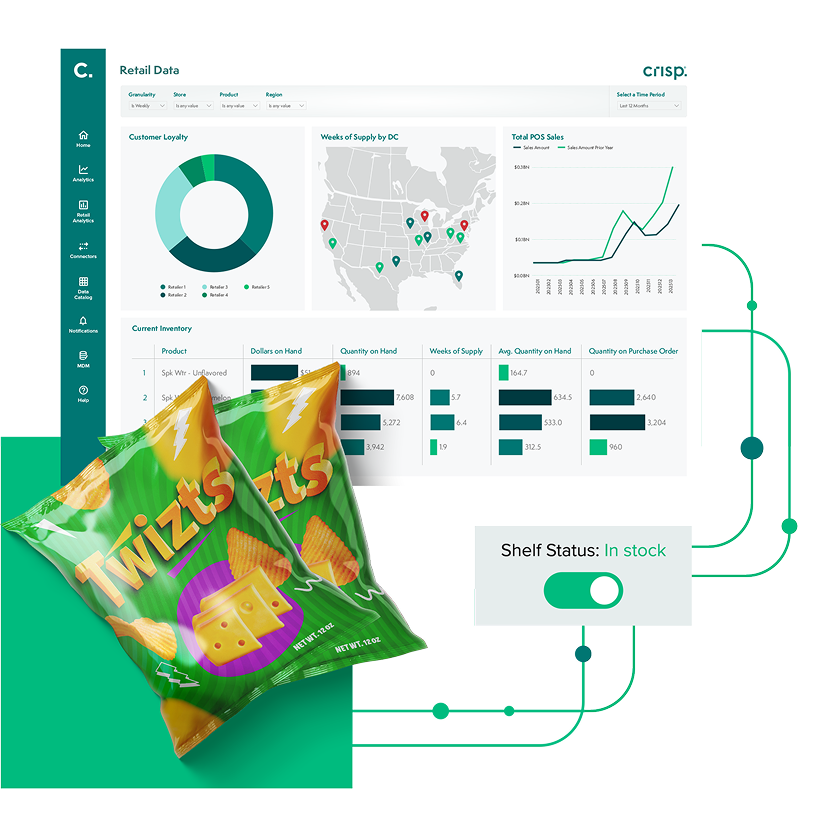
Accurate inventory tracking with real-time data
EDI and retail compliance problems
EDI failures happen when transactions between suppliers and retailers contain errors, missing information, or formatting problems. Because retailers rely on EDI for purchase orders, shipment notices, invoices, and other core documents, even a small error can delay the orders and shipments.
EDI also gets harder to manage when suppliers work across wholesale, e-commerce, and omnichannel programs. Different retailers often have different document requirements, validation rules, and deadlines. Managing EDI across these environments is often part of broader omnichannel order management operations.
For suppliers, EDI reliability is an operations issue, not just an IT issue. When transactions move through retailer systems correctly, orders stay on track. When they do not, suppliers may face delays, rejected shipments, chargebacks, or invoicing problems.
Many suppliers reduce this risk by using managed EDI services to monitor transactions, catch errors quickly, and stay aligned with retailer-specific requirements.
Accurate transactions are essential, but suppliers also need timely retail reporting to plan effectively. When sales and inventory data arrive late, forecasting becomes less reliable and demand shifts are harder to catch early.
EDI ROI Calculator
See how predictable pricing stacks up for your business with our ROI calculator.
Fragmented retail data and broken automation
For supplier teams, that often means pulling data from retailer portals, spreadsheets, EDI systems, and internal reports to piece together a usable view of what is happening. That manual work slows reporting, makes the data harder to trust, and limits how effectively teams can use automation.
If suppliers want automation or analytics to be useful, they first need retail data that is standardized across systems. When sales, inventory, orders, and shipment data follow a more consistent structure, teams can spot unusual selling patterns earlier, identify phantom inventory faster, and make better inventory decisions.
Data and system problems are common internal sources of supply chain friction. Suppliers also have to manage external disruptions, especially when transportation routes, lead times, and delivery schedules become less predictable.
If suppliers want automation or analytics to be useful, they first need retail data that is standardized across systems.
Retail logistics disruptions and longer lead times
Logistics disruptions make delivery schedules harder to predict and inventory harder to plan. For CPG suppliers, that can mean longer lead times, higher freight costs, and more pressure on replenishment decisions.
Many CPG products move through complex logistics networks that may include overseas manufacturing, international ports, domestic warehouses, and multiple retailer distribution centers before reaching stores.
Recent events have shown how quickly shipping routes can change. Rerouting around Africa has added roughly 12 days to some shipping routes, according to Reuters. Capacity constraints in the Panama Canal have added pressure as well.
Suppliers often respond by diversifying manufacturing locations and shipping options. But adding backup routes or suppliers is only part of the response. Teams also need timely retail data so they can see where inventory is tightening and make smarter allocation decisions.
Physical movement is only one side of retail supply chain risk. Suppliers also depend on digital systems and outside partners to keep orders, shipments, and data moving. That makes third-party cybersecurity risk another important operational concern.
Adding backup routes or suppliers is only part of the response. Teams also need timely retail data so they can see where inventory is tightening and make smarter allocation decisions.
Third-party cybersecurity risk
Third-party cybersecurity risk arises when a logistics partner, software provider, or data platform experiences a breach that disrupts supply chain operations.
Modern retail supply chains depend on a large network of connected systems. Suppliers exchange orders, shipment updates, inventory data, and other operational information with retailers, logistics providers, and technology platforms every day.
About 30% of data breaches involve a third-party partner, according to Verizon’s 2025 Data Breach Investigations Report. As supply chains become more digitally connected, cyber incidents can disrupt the flow of both goods and data.
For suppliers, cybersecurity is an operations issue, not just an IT issue. If a logistics partner, data platform, or order management system is hit by a cyberattack, suppliers may temporarily lose access to shipment tracking, order information, or other critical systems.When evaluating technology partners, suppliers should look for documented security practices and independent certifications such as ISO standards and SOC 2. Crisp, for example, says it holds ISO/IEC 27001:2022 and ISO/IEC 27017:2015 certifications and maintains SOC 2 compliance as part of its information security program.
As supply chains become more digitally connected, cyber incidents can disrupt the flow of both goods and data.
How suppliers can reduce retail supply chain risk
Suppliers cannot eliminate every retail supply chain risk, but they can reduce the impact by improving visibility and response across retail accounts. That starts with better access to store sales, inventory, order activity, and shipment status.
Most suppliers need five things:
- Faster access to retail data so teams can spot demand shifts and supply issues earlier.
- Store-level visibility to detect phantom inventory, stockouts, and unusual selling patterns.
- Reliable EDI operations to reduce transaction failures, chargebacks, and order delays.
- Standardized retail data across systems so teams can analyze activity more easily.
- Better oversight of logistics and technology partners to reduce disruption.
Suppliers cannot eliminate every retail supply chain risk, but they can reduce the impact by improving visibility and response across retail accounts. That starts with better access to store sales, inventory, order activity, and shipment status.
Better retail data will not remove every risk, but it helps suppliers respond before issues turn into lost sales, forecasting errors, service problems, or retailer friction. With stronger visibility, teams can make better decisions on replenishment, inventory allocation, and retailer support even when conditions remain unpredictable.
Learn more by getting in touch with Crisp today.
FAQs about retail supply chain challenges
-
What causes phantom inventory in retail supply chains?
Phantom inventory happens when a retailer’s system shows an item in stock even though it is not actually available on the shelf. It is often caused by inaccurate inventory records, missed scans, store execution problems, theft, damage, or reporting delays that prevent suppliers from seeing the issue quickly.
-
Why do EDI failures create supply chain risk?
EDI failures disrupt the documents retailers and suppliers use to move orders, shipments, and invoices through their systems. When transactions contain errors, missing fields, or formatting problems, suppliers can face rejected orders, delayed shipments, chargebacks, and invoicing issues.
-
How does delayed retail data affect demand forecasting?
When sales and inventory data arrive days or weeks late, suppliers are making forecast decisions using an outdated view of demand. That makes it harder to respond to changes in shopper behavior and can lead to overstocks, stockouts, and poor replenishment decisions.
-
Why is fragmented retail data a problem for suppliers?
Fragmented retail data slows reporting and makes analysis harder because teams have to pull information from multiple systems, portals, spreadsheets, and EDI feeds. That reduces visibility and makes automation, forecasting, and exception management less effective.
-
How do logistics disruptions affect retail supply chains?
Logistics disruptions make shipping routes, transit times, and delivery schedules less predictable. For suppliers, that can increase lead times, raise transportation costs, and make inventory planning more difficult across retail accounts.
-
Why is third-party cybersecurity risk a supply chain issue?
Modern retail supply chains depend on outside logistics providers, software platforms, and data partners. If one of those third parties experiences a cyber incident, suppliers can lose access to shipment data, order information, inventory visibility, or other systems needed to keep operations moving.
Get insights from your retail data
Crisp connects, normalizes, and analyzes disparate retail data sources, providing CPG brands with up-to-date, actionable insights to grow their business.