

How to choose category management technology for retail
Category performance is won week after week, not in one big reset.
Category management technology should make that weekly work easier with clearer decisions, faster planning, and fewer surprises on the shelf. But most teams have more retail data than ever and still struggle to turn it into one consistent view they can act on fast enough to matter.
That’s exactly why category management technology is changing. What to look for in your next platform should be very different from your last purchase. This guide breaks down what category management technology should cover today and how to evaluate vendors with confidence.
The easiest way to evaluate vendors is to look at the full stack: data foundation → analytics → planning → execution → AI governance. The latest technologies vertically integrate these crucial elements, combining AI-driven master data, planogram automation, and governed AI agents on a unified retail data foundation.
Key takeaways:
- Look for omnichannel cause-and-effect across channels – One view across store, pickup, delivery, and online to see what changed and why.
- Verify a daily, normalized data foundation – POS and inventory align across partners, with attribute-ready product definitions.
- Require planning outputs you can act on – Scenario testing plus assortments and planograms that lead to clear, defensible calls.
- Prioritize closed-loop execution and governed AI – Early shelf signals with explainable logic, thresholds, approvals, and audit trails.
Most CPG and category teams have more retail data than ever and still struggle to turn it into one consistent view they can act on fast enough to matter.
Category management technology for retail and CPG
The term ‘category management technology’ is sometimes used for procurement tools that support sourcing, contracts, and supplier negotiations. That’s not the focus here.
In this guide, category management refers to retail and CPG category work – using data to decide which products to carry, how much space to give them, how to localize assortments, and how to keep items available across store, pickup, and delivery.
Why you can’t manage store and ecommerce separately anymore
A few years ago, many teams could treat ecommerce as its own channel. Today, that split makes it hard to see what’s really driving performance.
If an item isn’t on the shelf, the associate picking the order may not find it. That can trigger substitutions, shorted orders, and frustrated customers. Similarly, if a product gets less shelf space, it can sell slower and lose visibility online. Actions in one channel can change results in another.
Omnichannel category management needs tools that connect cause and effect across channels. That only works when teams share a single source of category truth across store shelves, personal shoppers, online listings, and marketplaces. Look for systems that connect what’s happening across channels instead of forcing store and ecommerce into separate silos.With channels influencing each other, the first priority is a harmonized model of sales, inventory, and item definitions. If channels affect each other, your data has to line up first.
Omnichannel category management only works when teams share a single source of category truth across store shelves, personal shoppers, online listings, and marketplaces.
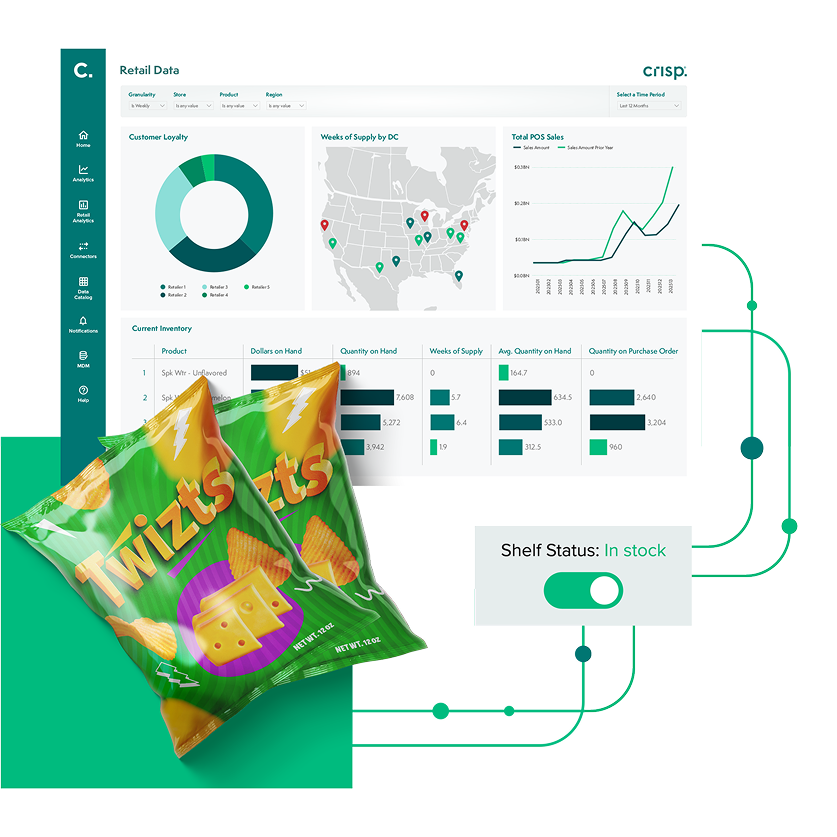
Optimization and analytics for AI-enabled digital commerce
Qualify the data layer first
Retailers and distributors publish data on different schedules and in different formats. Item IDs change, and retailers group and name categories differently. The same item can show up in different places depending on the partner. That manual cleanup work slows reviews and delays action.
The most common failure mode in category implementations is disorganized or late data. If sales or inventory arrives days later, your weekly decisions are already out of date.
A strong category stack starts with normalization: mapping partner data into one consistent internal view so you can compare like with like. With that foundation, you should be able to answer, “How are carbonated soft drinks performing this week across all retailers?” without exporting files and stitching them together in Excel.
According to Deloitte’s 2025 US Retail Industry Outlook, many retailers still rely on outdated, siloed systems that can take days to produce usable insights. If your stack requires days of spreadsheet work before you can even start analysis, the technology is failing. Look for a data layer that automates ingestion and modeling of POS and inventory so planning teams spend their time making decisions, not fixing files.
The most common failure mode in category implementations is disorganized or late data. If sales or inventory arrives days later, your weekly decisions are already out of date.
Product data and attributes for category decisions
Most item master data was designed to support transactions and accounting, not category decisions. Category teams need richer product details to make smart assortment and space decisions. That includes flavor, form, pack size, brand, price tier, dietary claims, key ingredients, sustainability flags, and channel-specific variants.
These details are useful in weekly category work like:
- Assortment: Identifying attribute gaps by cluster and channel
- Clustering: Grouping stores based on attribute-linked demand patterns
- Pricing: Building price ladders by size, tier, and brand role
- Innovation and automation: Comparing new items to true peers, improving matching, and flagging opportunities
This only works when most items have complete attributes in one shared format.
When you evaluate product data, focus on whether item identities are standardized across retailers, attributes are complete and governed, and those definitions are usable in planning and AI workflows. If the foundation isn’t consistent, recommendations won’t translate into shelf results.
Clean, enriched product data isn’t a nice-to-have. It’s what makes automation outputs usable and credible in retailer reviews.
Once product definitions are stable, teams can move faster into strategic assortments and planogram execution.
If the retail data foundation isn’t consistent, recommendations won’t translate into shelf results.
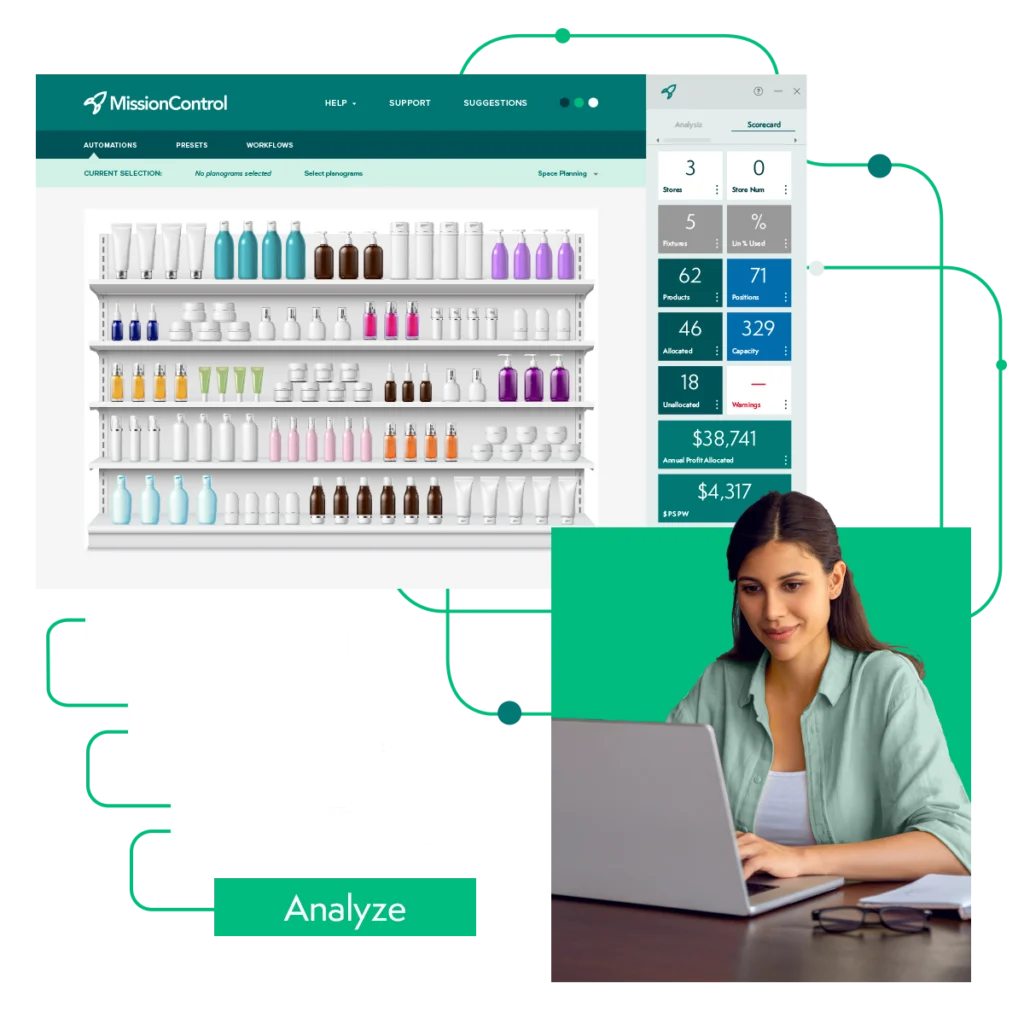
Category management technology with Crisp MissionControl
Turning data into assortments and planograms
Here, the goal is to turn trusted data into faster, retailer-ready decisions about what to carry, where it goes, and how to keep it in stock.
Faster iteration with scenario testing
In the past, a category review was mostly one-way. You built a plan, and if you wanted to test a different idea, you saved a new version and hoped everyone stayed aligned. Modern systems speed up iteration by letting teams test multiple scenarios without rebuilding everything each time.
Look for technology that can run “what-if” scenarios at scale. For example, what happens to category sales and margin if you reduce facings on the market leader and add a few fast-growing SKUs? Strong tools estimate the tradeoffs. They show where demand shifts, what gets cannibalized, and what the net impact is before you commit. They also let you run those scenarios across clusters, so the plan reflects local demand instead of a single national average.
Legacy tools often bog down under this kind of scenario load, especially across hundreds of store clusters. Newer planogram automation capabilities can shorten the iteration cycle, making it realistic to move from quarterly reviews to monthly, or even continuous, adjustments.
Attribute-based assortment planning
Traditional category management relies heavily on last year’s sales: keep the winners, cut the laggards. That approach doesn’t hold up when innovation moves fast and shopper preferences shift. Attribute-based planning uses product traits to explain demand and predict where similar items will win.
Done well, this approach makes recommendations easier to defend because it shows the ‘why,’ not just the ‘what.’ It helps identify true peers, find distribution gaps by cluster and channel, and forecast where a new item may perform even with limited history. When you evaluate vendors, confirm you can use your own attributes and hierarchies—and that those attributes directly drive recommendations, not just sit in a reference table.
It also requires the same product definitions across stores and ecommerce, so the tool is comparing true peers. That’s why many teams use an AI-assisted master data layer to standardize item identities, enrich products with custom attributes, and govern changes with approvals and audit trails, so planning recommendations are based on definitions you trust.
Modernizing space planning at scale
Assortment decisions tell you what to carry. Space planning determines where it goes and how much room it gets. For years, space planning lived in specialized tools that often sat apart from the rest of the category workflow. The challenge now is connecting space decisions to the same performance and inventory signals you use for assortment, so plans stay realistic and current.
Leading teams are moving toward space planning that stays tied to performance data. Instead of treating the planogram as a static drawing, modern tools can ingest updated sales and inventory signals and help refresh layouts when demand shifts. That matters because shelf space is the biggest constraint in physical retail – and small space errors can create big availability problems.
The best solutions also support planograms at scale. Rather than relying on one “regional” layout, they can generate store- or cluster-specific versions where facings adjust based on local sell-through. That kind of detail helps keep days of supply in line, reduces avoidable stockouts, and cuts the labor wasted restocking items that don’t match how each store actually sells. The real test is whether the shelf ends up matching the plan.
Even the best plan can fail if execution drifts – so the category system needs feedback from stores.
For years, space planning lived in specialized tools that often sat apart from the rest of the category workflow. The challenge now is connecting space decisions to the same performance and inventory signals you use for assortment, so plans stay realistic and current.
Where category plans meet store reality
Strong planning only pays off if the shelf matches the plan. If products aren’t stocked, placed correctly, and easy to find, the best assortment and planogram won’t show up in sales.
Plans can go off track if resets aren’t fully implemented, shelves drift from the intended layout over time, or availability problems aren’t spotted until sales have already dropped.
Inventory record inaccuracy
Research shows why it matters when system inventory doesn’t match what’s actually in the store. A 2025 grocery retail study on inventory record inaccuracy found that inventory audits that corrected system-versus-actual gaps were linked to an 11% store-wide sales lift, with the gains concentrated in items where the system overstated inventory.
Your category tool should be able to ingest the store’s running inventory count and flag patterns that don’t add up. For example, if a product is planned for two facings but shows zero sales – even though the system says it’s in stock – that’s likely an inventory record error. The system thinks the item is available, but shoppers can’t find it.
Catching those gaps early turns category management from a planning exercise into operational support, helping stores fix problems before sales are lost.
Integrating with store execution signals
Store execution is easier to manage when the planogram isn’t the finish line. Strong systems pull in execution signals – like planogram compliance checks, shelf conditions, and availability indicators – so category teams can see where the plan broke and fix it quickly.
This matters because you don’t want to wait for sales to dip before learning a reset didn’t stick. If the same fixture or layout is consistently non-compliant across many stores, the issue may be the plan, not the store. The right approach closes the loop by connecting shelf execution and measurement back to planning, so teams can adjust layouts, prioritize fixes by revenue impact, and prevent repeat problems.
The strongest stacks create a continuous feedback loop that connects planning, execution, and measurement so teams can fix shelf problems before sales drop.
Strong category management systems pull in execution signals – like planogram compliance checks, shelf conditions, and availability indicators – so category teams can see where the plan broke and fix it quickly.

Grow retail revenue with real-time data
AI agents and governance for category management
Agentic AI is moving from experiments to day-to-day execution. Deloitte reports that nearly 68% of retail executives expect to deploy agentic AI within the next 12 to 24 months, and 44% say legacy systems are already slowing down innovation. That combination is why the AI question in category tech has shifted from capability to control — can teams trust it, govern it, and explain its decisions?
Crisp frames this well: AI Agents should sit on a retail-specific semantic layer and knowledge graph, so insights are grounded in consistent definitions and business logic, not loose interpretation. That means agents can automate recurring work like Monday Morning reporting, flag out-of-stock risks, and surface distribution or assortment opportunities while still showing their work.
When you evaluate AI agents, focus on control and accountability:
- Traceability: Can you see what data and logic drove the recommendation?
- Guardrails and approvals: Can you set thresholds and require sign-off for bigger changes?
- Audit history: Are recommendations and actions logged so teams can review outcomes over time?
- Permissions: Can access and actions be limited by role and responsibility?
AI can absolutely speed up category work. But the winners will be the teams that pair automation with clear guardrails so faster decisions don’t turn into faster mistakes.
Making the decision with a vertical approach
All-in-one category planning solution suites can work, but teams should still evaluate the foundation and the planning layer separately. A practical approach is to treat category management as a set of connected parts and evaluate each layer with clear criteria. Even when you choose a single platform, it helps to assess it in layers – so each part is strong and integrates cleanly:
- Data foundation: Pulls retailer and distributor data, cleans it, and lines it up so the numbers match across partners.
- Analytics and reporting: Helps teams see trends, explain what changed, and build the retailer story.
- Planning: Turns data into assortments and planograms, and supports scenario testing.
- Collaboration: Makes it easier to share plans, align on changes, and track what was agreed.
When the data foundation is strong, you can change planning tools later without losing consistency or history. When it’s weak, even great planning software ends up running on messy inputs and the outputs get harder to trust.
The choice comes down to the data foundation
In practice, teams are choosing between two paths. Some tools mainly digitize existing work – better diagrams, better files, faster versions. Others are built around always-updated retail data, so planning can stay current as sales, inventory, and execution change.
For brand and retail leaders, the deciding factor is usually the foundation underneath planning. Planning tools only work when the data layer stays current and normalized. If sales and inventory data arrive late, or product definitions don’t line up across retailers, teams spend their time reconciling numbers instead of making decisions.
This is where Crisp typically fits: helping automate the pull and alignment of retail sales and inventory data across many partner sources, so teams can use the same definitions and act faster. Crisp Cantactix solutions like MissionControl also extend that foundation into planogram and space automation, turning aligned retail data into faster, compliant, shelf-ready execution.
Whether you need POS, inventory, and planogram data in Blue Yonder, BI or cloud tools, or automation workflows, the accuracy and freshness of the foundation often determines whether or not plans succeed and show up accurately on the shelf.
FAQs about category management technology
-
What is the difference between space planning and category management software?
Space planning software specifically focuses on the visual layout of products on a shelf (planograms), whereas category management software encompasses a broader set of activities including assortment strategy, pricing analysis, promotion planning, and consumer insights. Space planning is a subset of the broader category management discipline.
-
How does real-time data impact category management?
Real-time data allows category managers to spot out-of-stocks, phantom inventory, and sudden demand shifts immediately rather than waiting for weekly or monthly reports. This enables ‘dynamic’ category management where shelf allocations or orders can be adjusted mid-cycle to capture revenue that would otherwise be lost.
-
Can AI replace human category managers?
AI is unlikely to replace category managers entirely, but it will shift their focus from building spreadsheets to reviewing strategic recommendations. AI agents can automate tasks like clustering stores or generating initial planogram drafts, allowing humans to focus on negotiation, innovation, and overarching strategy validation.
-
What is the biggest barrier to implementing new category tech?
The biggest barrier is typically the quality and fragmentation of data across different retailers and internal systems. New software often reveals underlying data governance issues, requiring organizations to fix their product hierarchies and data pipelines before they can get value from the new tools.
-
How long does it take to implement category management software?
Implementation timelines vary widely, from a few days for cloud-based solutions like Crisp, to 6-12 months for other planning suites. The timeline depends heavily on the cleanliness of your data and the complexity of integrations required with your existing ERP or PLM systems.
Get insights from your retail data
Crisp connects, normalizes, and analyzes disparate retail data sources, providing CPG brands with up-to-date, actionable insights to grow their business.