












CPG data analytics: how consumer goods brands use retail data to grow
Key takeaways:
- CPG analytics turns retailer, distributor, and syndicated data into decisions that drive sales, reduce waste, and strengthen retail partnerships.
- The biggest challenge isn’t accessing data — it’s connecting, cleaning, and acting on it fast enough.
- AI Agents and AI-powered master data management are eliminating the manual work that slows most CPG analytics programs down.
What is CPG data analytics?
CPG data analytics is the process of collecting, analyzing, and acting on data about your products, customers, and retail partners. It’s how consumer goods brands understand what’s selling, where it’s selling, and why — so they can make better decisions about everything from product development to supply chain operations.
Every CPG brand generates data. The difference between brands that grow and brands that stall is what they do with it.

Grow retail revenue with real-time data plus AI
What types of data do CPG brands use?
CPG analytics draws from three primary sources, each offering a different view of your business:
Retailer data includes point-of-sale (POS) scan data, store-level sales, and inventory information from retail partners. It tells you how products perform at the shelf — which stores sell the most, how promotions land, and where you’re going out of stock.
Distributor data covers shipment information from distributors to retailers, along with inventory levels at distribution centers. It helps you understand how product flows through the supply chain and where it ultimately ends up.
Syndicated data is aggregated sales and consumer insights collected by market research firms. It compares your performance against competitors at the category, item, and retailer level, and includes panel data on consumer demographics, brand affinity, and shopping behavior.
Each source answers different questions. Together, they give you a complete picture of your business across the supply chain.
Retailer data tells you what’s happening at the shelf. Distributor data tells you what’s moving through the pipeline. Syndicated data tells you how you stack up against the competition.
How do CPG brands use retail data?
Retail data serves two purposes: tracking what’s happening now, and planning for what comes next.
Tracking performance
- Sales velocity — how quickly products sell at individual store locations. Velocity is typically measured in units per store per week, and it’s the clearest signal of whether a product is gaining traction or losing momentum. Learn more about retail velocity.
- Promotion evaluation — which campaigns actually drive incremental sales, and which ones just shift purchases around. Without this data, you’re guessing at ROI.
- In-stock performance — how consistently your products are available when shoppers reach for them. Voids and out-of-stocks are one of the fastest ways to lose shelf space to a competitor.
- Distribution tracking — where your products are carried week to week, broken down by region, retailer, and store format.
Planning for the future
- Demand forecasting — using historical sales patterns and market signals to predict what you’ll need and where. Getting started with retail demand forecasting.
- Product development — using performance data from existing products (yours and competitors’) to validate new product concepts before launch.
- Distribution growth — identifying which regions, chains, and store formats have the highest unmet demand for your products.
- Inventory planning — ensuring you meet demand without over-producing, which leads to higher carrying costs and waste.
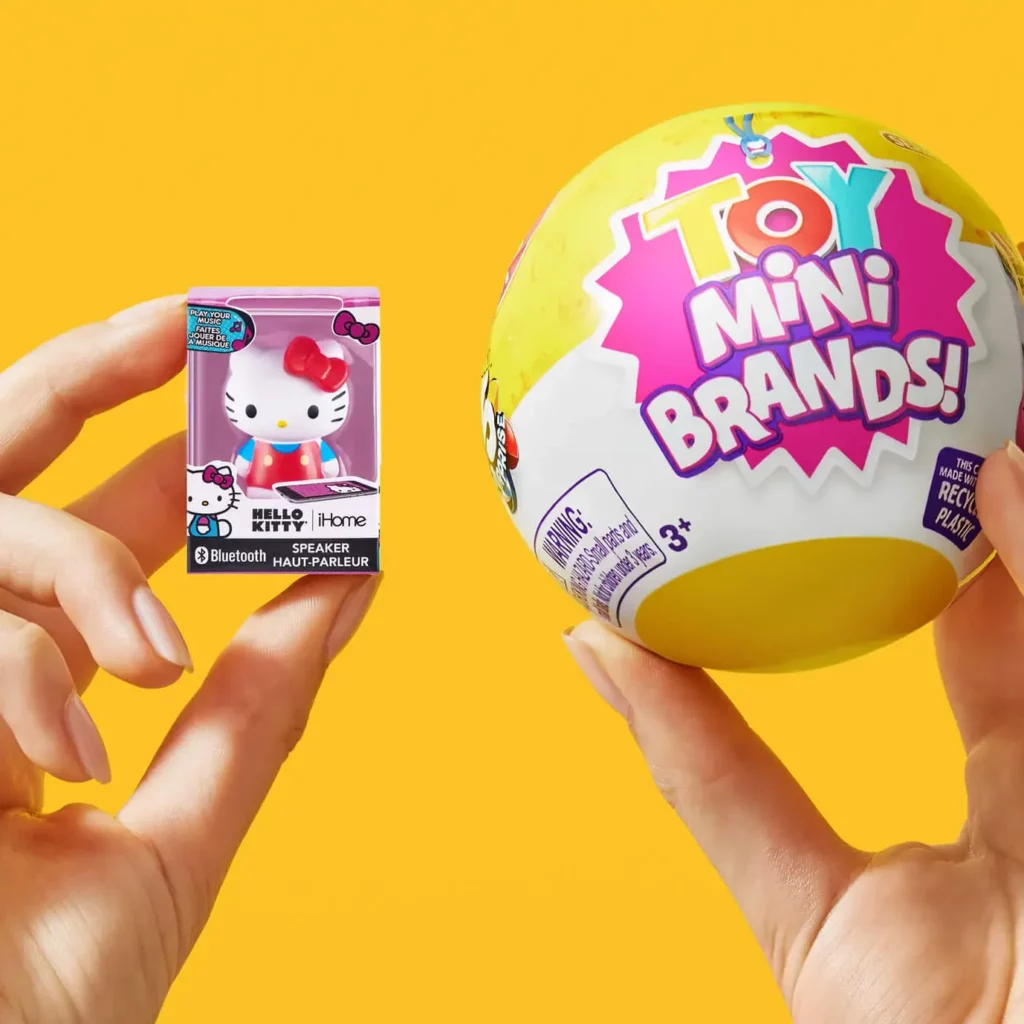
“Today, we don’t spend time talking about numbers because everybody has the numbers. We spend time turning those numbers into actions.”
Franz Oliveira, Global Analytics Lead, ZURU
Retailer data tells you what’s happening at the shelf. Distributor data tells you what’s moving through the pipeline. Syndicated data tells you how you stack up against the competition.
What are the most important CPG KPIs?
Not every metric matters equally. These are the ones that consistently drive better decisions:
Sales and revenue — your primary measure of success, broken down by product line, brand, retailer, and customer type. The deeper you can slice it, the more useful it becomes.
Velocity — units sold per store per week. It’s the metric retail buyers care about most, because it tells them whether your product earns its shelf space.
Voids — gaps in expected sales caused by out-of-stocks, misplaced products, or distribution disruptions. Voids quietly erode distribution gains and can cost brands significant revenue before anyone notices.
Chargebacks — deductions retailers and distributors take from your invoices to cover trade spend, compliance penalties, or logistics costs. Without clear visibility, chargebacks can eat into your margins faster than you realize.
Store and retailer retention — getting products into stores is only half the job. Monitoring performance at each account ensures you keep the distribution you’ve earned and spot problems before they escalate.
Before any analytics can work, your data has to be clean, connected, and correctly attributed. Traditional master data management means manually mapping product identifiers across retailers, correcting inconsistencies, and maintaining a single source of truth. AI Master Data automates the mapping and enrichment process — so your team can focus on insights, not data entry.
What are the biggest challenges with CPG data?
Most CPG brands don’t lack data — they lack the ability to act on it quickly enough:
Data is scattered across portals and formats. Every retailer and distributor has its own portal, its own export format, and its own timeline for sharing data. Pulling it all together manually takes hours that your team doesn’t have.
Cleaning and connecting data requires specialized skills. Raw data from different sources uses different product names, different store identifiers, and different time periods. Joining it into a single, accurate view takes technical skill and constant maintenance. AI Master Data now automates much of this work — mapping, attributing, and enriching product data that used to take weeks of manual effort. Learn what to look for in retail MDM software.
DIY data pipelines are expensive to build and maintain. Custom-built systems to ingest retail data can cost up to $100K per data source, with maintenance costs exceeding $500K per year. That’s budget and engineering talent pulled away from your core business.
Spreadsheets can’t keep up. Excel was fine when you had a handful of retail accounts. At the scale of hundreds of products and thousands of store locations, it breaks down — slow to update, prone to errors, and impossible to share in real time.
How AI is changing CPG analytics
Two shifts are transforming how CPG brands work with data: AI-powered agents that analyze and act on data automatically, and AI-driven master data management that eliminates the manual work of connecting disparate data sources.
AI Agents for retail
Crisp AI Agents are purpose-built for retail — trained on retail data with a retail-specific semantic model, not generic AI layered on top of a general-purpose platform.
What does that look like in practice? A brand can task an agent to monitor in-stock rates across 2,000 store locations and surface exceptions the moment they appear. Or generate a weekly business health summary every Monday morning with performance trends, risks, and recommended next steps — delivered straight to Slack or Teams.
Kraft Heinz Away From Home used Crisp AI Agents to identify risk across approximately 6,200 cases and action it immediately. That’s the kind of speed and specificity that manual reporting can’t match.
AI Agents can also analyze event impacts (weather, sporting events, holidays) on store-level sales, generate presentations and emails from your data, and run recurring analyses on a schedule. Get started with AI Agents for demand forecasting.
AI Master Data
Before any analytics can work, your data has to be clean, connected, and correctly attributed. That’s where AI Master Data comes in.
Traditional master data management means manually mapping product identifiers across retailers, correcting inconsistencies, and maintaining a single source of truth. It’s tedious, error-prone, and never finished.
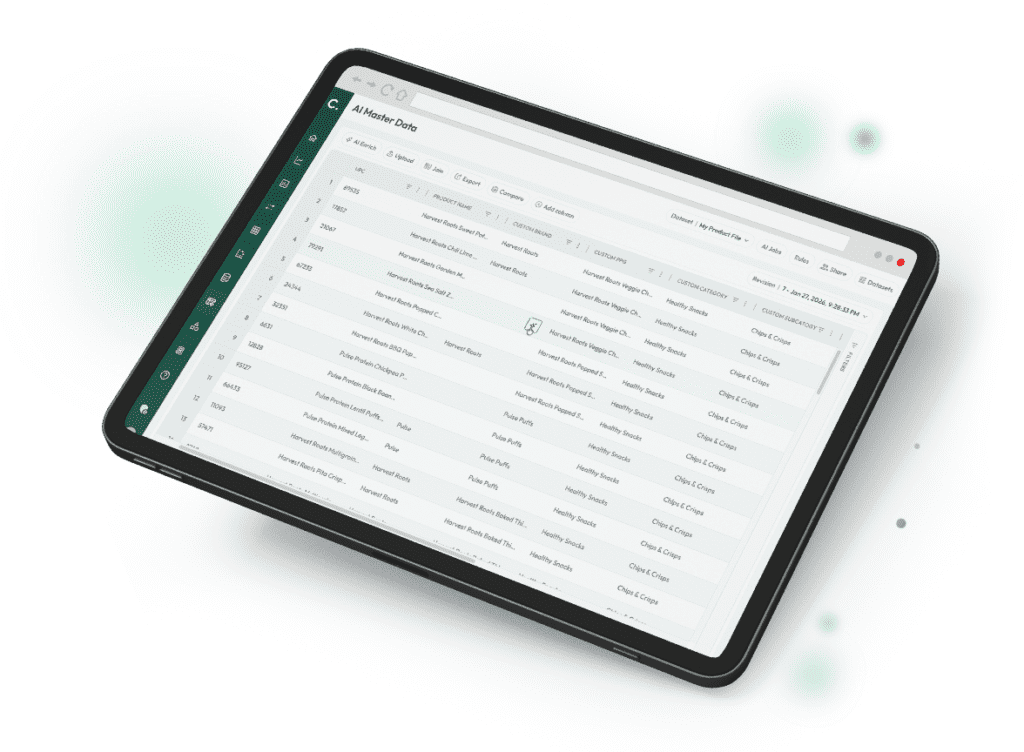
AI Master Data automates the mapping and enrichment process — connecting retail and syndicated datasets, detecting discrepancies, and even creating custom classifications (like flavor profiles or ingredient categories) tailored to your analytics needs. Changes are AI-suggested and human-approved, so you stay in control. Learn why retail MDM matters for CPGs.

“With Crisp, we can access all our sales and inventory data in such detail, so fast. The Master Data Management tool enables us to view our data exactly how we want to.”
Adriane Walters, Director of Grocery Sales, Mars Nature’s Bakery
Experience Crisp AI Master Data for CPG and Retail
How do you choose a CPG analytics platform?
Your approach depends on your size, distribution footprint, and internal resources. Here’s how it typically breaks down:
Early-stage brands may start with retailer portals and spreadsheets. It works when you have a handful of accounts, but it won’t scale.
Growth-stage brands need automation. Pulling data from multiple retailer portals manually, cleaning it, and loading it into a BI tool every week is a full-time job — and it’s the lowest-value work your analysts could be doing. A platform that automates ingestion, harmonization, and delivery frees your team to focus on the insights.
Enterprise brands need a platform that handles hundreds of retail and distributor connections, delivers data to cloud warehouses and BI tools at scale, and layers AI on top for forecasting, alerting, and autonomous analysis.
Regardless of size, the right platform should connect to your existing tools — whether that’s Tableau, PowerBI, Snowflake, or Google BigQuery — and deliver clean, structured data you can trust.
Get started with Crisp
Crisp connects CPG brands to real-time POS and inventory data from 40+ retailers and distributors, delivering store-level insights through BI tools, cloud platforms, interactive dashboards, and AI Agents. Nearly 6,000 brands rely on Crisp to grow sales, streamline operations, and reduce waste across the supply chain.
Book a demo to see how Crisp can work for your business.
Get insights from your retail data
Crisp connects, normalizes, and analyzes disparate retail data sources, providing CPG brands with up-to-date, actionable insights to grow their business.