Retail companies operating in a fast-paced environment should prioritize their core strengths and brand development. They should avoid diverting focus and resources to managing technologies that can be handled more effectively by specialized experts.
In the early days of B2B commerce, companies had no choice but to build their own EDI departments. They invested in translators, servers, and specialized staff. But nowadays, as supply chains become more complex and retail demands more stringent, many are realizing that running EDI in-house is like trying to build your own power plant just to keep the lights on.
Running EDI internally requires a surprising amount of investment, including:
EDI translator: This is a software tool that helps you construct an EDI translation using a mapping template, or parse out a received EDI document into human-readable components.
Communication solution: To transact EDI, you either need a mailbox on a VAN (Value Added Network), or AS2 software (a solution that handles encrypted direct file transfers over the internet), SFTP – or all three! Every retailer has their own preferred file transfer mechanism, and as the vendor you have to comply with the retailer’s chosen format. So while you may use AS2 to connect to one retailer, another may require you to use a VAN.
EDI mapping expert: You will need someone who can set up the EDI transactions for each of your customers, according to their own mapping specifications (EDI implementation guides). This may be a staff member you hire, or a consultant you contract when needed. While you may have several customers who all exchange the EDI 850 Purchase Order, the EDI 856 Advance Shipment Notice, and the EDI 810 Invoice, the exact segments, elements, and qualifiers used by each customer will vary from retailer to retailer and each map must be set up separately. Depending on how often you add new customers, you may need this expert’s services often.
EDI administrator:You will need a staff member who will monitor your EDI transactions, ensure that documents are running through the translator properly, and that confirmation of receipt (EDI 997 Functional Acknowledgements) are being sent and received for every file exchanged. This person will also need to know how to troubleshoot issues, and interpret error messages sent via EDI 824 Application Advice, EDI 864 Text Message, or within the EDI 997 itself. This is imperative to avoid chargebacks and compliance issues. Furthermore, depending on the volume of your EDI transactions, and the SLAs you have in place with your customers, you may need to have staff monitoring your systems outside of regular business hours, meaning you likely need more than one EDI Administrator handling your system.
Supporting systems:Of course, you will need to have all of the necessary infrastructure in place to support the systems above (servers, firewall, etc.)
While you may have several customers who all exchange the EDI 850 Purchase Order, the EDI 856 Advance Shipment Notice, and the EDI 810 Invoice, the exact segments, elements, and qualifiers used by each customer will vary from retailer to retailer and each map must be set up separately.
Seamlessly connect EDI with back-office operations
The above just lists the basics… but these costs can add up. Often, there are one or two people (the “EDI gurus”) who really know how to manage the EDI system when it is run in-house, and I am sure everyone gets nervous when that person goes away on vacation. Or worse: what if they leave the company? Fingers crossed the EDI system keeps working in their absence!
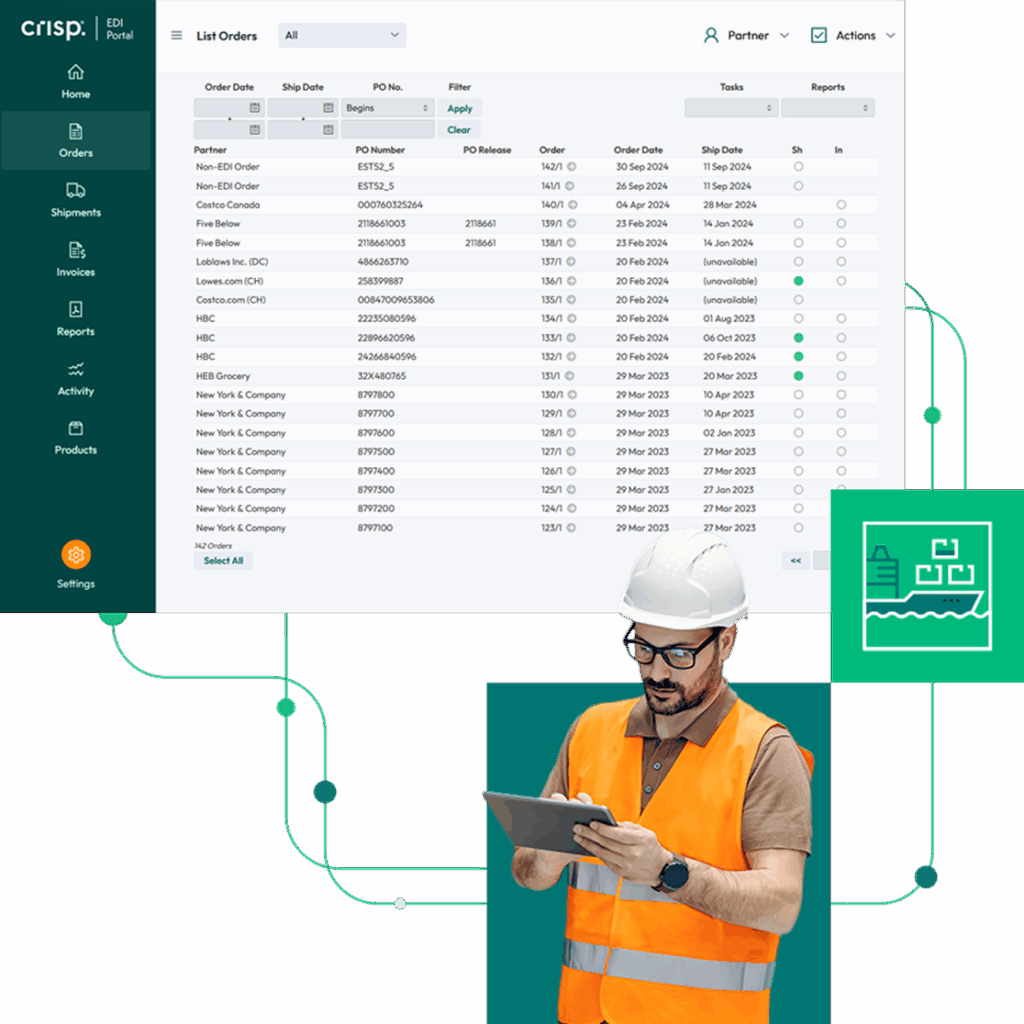
That is a lot for your team to manage, and that is not even your core business! That’s why many companies nowadays choose to outsource their EDI requirements to a trusted third party provider, like Crisp.
We handle all of the components above for you, providing 24/7 data monitoring, and full support.
The Crisp advantage: We help you focus on your core business
Why manage servers and mapping specs when you could be focusing on your products? By outsourcing to Crisp, you aren’t just buying software; you’re gaining a dedicated team, a true partner.
Seamless scaling: We have the maps for major retailers ready to go.
Risk mitigation: We handle the 24/7 monitoring, ensuring you stay compliant and avoid costly fines.
Institutional stability: We are a full-service partner that grows with you. We have a team of EDI experts available to help you.
Back-end integrations: In addition to handling the EDI basics, we can integrate these EDI transactions into your existing ERP or accounting system, allowing you to work with the data in a software solution you are familiar with – no need to learn EDI! Read more about our back-end integration here.
Trusted experts in retail data and automation: Not only does Crisp offer an EDI solution, but we also offer first-class retail analytics, intelligent replenishment, space automation solutions, and a vertical AI approach that embeds data with semantic layer technology for retail that adds crucial structure and context for trusted AI-powered outputs.
In addition to handling the EDI basics, we can integrate these EDI transactions into your existing ERP or accounting system, allowing you to work with the data in a software solution you are familiar with – no need to learn EDI!