

Improving On-Shelf Availability (OSA) with Databricks
Missing products on physical shelves strip nearly $1 trillion in lost sales from the global retail industry annually. Closing the gap between what inventory systems report and what actually sits on the aisle requires shifting from delayed manual audits to active data processing. By routing point-of-sale streams and supply chain records through an analytical engine like Databricks – fed by Crisp’s automated retailer data pipeline – you can catch counting errors and flag abnormal purchasing patterns before they compound into prolonged stockouts.
Key takeaways:
- Out-of-stock items occur on as often as 1 in 3 shopping trips according to IHL Group, and an IRI study found that 20 percent of all out-of-stocks remain unresolved for more than three days.
- Relying on intermittent manual store audits or weekly batch data feeds delays your response to sudden demand spikes.
- Crisp automatically consolidates supplier portal data into your Databricks lakehouse, giving engineers clean, normalized inputs for streaming retail analysis.
- Analyzing consecutive zero-sales events – surfaced daily in Crisp Retail Analytics – helps analysts differentiate between naturally slow-moving products and actual inventory gaps.
- According to ECR, increasing product availability by just 2 percent generally yields a 1 percent measurable bump in total sales volume.
The true cost of empty shelf space
The supply chain fails the moment a shopper reaches for a product and finds an empty space. Studies indicate the average out-of-stock rate hovers around 8 percent across the industry. Roughly 1 out of every 13 products is missing at the exact moment a customer wants to buy it.
Shoppers rarely leave empty-handed, but their actions damage your long-term revenue. A subset of consumers will substitute your item for a competitor’s product. Others will pull out their phones and order the item from an online marketplace. Research from NielsenIQ shows that 30 percent of shoppers will visit new stores entirely when they cannot locate their desired items, and IHL estimates that upwards of 24 percent of Amazon’s current retail revenue comes from customers who first tried, and failed, to buy the product in-store.
The growth of omni-channel fulfillment amplifies the problem. When store associates pick items for curbside pickup or local delivery, they draw from the exact same physical inventory as walk-in shoppers. Accurate tracking prevents your digital catalog from promising items that don’t exist on the floor.
Shoppers rarely leave empty-handed, but their actions damage your long-term revenue. A subset of consumers will substitute your item for a competitor’s product. Others will pull out their phones and order the item from an online marketplace.
Understanding the underlying causes of inventory gaps
Treating all out-of-stock messages as uniform supply chain failures prevents teams from applying the correct fixes. Retailers must identify exactly why an item stopped selling to prevent identical issues from happening again.
Defining phantom inventory discrepancies
Phantom inventory occurs when point-of-sale systems and inventory software report that units are available, but the physical shelf sits empty. Unreported shrinkage and physical theft create situations where the digital record overstates reality. If the algorithm calculates that the store holds 20 units of a specific SKU, the replenishment system won’t trigger a new order.
Crisp surfaces phantom inventory signals daily across retailers, giving supply chain teams fast visibility into where the gap between reported and actual stock is widest – and where intervention will have the most impact.
Recognizing safety stock violations
Organizations define specific thresholds for local inventory to trigger resupply orders. If analysts set that threshold too low, minor shipping delays cause the store to run dry before the delivery truck arrives. Analysts must weigh the risk of stockouts against the high carrying costs of excess inventory when determining store-specific requirements.
Filtering consecutive zero-sales events
An out-of-stock condition eventually manifests as a period where zero units register at the checkout counter. Not every day without a sale points to an availability crisis. Specialty items or expensive slow-moving formulations frequently experience days with zero registered purchases while fully stocked.
Data teams look at the cumulative probability of back-to-back zero-sales events for a specific item. When a high-velocity staple product experiences four consecutive days of zero movement, the system flags the anomaly for immediate investigation. In Crisp, these Zero Sales signals are refreshed daily and available at the SKU and store level, giving sales and category teams a direct view of where execution is slipping.
In Crisp, Zero Sales signals are refreshed daily and available at the SKU and store level, giving sales and category teams a direct view of where execution is slipping.
Detecting hidden merchandising errors
Products often sit in the stockroom while the retail floor display remains barren. In other scenarios, employees place the merchandise deep on the wrong shelf or set up the promotional display in a low-traffic corner. The store technically owns the inventory, but consumers can’t easily find or purchase it.
Detecting these hidden errors requires comparing real-time performance against expected baselines. If physical items exist in the building but the daily metrics consistently miss forecasts, the system should dispatch a team member to verify the floor placement.
Processing high-velocity data on the Lakehouse
Manually counting hundreds of thousands of individual SKUs across large footprint stores around the clock is practically impossible. Periodic physical audits inevitably let discrepancies slip through the cracks. Tracking on-shelf availability effectively requires a comprehensive retail data analytics strategy built upon complex data architecture.
Engineers use the Databricks intelligence platform to aggregate point-of-sale logs, e-commerce clickstreams, ERP databases, and third-party signals into a unified environment. Crisp’s Databricks integration serves as the automated data pipeline that makes this possible at scale – continuously consolidating supplier portal data from dozens of retailers and distributors into your lakehouse, delivered in a harmonized, consolidated format that’s ready for analysis without manual CSV downloads or custom ETL work.
With Lakehouse architecture, you can ingest high volumes of streaming data into raw storage layers. Declarative pipelines then clean and join these diverse data types into trusted tables built specifically for forecasting.
Legacy data warehouses typically rely on nightly or weekly extract and load procedures. Because of these delayed procedures, merchandising teams receive alerts days after the purchasing gap began. Processing transactions at low latency gives your field representatives the chance to correct physical shelf placement before peak shopping hours begin.
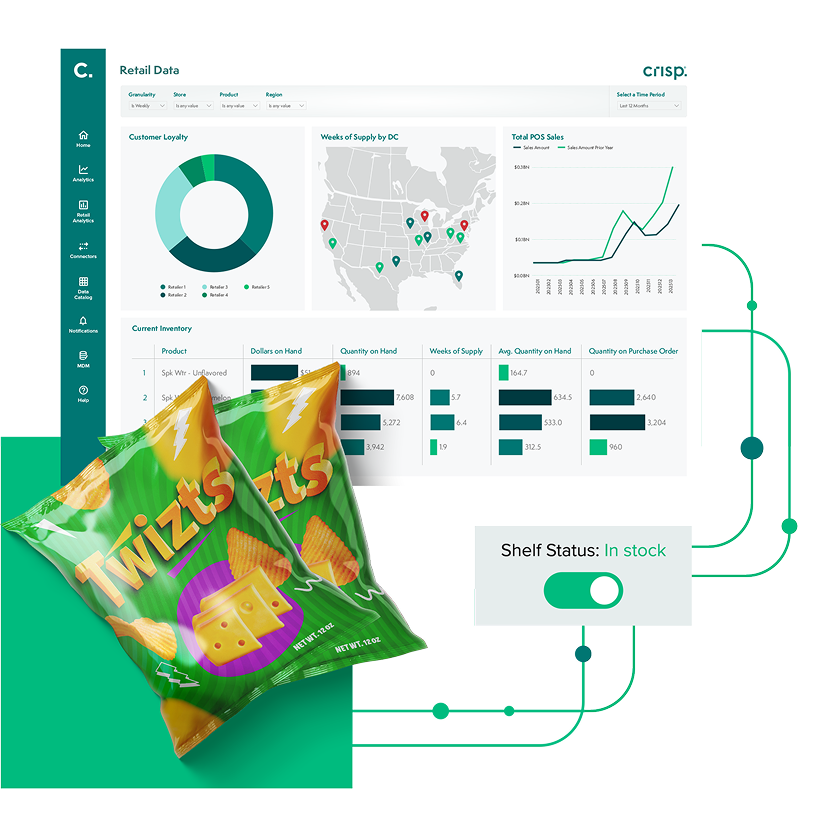
Accurate inventory tracking with real-time data
Analysts must weigh the risk of stockouts against the high carrying costs of excess inventory when determining store-specific requirements.
Real-world impact of AI-driven replenishment
Transitioning from legacy batch reporting to continuous streaming analytics produces tangible results for global retail brands. When supply chain applications simultaneously process point-of-sale inputs, external weather signals, and local demographic patterns, retailers achieve immediate operational resilience. By catching minor demand signals before they evolve into widespread stockouts, businesses using advanced AI solutions report reductions in stockouts by 20 to 30 percent.
Brands using Crisp have demonstrated this impact firsthand. Safe Catch seafood used Crisp’s advanced forecasting and fill-rate analytics to recover $1 million from stockouts while navigating the inherent unpredictability of international supply chains and seasonal fishing patterns. Mars’ Nature’s Bakery uses Crisp to maintain optimal product placement and consistent availability across highly competitive retail floors – with real-time shelf management data flowing directly into their analytics environment.
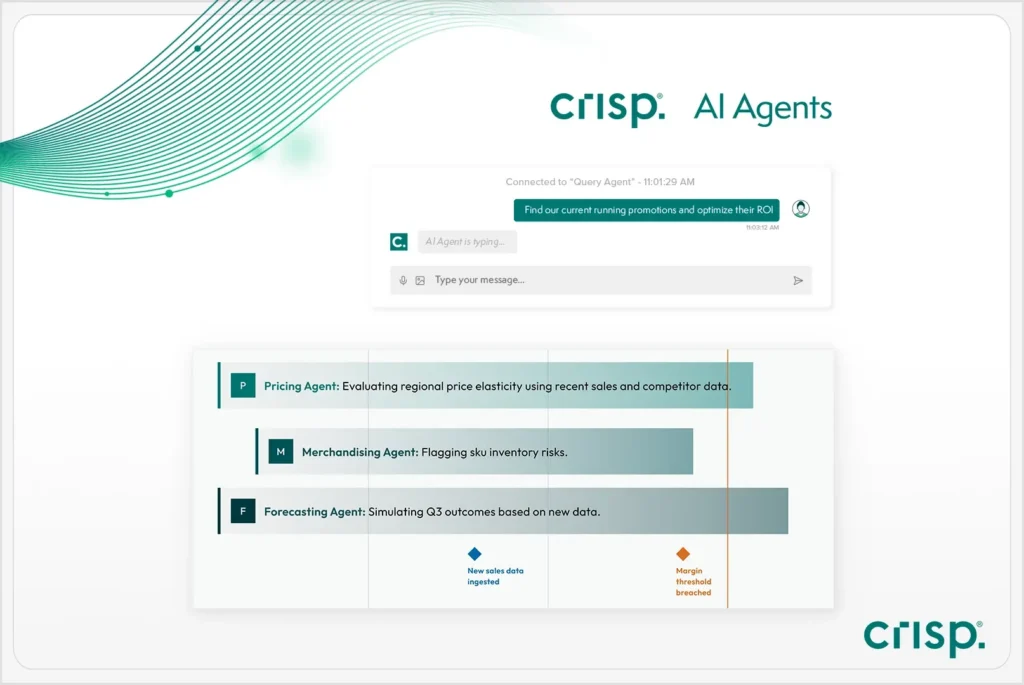
Accurate inventory tracking with real-time and AI-ready retail data
Building predictive baselines for physical stores
Identifying hidden stockouts depends on calculating precisely what a given store should have sold on a specific day. The system generates an expected mathematical value for a historical period to identify where actual sales fell short of theoretical demand.
Data scientists frequently use simple exponential smoothing to process timeseries metrics for individual store-and-SKU combinations. Crisp’s AI Agents for Retail are tailored for retail environments that accelerate your baseline modeling without requiring teams to build from scratch. The algorithms study the long-term sales patterns of an exact item in an exact zip code to determine the baseline expected volume.
Once you establish the expected volume, you compare it against the actual receipts. Analysts configure logic to catch sustained deviations because alerting on a single daily miss creates too much noise for field associates to manage. You might program the platform to trigger an alert only when a specific product sees four consecutive days of increasing misses, with an average daily deviation exceeding 20 percent of the expected volume.
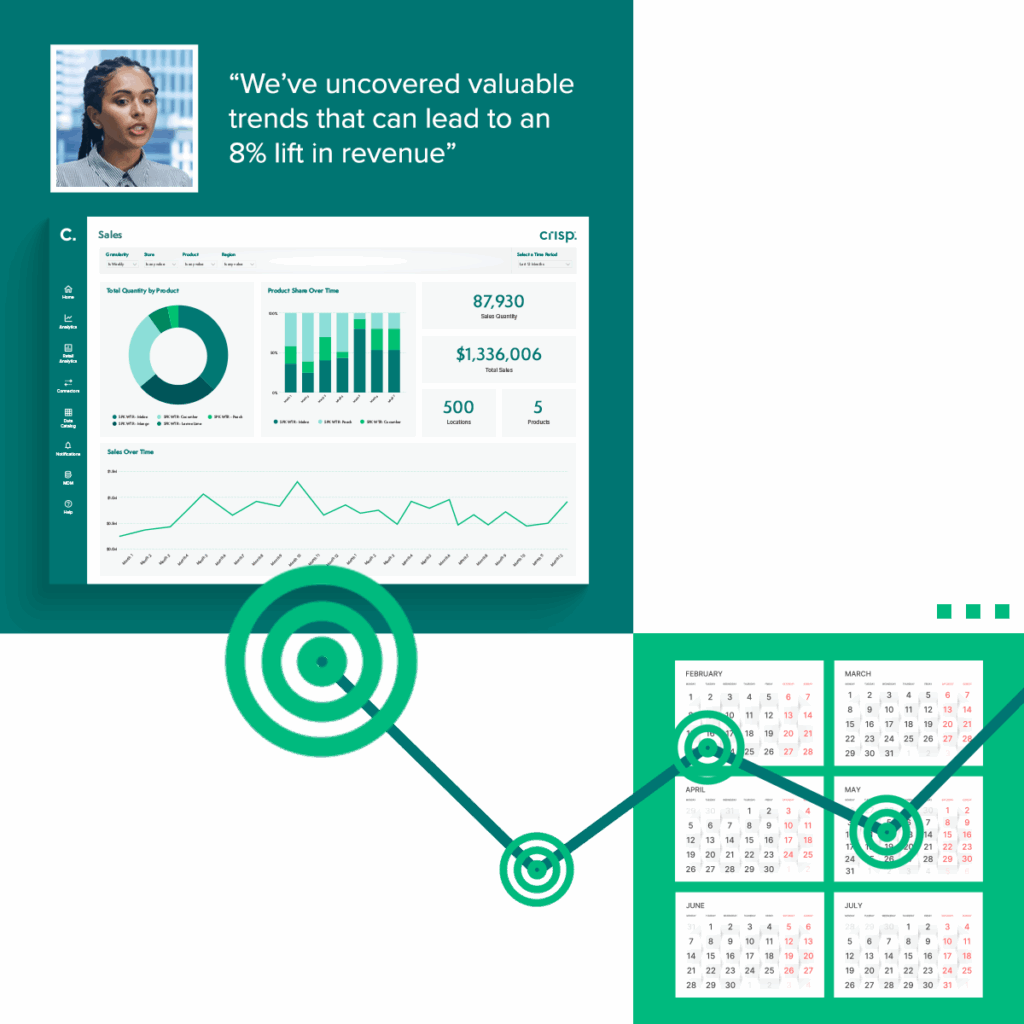
Grow retail revenue with real-time data plus AI
Fixing stockouts before revenue drops
A high-performing supply chain requires immediate visibility into what is actually happening on the retail floor. Resolving the disconnect between theoretical inventory and physical availability prevents consumers from abandoning their preferred items.
Before engineers can run sophisticated out-of-stock models, they must secure reliable inputs. Crisp automatically consolidates supplier portal data in Databricks by ingesting complex retail feeds and formatting the information precisely for analysis. That normalized data is pushed directly into your Databricks Delta tables in real time. This automated ingestion alleviates the heavy manual data cleansing burden that typically traps data engineering teams, freeing them to focus immediately on running predictive algorithms.
Understanding whether your products are truly available to shoppers – not just present in inventory systems – requires daily visibility into Walk-In Purchasability and Digital Purchasability metrics. Combining frictionless direct retailer feeds with advanced probability models ensures your field teams detect missing products and trigger replenishment alerts the moment sales activity stalls.
Get insights from your retail data
Crisp connects, normalizes, and analyzes disparate retail data sources, providing CPG brands with up-to-date, actionable insights to grow their business.