

Retail data management: What do I need to be effective?
Centralizing retailer data is no longer the finish line for CPG teams. The bigger challenge is turning that data into a current, connected view that sales, supply chain, marketing, and retail execution teams can use to make decisions from the same facts.
That matters because retail problems rarely stay in one lane. Inventory affects promotions. Replenishment affects sales. Store-level availability affects forecasting. When those data points are reviewed separately, teams may see pieces of the issue without seeing what is causing it.
A retailer report may show healthy inventory while key stores are already running low. A promotion may drive demand before replenishment catches up. Marketing, sales, and supply chain teams may each be looking at different reports, making it harder to decide what to fix first.
The article explains how retail data management is evolving from centralized reporting into a way for CPG teams to act faster across accounts, stores, products, and promotions.
The article explains how retail data management is evolving from centralized reporting into a way for CPG teams to act faster across accounts, stores, products, and promotions.
What is retail data management?
Retail Data Management is the process of collecting, cleaning, and standardizing retailer data so CPG teams can use it to understand sales, inventory, replenishment, and store performance across retailers.
For CPG brands, retail data often includes:
- Retail execution reporting
- Retailer sales and POS data
- Inventory and availability data
- Store-level performance data
- Replenishment and order data
- Marketing and promotional activity
For many CPG teams, retail data management has traditionally focused on centralizing data from different retailers, distributors, and internal systems into one reporting environment. That made it easier to review sales, inventory, and retailer performance in one place.
More CPG teams are now moving toward connected retail data. Connected data links sales, inventory, replenishment, promotions, forecasting, and store-level performance so teams can see how changes in one area may affect another.
For example, a sales team may see a product gaining traction at one retailer. A supply chain team may see inventory starting to run low in the stores where sales are increasing. A marketing team may be planning more support for that item. Connected retail data helps those teams respond before demand outpaces availability.
Connected retail data helps CPG teams collectively respond before demand outpaces availability.
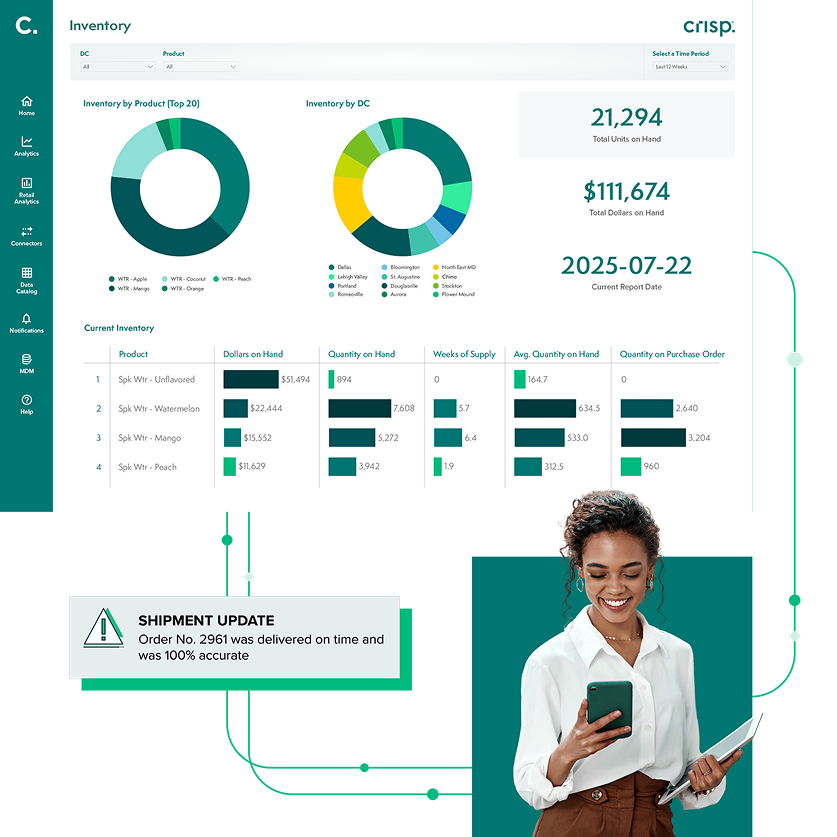
Grow retail revenue with real-time data
Retail data management vs. Master Data Management (MDM)
Master data management (MDM) helps standardize retailer and product data across the systems CPG teams use to plan, report, and analyze performance. Retailers generally send data in different formats, with different product names, store structures, and inventory definitions.
While master data management makes product and retailer data consistent, retail data management makes that data useful for day-to-day decisions by connecting sales, inventory, replenishment, marketing, and retail execution data.
For example, teams can see whether a promotion is increasing demand in stores where inventory is already low. They can also see whether replenishment needs to be adjusted before availability problems affect sales.
Crisp AI Master Data goes beyond classic mapping and manual maintenance, making it easier than ever to uncover strategic insights across your retail portfolio and gain a competitive edge at the shelf.
Why traditional retail data management falls short
Traditional retail data management helped teams centralize reporting across retailers, products, and accounts. That was a useful step, especially for teams that were previously working from separate retailer portals and spreadsheets.
But stores, shelves, promotions, and replenishment needs can change faster than reporting cycles. When teams can’t see those changes early enough, they may miss the chance to protect sales, support promotions, or address availability issues before they spread.
The limitations usually show up in a few common ways:
Reporting cycles slow response
Many CPG teams still wait for retailer reports to update before they can see what changed.
By the time teams identify an inventory problem or sales shift, stores may already be out of stock or promotions may already be underperforming.
Daily store-level signals give teams a better chance to adjust replenishment or follow up with a retailer before a small issue becomes a larger sales problem.
Teams may be working from different retail reports
Sales, marketing, supply chain, and retail operations teams don’t always work from the same retailer data, update schedules, or reporting views.
One team may be reviewing retailer POS trends while another is looking at replenishment updates or inventory reports from a different time period. Those differences make it harder to coordinate decisions across promotions, forecasting, replenishment, and retail execution.
The business risk is not only confusion. Different reports can lead teams to take different actions. Marketing may keep supporting an item that supply chain can’t replenish quickly enough. Sales may prepare for a retailer conversation without the latest store-level availability context.
Marketing activity and store-level inventory may stay disconnected
Marketing activity and store-level inventory need to be viewed together.
A campaign may increase demand before replenishment plans change. A promotion may look weak when limited inventory in key stores is the real issue. A retailer may show strong sell-through in one region while nearby stores are already running low.
When marketing and supply chain data remain separate, teams may not know whether performance is driven by demand, inventory, execution, or a combination of all three.
Better data gives teams more useful questions to ask: Should the team add promotional support, shift spend, adjust replenishment, or focus on store-level execution?
Retailer data is difficult to compare
Retailers often structure product, inventory, and sales data in their own ways. Without consistent product names, store hierarchies, inventory definitions, and reporting formats, teams may struggle to compare performance across accounts.
That can slow decisions. Instead of asking what to fix first, teams may spend time debating whether the numbers are comparable or current enough to trust.
Store-level problems can stay hidden too long
Retailer-wide reporting may not reveal what is happening in individual stores.
Account-level inventory can look stable even when certain stores are already running low. A promotion may appear successful at the account level even when shelves are empty in key locations.
Store-level data shows where the issue is happening and where to follow up first. Strong retail inventory tracking gives teams the details they need to point retailer conversations to the affected stores, products, and time periods.
Reconciliation delays action
Even after retailer data is available, many teams still have to pull reports, check spreadsheets, and reconcile numbers across systems before they can use it.
That manual work slows response time. Analysts spend time cleaning files instead of finding patterns. Account teams lose time preparing for retailer conversations. Supply chain teams may not see inventory risk until availability is already affected.
Strong retail inventory tracking gives teams the details they need to point retailer conversations to the affected stores, products, and time periods.
How retail data management helps CPG teams act faster
Better retail data management changes how teams use retailer data. Instead of waiting for reporting cycles to close, CPG teams can use fresher, connected data to understand what is happening and decide where to act first.
Connected retail data supports faster decisions
Centralized reporting helps teams review sales, inventory, and retailer performance in one place.
Connected retail data goes further by bringing fresher sales, inventory, replenishment, promotion, and store-level data together. Teams can see how changes in one area may affect another, spot inventory risk or sales shifts earlier, and decide how to respond while there’s still time to act.
| What teams see in connected retail data | How teams may respond |
| Inventory is running low in stores supporting a promotion | Adjust replenishment before shelves go empty |
| Store-level sales are slowing in one region | Review local execution or shift promotional support |
| Distribution increased but sell-through remains weak | Reevaluate assortment, placement, or retailer support |
| Inventory looks healthy overall, but specific stores are understocked | Focus retailer conversations on affected locations |
| Replenishment delays are affecting availability | Update forecasts and prioritize inventory allocation |
| Promotional lift is weaker where inventory is inconsistent | Adjust campaign targeting, timing, or support |
Different teams can act on the same retail data
The same retail data may matter to different teams for different reasons.
Low inventory in promoted stores may tell supply chain to review replenishment, marketing to adjust campaign support, sales to prepare a retailer conversation, and forecasting teams to revisit demand assumptions.
Weak sell-through after a distribution gain may tell sales to review account performance, retail operations to check store execution, and marketing to reconsider where support is needed.
Retail data management lets these teams work from the same facts, even when they use the data to make different decisions. Better retail data in every department can help teams coordinate inventory, forecasting, replenishment, promotions, and retailer conversations more effectively.
Better retail data in every department can help teams coordinate inventory, forecasting, replenishment, promotions, and retailer conversations more effectively.

Grow retail revenue with real-time data plus AI
What modern retail data management requires
For CPG teams to act before store-level issues affect sales, retail data needs to be timely, standardized, comparable across retailers, and useful across teams.
Reliable daily retailer data
Store and shelf conditions can change quickly during promotions, seasonal demand shifts, distribution changes, or replenishment delays.
Many CPG teams now depend on daily retailer data rather than on weekly or delayed reporting cycles. Faster updates make it easier to catch inventory risks, availability problems, and changing sales patterns.
Store- and SKU-level data is especially important because retailer-wide reporting may hide where problems are developing first.
Standardized retailer and product data
Retailers often structure product, inventory, and sales data in their own ways. CPG teams need a consistent way to compare performance across accounts.
That includes:
- Product identifiers
- Store hierarchies
- Inventory definitions
- Reporting formats
- Replenishment data
- Promotional reporting
Without consistency and shared definitions across retailer data, teams may spend more time reconciling reports than responding to changing retail needs. A strong semantic layer can help teams compare retailer data more consistently across systems and reports.
Without consistency and shared definitions across retailer data, teams may spend more time reconciling reports than responding to changing retail needs.
Data teams can use across functions
Sales, marketing, supply chain, forecasting, inventory, and retail operations teams often rely on the same sales, inventory, and store-level data, even though each team uses it differently.
Modern retail data management provides teams with a common way to view inventory, sales, promotions, replenishment, and store-level performance. That makes it easier to prioritize the stores, products, and retailers that need attention first.
Action-ready retail data can support decisions such as:
- Prioritizing stores with inventory risk
- Adjusting replenishment plans
- Validating distribution gains
- Evaluating promotional performance
- Identifying regions with changing demand
- Supporting retailer conversations with current data
A stronger retail analytics strategy can help teams turn those decisions into repeatable workflows across sales, inventory, forecasting, and retail execution.
Why this matters more in the AI era
CPG retail operations are becoming more automated. Forecasting systems, replenishment tools, inventory planning systems, and AI-driven workflows increasingly depend on current sales, inventory, and store-level data.
That makes delayed, incomplete, or disconnected retail data riskier. Automated workflows can move faster than teams can correct them. A forecast may adjust before inventory data is updated, or a campaign may keep driving demand in stores that cannot support it.
As more decisions become automated, retail data systems need to connect inventory, replenishment, forecasting, marketing, and retail execution. More advanced AI-driven workflows depend on connected retail data to help teams identify risks, prioritize actions, and respond faster across retail operations.
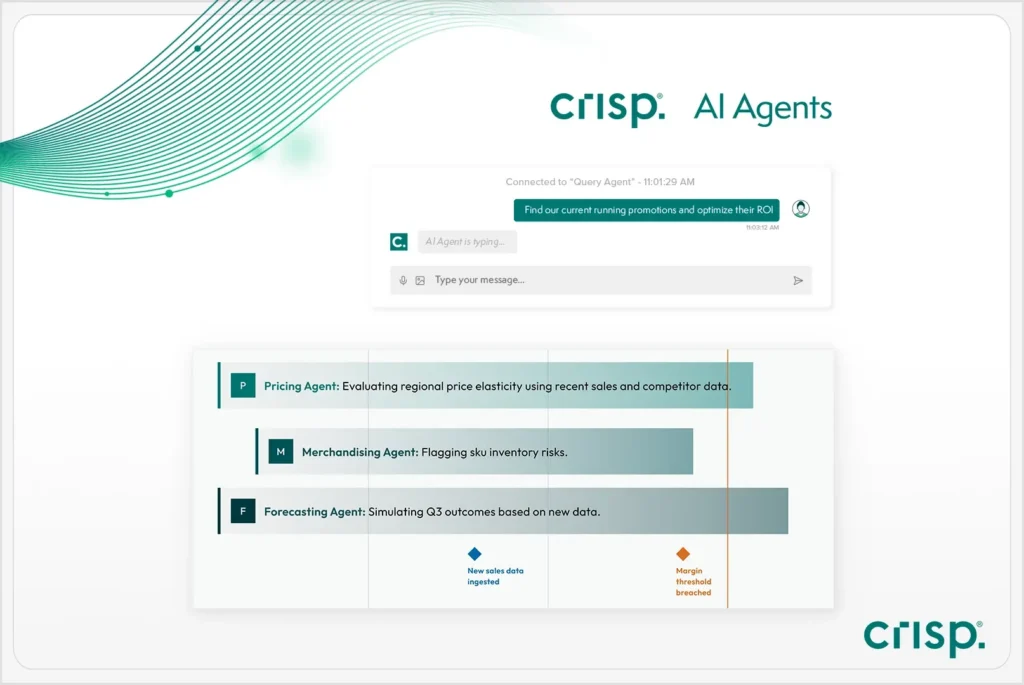
Discover Crisp AI Agents for Retail
How Crisp helps CPG teams connect retail data to daily decisions
Crisp helps CPG teams move beyond centralized reporting by turning retailer, distributor, inventory, and sales data into a reliable daily flow that teams can use across inventory, forecasting, replenishment, marketing, sales, and retail execution.
Reliable retailer data across accounts
Crisp connects SKU- and store-level data across retail accounts through retailer data integrations, giving teams a more current way to monitor inventory risk, sales shifts, availability issues, and store-level performance across retail partners.
Standardized and connected retail data
Retailers often structure product, inventory, and sales data differently across accounts. Crisp standardizes retailer and product data so teams can compare performance across retailers, stores, and categories.
Crisp also connects sales, inventory, replenishment, promotional, and retail execution data so teams can view promotion performance alongside inventory levels instead of reviewing campaign results and supply chain issues separately.
Store-level data that supports faster response
Store-level data helps teams identify where inventory risk, uneven sales patterns, replenishment problems, and availability issues are happening, helping teams:
- Validate whether distribution gains are translating into sales
- Identify stores with repeated availability problems
- Support retailer conversations with current data
- Prioritize actions before problems affect broader performance
CPG brands including J.M. Smucker, Clorox, and Made By Gather use Crisp to improve visibility across retail accounts, support forecasting and replenishment decisions, validate store-level performance, and respond faster to store-level issues.
FAQs about retail data management
-
What Is retail data management?
Retail data management is the process of collecting, cleaning, standardizing, and connecting retailer data so CPG teams can use it to support forecasting, replenishment, promotions, inventory tracking, and retail execution decisions./
-
Why Is retail data management important for CPG brands?
Retail data management helps CPG teams identify inventory risk earlier, monitor store-level performance, support forecasting, coordinate promotions, and respond faster across retailers and distributors.
-
Why does store-level visibility matter?
Store-level visibility matters because retailer totals can look healthy even when certain stores are already out of stock, missing shelf placement, or failing to support a promotion. Store-level detail helps teams spot problems sooner and reduce lost sales.
-
What Is the difference between retail data management and Master Data Management (MDM)?
Master data management makes retailer and product data consistent across systems. Retail data management uses that standardized data to support day-to-day operational decisions.
-
Why is retail data difficult to compare across retailers?
Retail data is difficult to compare because retailers structure product, sales, inventory, and replenishment data differently.
-
How does retail data management support forecasting and replenishment?
Retail data management helps teams monitor inventory conditions, store-level sales patterns, and changing demand signals earlier so they can adjust forecasts and replenishment plans before availability problems affect sales. Better forecasting and order automation depend on timely retail data that reflects what is actually happening in stores.
-
How can retail data help support promotions and marketing?
Retail data can show whether promotions are supported by enough inventory, distribution, and store-level availability. Teams can then see whether campaign performance is being affected by demand, inventory, or execution issues.
-
What should CPG brands look for in retail data management software?
CPG brands should look for retail data management software that supports reliable retailer integrations, daily SKU- and store-level visibility, standardized retailer data, store-level analysis, and connected reporting across forecasting, replenishment, inventory, and promotions.
Get insights from your retail data
Crisp connects, normalizes, and analyzes disparate retail data sources, providing CPG brands with up-to-date, actionable insights to grow their business.