

AI Agents for assortment recommendations: Getting started
Key takeaways
- Shelf-aware decisions: Move beyond broad averages to store-level granularity, ensuring your assortment reflects the unique demand curves of individual locations.
- Traceable reasoning: AI agents use logic chains to “show their work,” providing an auditable trail of reasoning that proves the validity of every SKU addition or cut.
- Eliminating administrative drudgery: Automated data extraction and cleaning allow category teams to stop acting as “data janitors” and start focusing on strategic validation.
- Active interrogation: Query your assortment productivity in real-time through natural language to identify growth levers before your buyer asks.
Why vertical AI changes assortment work
Aligning the right mix of products across physical and digital shelves stands as one of the most direct levers a category team has to drive growth. Achieving an optimal assortment requires turning millions of daily store and item signals into recommendations a retailer will feel confident enough to act on.
While model intelligence has advanced, the true bottleneck remains the capability-deployment gap. General-purpose chatbots can summarize reports, but they cannot run category decisions from slide decks and files scattered across shared folders. Vertical AI changes the process by building on a structured, harmonized retail data foundation. AI agents equipped with Logic Chains provide recommendations that category managers and retailers can trust. With a specialized foundation in place, teams move from reactive, calendar-bound reviews to a continuous loop that turns assortment insight into shelf-level action.
The role of AI Agents in category management
Detecting distribution gaps and voids
Identifying a void detection opportunity is one thing; proving the “size of the prize” is another. Crisp AI Agents maintain a constant pulse on your On-Shelf Availability (OSA) and velocity across thousands of stores. By cross-referencing peer-store performance, agents can automatically flag where high-velocity items are missing from the shelf. “Shelf-aware” automation catches gaps earlier and surfaces the root cause – whether it’s a planogram error or a supply chain lag – so teams can act before the problem compounds.
Streamlining SKU rationalization
SKU rationalization has traditionally been a defensive, periodic exercise built on latent data – a reactive cleanup rather than a live instrument. AI agents change that by continuously monitoring your portfolio to identify low-performing items at risk of being cut, alongside high-performing items with low distribution. With a clear narrative of reasoning behind each recommendation, category managers walk into buyer meetings with pre-validated assortment recommendations that protect revenue and maximize shelf productivity.
Localizing assortments at scale
Manual store clustering often relies on broad regional averages that obscure local opportunities. A store in Miami experiences different seasonal trends than one in Chicago. AI agents build specific predictive models for every store-SKU combination, allowing teams to achieve hyper-localization at scale. This ensures that your fair share of the category gets optimized store-by-store, reducing waste and putting the right product in front of the right shopper in the moments that matter.
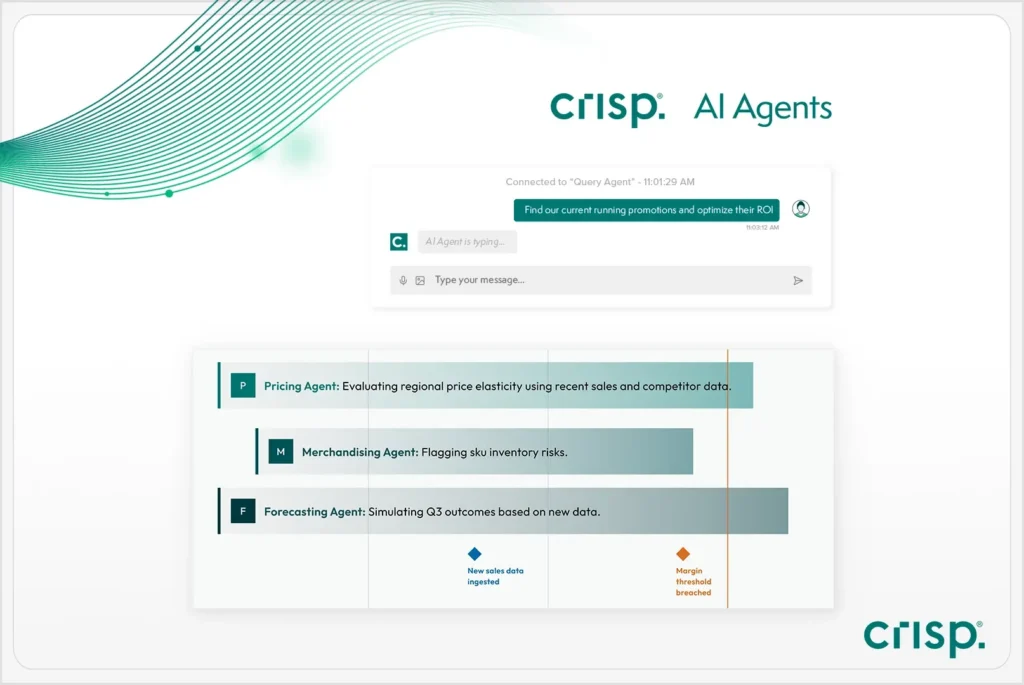
Discover Crisp AI Agents for Retail
“Shelf-aware” automation catches gaps earlier and surfaces the root cause – whether it’s a planogram error or a supply chain lag – so teams can act before the problem compounds.
What makes an AI agent’s recommendation trustworthy
A category manager can’t walk into a meeting with a major retailer and suggest a $100k inventory shift “because the AI said so.” That’s the trust deficit traditional AI creates – and without a clear, auditable trail of reasoning, even a correct recommendation stalls.
Crisp vertical AI solutions employ logic chains (Chain of Thought reasoning) at their core. When an agent identifies a growth opportunity, it delivers a clear narrative of its reasoning – cross-referencing localized sales trends, distributor inventory, and lead times – so human experts can focus on strategic validation rather than chasing down the source of the number. The result is the kind of verifiable confidence that moves a recommendation into action.
Building an AI-ready assortment foundation
Harmonizing data with a retail knowledge graph
Data fragmentation across retailer portals is a massive barrier to automated assortment work. To be effective, an agent needs a unified view of the portfolio. Crisp AI Master Data unifies fragmented SKUs into a cohesive retail knowledge graph, ensuring that mathematical models evaluate all available market activity without skipping major retail channels.
Customizing benchmarks with AI Master Data
Agentic action takes on more value with your specific business context. By layering on your brand’s own custom hierarchies and taxonomies – such as “Trial Size” or “High Protein” – teams can track the performance of these groupings through active interrogation. This ensures the AI learns your brand’s “internal dialect” and applies your specific KPIs to every assortment recommendation.
If an AI Agent flags a $50,000 revenue gap in a specific region, planners can “drill down” into the logic in real-time: “Which specific stores are driving this gap?” or “Does this account for the upcoming promotion in Week 12?”
From static reviews to a continuous assortment loop
Calendar-bound resets often create a lag problem where the market shifts before a planogram even reaches the shelf. The window between a data-driven recommendation and real execution can span months, leaving performance gaps unaddressed until the next review cycle.
Creating an Ever-Perfect Shelf with Crisp provides an antidote by connecting planning, execution, and measurement continuously. This framework relies on four capabilities working in concert: AI Master Data to organize product data, Space Management to execute planograms, Shelf Intelligence to track store-level reality, and AI Agents to surface recommendations before issues compound.
Ongoing measurement transforms the workflow into a loop. Crisp Shelf Intelligence ingests planogram, POS, and inventory data daily to deliver visibility into availability and space productivity. A continuous read on performance flows back into assortment decisions, flagging where high-velocity items are under-distributed or where a reset didn’t land as planned.
“Having data is just the starting point. Real value comes from turning it into insights and action. Crisp helps us do that faster and more efficiently – simplifying our retail data analysis, and leading to stronger recommendations and consistent value for our retail partners.”
Rachael Peot, Senior Director of Category Strategy, Schwan’s Company
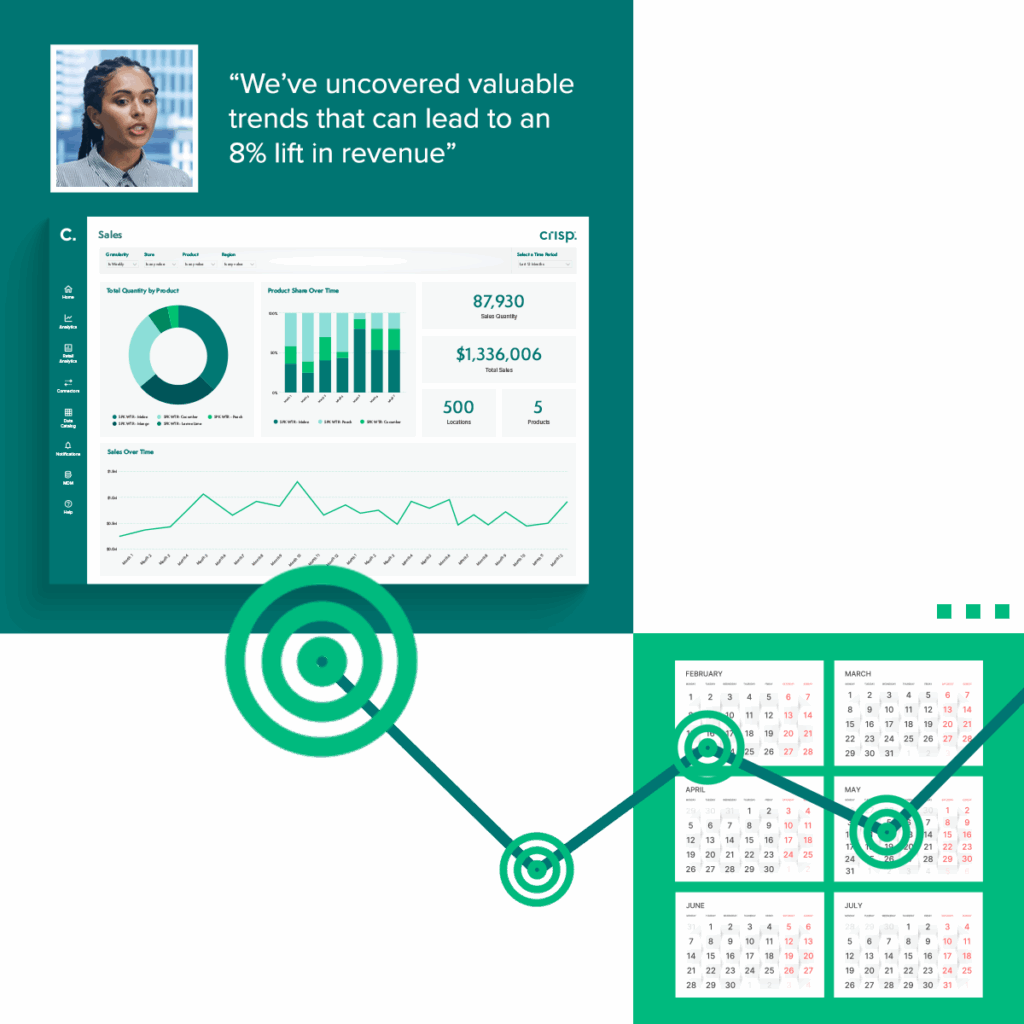
Grow retail revenue with real-time data plus AI
Crisp’s Ever-Perfect Shelf is fueled by: AI Master Data to organize product data, Space Management to execute planograms, Shelf Intelligence to track store-level reality, and AI Agents to surface recommendations before issues compound.
How Crisp AI Agents power assortment recommendations
Crisp pairs a vertical AI retail data foundation with agents built for category workflows. The platform ingests daily retailer data, reconciles product identities through AI Master Data, and normalizes everything through a semantic layer. Crisp AI Agents then triage anomalies and surface store-level recommendations, including whitespace and distribution expansion by store cluster.
Incrementality validation ensures a swap adds net category volume instead of cannibalizing neighboring SKUs. Clean data flows directly into planogram execution, closing the gap between the recommendation and the shelf.
The proof exists in how teams use it today. Schwan’s Company applies Crisp’s agents to identify high-performing items with low distribution as growth levers. J.M. Smucker built a store-cluster strategy for its pet dental products on SKU and store-level data, expanding items in high-demand groups.
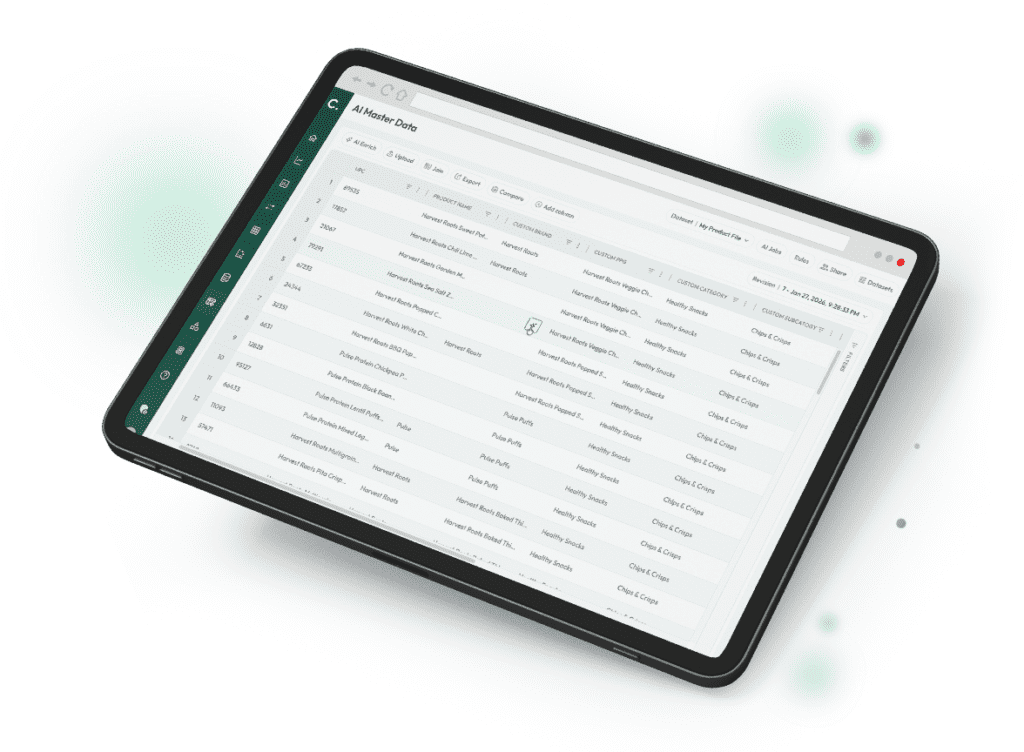
Experience Crisp AI Master Data for CPG and Retail
Structured roll-out for AI Agents in retail
Trusting a system with multi-million dollar inventory decisions requires a gradual operational adjustment:
- Start with high-volume pilots: Use stable, fast-moving items to identify patterns and build internal support for the technology.
- Define logic gates: Set maximum and minimum inventory thresholds (guardrails). If a recommendation exceeds these gates, the system flags it for human review.
- Side-by-side validation: Run automated models alongside manual efforts for 90 days. Documenting where the software successfully identified emerging trends helps analysts view the agent as a force multiplier rather than a replacement.
Implementing autonomous agents gives companies the processing speed required to operate at the speed of the shelf. While humans guide the strategy, the agents handle the complex mathematical forecasting required to keep products available across every touchpoint.
Get started with Vertical AI for category management and assortment optimization; reach out to learn more.
FAQs about AI-driven assortment planning
-
How does automated assortment optimization differ from traditional reviews?
Traditional reviews are periodic and rely on manual benchmarking. Automated optimization uses persistent Retail Agents that ingest daily POS data to identify voids and underperformers in real-time, providing a logic-based narrative for “what to do next.
-
Can AI Agents capture our team’s unique category rules?
Yes. Through Memory and Preferences, Crisp AI Agents learn your brand’s specific financial rules and dynamic SOPs. This preserves the “expert logic” of your senior team members as a digital asset that stays within the company.
-
How do logic chains help with buyer pitches?
Logic chains provide a step-by-step audit trail of how an agent reached a conclusion. By “showing the work,” category managers can provide retailers with the data-enriched reasoning required to prove that an assortment shift will drive mutual growth.
-
Do we need to hire data scientists to use AI Agents for retail?
No. Vertical AI arrives with deep retail domain context already built-in. Category teams can operate the system through Active Interrogation – using natural language to query and refine insights without needing to write code.
Get insights from your retail data
Crisp connects, normalizes, and analyzes disparate retail data sources, providing CPG brands with up-to-date, actionable insights to grow their business.