

Data-driven category management strategy in retail
A category management strategy only works if it holds up in stores.
In retail, a category management strategy helps teams make better decisions across a group of products to grow sales, improve availability, and protect margin. Most strategies are built around a familiar planning process that guides assortment, pricing, placement, and promotion decisions.
That structure is useful. It helps teams define priorities and align around how the category should perform.
But even a well-built plan can fall out of sync when teams cannot see what is actually happening in stores. Products go out of stock. Promotions are not fully executed. Inventory records do not match reality. These problems often begin at the store level and stay hidden until they show up in category reporting.
By the time they appear in aggregate data, performance may already be affected.
That creates a disconnect between the strategy on paper and what is actually happening in stores. The next step is understanding why that happens and what it takes to keep the strategy aligned.
Even a well-built plan can fall out of sync when teams cannot see what is actually happening in stores. Products go out of stock. Promotions are not fully executed. Inventory records do not match reality. These problems often begin at the store level and stay hidden until they show up in category reporting.
The traditional category management process and where it falls short
Most category management strategies in retail follow a structured planning process. Retailers and CPG teams use that approach to define how a category should perform. The framework gives teams a clear way to set direction, align around priorities, and make decisions across assortment, pricing, placement, and promotion. The most common version of that framework is known as the 8-step category management process.
The 8-step category management process
The traditional category management process is often described as an 8-step framework used by retailers and CPG teams to plan how a category should perform.
While the exact wording may vary, the process usually includes:
- Define the category
- Assign a category role
- Assess category performance
- Set targets and scorecards
- Develop the strategy
- Build tactics
- Execute the plan
- Review results
The 8-step category management process helps teams organize category planning and align around how the category should grow. It works especially well for:
- Annual or quarterly planning
- Aligning internal teams and suppliers
- Structuring category reviews
But the process is built around planning cycles, not what is happening in stores day to day.
Why the traditional process is not enough on its own
Retail conditions do not stay fixed between reviews.
Demand shifts. Some stores run into availability issues. Shelf execution varies. Promotions do not always land as expected.
Most of these changes do not show up clearly in category-level reporting right away.
A product can still look healthy in aggregate data while key stores are already losing sales. A promotion may appear to be running, even if it is not fully supported on the shelf. Inventory may look sufficient on paper, even when certain locations are out of stock.
That creates a gap between the plan and what is actually happening.
The strategy may still look correct, while performance at the store level is already starting to drift.
By the time those issues appear in category reporting, the impact has often already started.
A product can still look healthy in aggregate data while key stores are already losing sales. A promotion may appear to be running, even if it is not fully supported on the shelf. Inventory may look sufficient on paper, even when certain locations are out of stock.
Modern category management needs a continuous process
The traditional process still plays an important role. Teams need a structured way to define the category, set priorities, and align around the plan.
But on its own, it is not enough to maintain performance.
Stronger category management strategies combine planning with continuous visibility into store-level conditions. Instead of waiting for periodic reviews, teams monitor what is happening across sales, inventory, distribution, pricing, promotion, and shelf execution as conditions change.
This creates a continuous process:
Plan → Monitor → Detect → Act → Learn → Repeat
Planning sets the direction. Continuous monitoring helps teams manage what changes between reviews.
Stronger category management strategies combine planning with continuous visibility into store-level conditions.
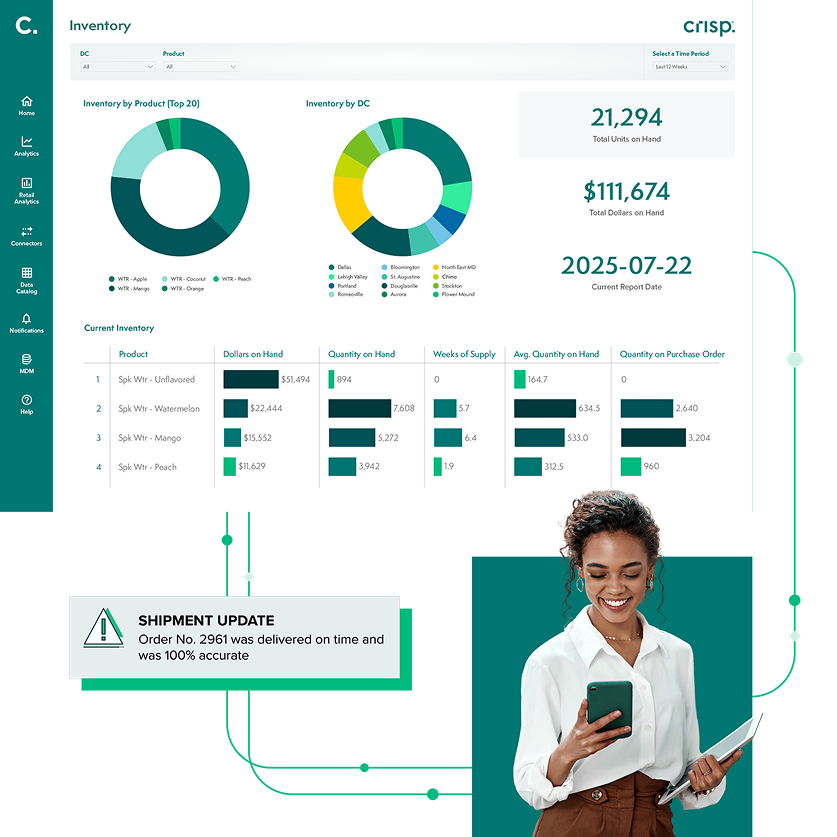
Grow retail revenue with real-time data
Key components of a data-driven category management strategy
A category management strategy comes down to five connected decisions: what to carry, how to price it, where to place it, how to promote it, and whether it is actually available when shoppers want it.
Most category strategies focus on the first four. But a fifth component, availability and execution, often determines whether the strategy works in stores.
A product cannot drive sales if it is out of stock. A promotion cannot perform as planned if the product is missing, poorly placed, or not supported at the shelf.
That is why strong category management depends on more than planning. It depends on whether the plan is actually showing up in stores.
Product and assortment
Product decisions should reflect real shopper behavior, not just category reviews. That includes what sells, which items shoppers see as substitutes, and which products drive trips versus fill baskets.
Strong assortment decisions also depend on local demand. A product that looks weak at the category level may still matter in certain stores, seasons, or shopper missions.
A product that looks weak at the category level may still matter in certain stores, seasons, or shopper missions.
Price
Pricing should reflect how shoppers respond in the real world, not just how the category looks in a review. The same price can perform differently depending on the store, the local market, the competitive set, and the role of the item in the category.
What looks right in a planning meeting does not always hold up at the shelf.

Planogram automation for retail execution
Placement
Placement decisions only matter if stores carry them out correctly. That includes whether the right items are stocked, whether they have the planned number of facings, and whether they appear where the plan says they should.
A strong shelf strategy can still fail if execution slips.
Promotion
Promotions should be planned with store reality in mind, not just calendar timing. Before a promotion begins, teams need to know the product is in stock, distributed to the right locations, and supported by the expected shelf placement or display.
Promotions tend to underperform when execution and availability are treated as separate issues instead of part of the strategy.
Availability and execution
Availability and execution are what connect the strategy to actual results.
This includes whether products are in stock, whether they are distributed to the right stores, and whether shelf conditions match the plan. When teams monitor those signals at the store level, they can catch problems earlier and respond before sales are affected.
These five components are tightly linked. When one starts to break, the others are affected too. That is why a strong category management strategy needs both a clear plan and a way to see whether the plan is holding up in stores.
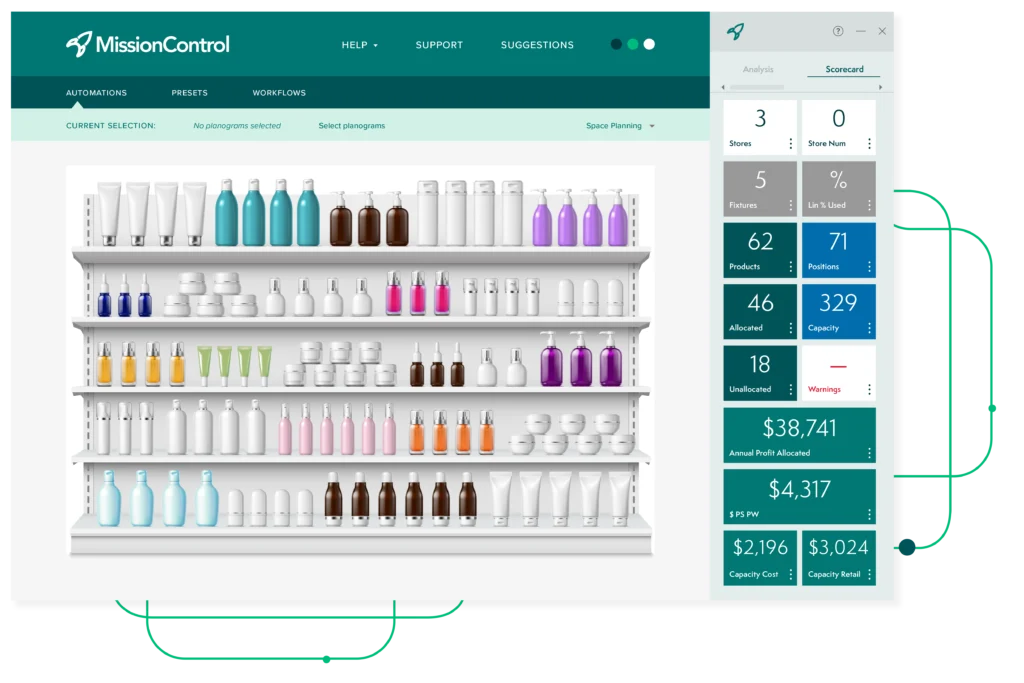
Execute space plans at scale, from approval to in-store reality
Why category strategies fall out of sync
A category strategy starts to break down when the plan no longer matches what is happening in stores.
Teams may begin with a sound strategy based on syndicated data, retailer input, historical performance, and category reviews. But store conditions do not stay fixed. Demand changes. Some stores run into availability problems. Shelf execution varies. Promotions do not always show up as planned.
When teams rely on delayed or aggregated reporting, they often do not see those changes early enough.
A SKU can still look healthy in category-level reporting while key stores are already losing sales. A promotion can appear to be live, even when the product is not fully stocked or supported on the shelf. Inventory may look sufficient overall, while certain stores are already out of stock.
That is how a category strategy can start strong and still lose effectiveness over time.
In practice, this is where teams lose time and make slower decisions. One view may suggest demand is weak, while another shows the product was never truly available. When those signals are disconnected, it becomes harder to know what needs action first.
What data a category strategy depends on
A category management strategy depends on data teams can trust, compare, and act on.
No single data source is enough on its own. To understand how a category is really performing, teams need a connected view across sales, inventory, distribution, and shelf execution.
Most category decisions depend on four main data types.
- Point-of-sale data – Point-of-sale data shows what sold, where it sold, and how quickly it moved. This helps teams understand demand at the item, store, and retailer level. It is one of the clearest signals of what shoppers are actually buying.
- Inventory and distribution data – Inventory and distribution data shows whether shoppers had a fair chance to buy the product in the first place. It helps teams separate weak demand from availability problems. If a product is not in stock, not fully distributed, or not reaching the right stores, sales alone will not tell the full story.
- Syndicated market data – Syndicated market data helps teams understand how the category is performing more broadly. It gives context on market share, category trends, competitive movement, and retailer performance compared with the wider market. This matters because a product may look weak in one account but strong across the category – or vice versa.
- Shelf and execution data – Shelf and execution data shows whether the strategy is actually showing up in stores. That includes placement, facings, displays, promotional support, and other conditions that affect whether shoppers can find and buy the product as planned. Without this view, teams may know performance changed without knowing why.
Point-of-sale data shows what sold, where it sold, and how quickly it moved. This helps teams understand demand at the item, store, and retailer level.
Why data timeliness and standardization matter
These data sources are most useful when they are timely and standardized.
Timeliness matters because store conditions can change quickly. If the data arrives too late, teams may not spot the issue until sales have already been affected.
Standardization matters because retailers often use different product names, category structures, and reporting logic. One retailer may group a product one way, while another uses a different structure. Without a consistent view, it becomes harder to compare performance across accounts and act with confidence.
Strong category strategies depend on timely, standardized, store-level data that brings these signals together. Without that shared view, teams end up comparing disconnected reports instead of making faster, better decisions.
Standardization matters because retailers often use different product names, category structures, and reporting logic. One retailer may group a product one way, while another uses a different structure. Without a consistent view, it becomes harder to compare performance across accounts and act with confidence.
Five signs your category management strategy is off track
Even a strong category management strategy can lose effectiveness when demand, availability, or execution changes faster than teams can see and respond.
These are some of the clearest warning signs to watch for.
- Promoted items are not widely available – A promotion may launch before the product is fully distributed or stocked. Promotions only perform as expected when products are available, visible, and supported in stores. If shoppers cannot find the item, the strategy breaks down before the promotion has a real chance to work.
- Fast-moving items look healthy overall, but certain stores are out of stock – Aggregate reporting can hide store-level availability problems. A product may still look strong across the category while key stores are already losing sales. When that happens, the issue is often not demand. It is that the product is missing where demand exists.
- Shelf execution does not match the plan – Shelf strategy only works if stores carry it out. That includes stocking the right items, giving them the planned number of facings, and placing them where the plan says they should go. If execution slips, even a strong category strategy can underperform.
- Items are removed because they look weak overall, but still matter in certain stores or seasons – Category-level reporting can hide local and seasonal demand. A product that looks weak in the aggregate may still play an important role in specific stores, regions, or shopper missions. When teams rely too heavily on broad averages, they risk removing items that still matter.
- Pricing or promotions perform unevenly across retailers or markets – A strategy that works in one retailer or region may not work the same way somewhere else. Local competition, shopper behavior, availability, and execution all affect results. Uneven performance is often a sign that the strategy needs to be adjusted based on actual store conditions, not rolled-up averages.
These warning signs usually point to the same underlying issue: the strategy may look right at a high level, but it is no longer holding up in stores.
How to improve category management strategy with daily data
Daily data helps teams spot problems sooner and reduce the impact.
Most teams do not need to review every item in every store the same way. A more useful approach is to focus on the exceptions most likely to affect sales, availability, and margin.
That is why many teams are moving toward exception-based management. Instead of treating every signal equally, they focus first on the issues most likely to need action.
That might include:
- Stores with distribution gaps, where an item is authorized but not selling
- Products that show inventory but have no sales
- Items that are selling quickly but are at risk of going out of stock
- Promotions where execution varies across stores
A category management strategy gets stronger when teams can compare the plan with what is actually happening in stores. Daily data makes that possible by showing where products are selling, where they are not, and where availability or execution is falling short.
For teams working across multiple retailers, cross-account comparisons add another layer of insight. They help show where products are performing well, where execution is weaker, and where the same strategy is producing different results.
Those comparisons can help teams catch availability issues, spot weak promotions, and identify tactics worth expanding.
To make those comparisons useful, the data needs to be timely and standardized. Retailers often use different product names, metrics, and category structures, so teams need a consistent way to evaluate results across accounts and act sooner.
With timely, standardized daily data, teams can:
- Spot gaps in distribution or availability
- Identify execution issues at the shelf
- Understand why performance differs across stores or regions
- Adjust pricing, assortment, or promotions based on real conditions
With daily data, category management becomes less dependent on periodic reviews and more of a continuous process.

AI category management: Getting started
Benefits of a strong category strategy
When a category management strategy stays connected to real store conditions, teams make better decisions and see more consistent results.
- Stronger sales performance – Products are more likely to be available, visible, and supported in ways that match shopper demand.
- Improved margins – Better assortment, pricing, and promotion decisions can reduce low-value duplication and support more effective trade spend.
- Fewer availability gaps – Teams can spot out-of-stocks, distribution issues, and execution problems earlier, before they affect performance across more stores.
- More effective promotions – Promotions perform better when products are in stock, placed correctly, and supported the way the plan intended.
- Better alignment across teams – Retailers and brands can work from the same view of performance, which helps reduce delays, rework, and conflicting decisions. A strong category strategy does more than set direction. It helps teams stay aligned with what is happening in stores so they can protect sales, availability, and margin over time.
A category management strategy example
PopSockets offers a clear example of how store-level data can strengthen category management.
The brand used store-level data to understand how its products were performing across retailers. Instead of relying only on category averages, the team looked at in-stock rates, inventory movement, and merchandising execution at the store level.
That view helped the team see where performance was being limited by availability or execution, not just demand.
Based on those insights, PopSockets adjusted inventory levels, improved in-stock performance, and refined how products were placed and supported in stores.
The result was stronger execution and measurable growth, including a 44% increase in sales at Best Buy and in-stock rates above 95% at Target.This is a good example of how category strategy gets stronger when teams can compare the plan with what is actually happening in stores and respond before small issues turn into bigger performance problems.
Conclusion
A category management strategy sets direction for the category, but results depend on what happens in stores between reviews.
When teams can see availability, execution, and performance clearly at the store level, they can respond sooner and make better category decisions.
With timely, standardized data, category management becomes less about looking backward and more about managing change as it happens.
Crisp helps CPG teams bring daily retailer sales and inventory data into one place, making it easier to spot out-of-stocks, phantom inventory, and digital availability issues before they lead to longer periods of lost sales.
FAQs about category management strategy
-
What is a category management strategy in retail?
A category management strategy is a plan for managing a product category as a business unit. It guides decisions across assortment, pricing, promotion, shelf placement, and performance tracking.
-
How does AI impact category management?
AI helps teams analyze sales, inventory, pricing, and product data more quickly. Faster analysis can support forecasting, assortment decisions, and less manual work. Learn more here.
-
What are the main parts of a category management strategy?
The main parts usually include product and assortment decisions, price, placement, promotion, and availability and execution monitoring.
-
What is the category management process?
The category management process is the way teams build, review, and adjust the category plan. Traditional models often follow an eight-step framework, often called the 8-step category management process, while more modern approaches rely on a continuous loop of monitoring store conditions, understanding what’s driving performance, and acting sooner.
-
Why do category management strategies underperform?
A category strategy usually underperforms when the plan no longer matches what’s happening in stores. Common causes include availability gaps, weak shelf execution, uneven promotion performance, and delayed or overly broad reporting.
-
How does daily data improve category management strategy?
Daily data helps teams spot problems early, compare store performance more clearly, and respond while issues are still small and easier to fix. That helps to keep the strategy aligned with real store conditions.
Get insights from your retail data
Crisp connects, normalizes, and analyzes disparate retail data sources, providing CPG brands with up-to-date, actionable insights to grow their business.