

Guide to retail supply chain management
Retail supply chain management is the work of keeping products moving across retailers, warehouses, distributors, and stores. For CPG teams, that work depends on sales, inventory, orders, replenishment, fulfillment, logistics, and retailer requirements lining up clearly enough to support day-to-day decisions.
The job has become more complex. Retailer data may update at different times, inventory may look healthy at the account level while stores are running low, and replenishment issues may appear before teams have a clear view of the problem.
When retailer sales, inventory, and replenishment data don’t line up, CPG teams lose time trying to understand what is actually happening. That can affect retailer conversations, forecasting, inventory planning, and fulfillment decisions.
Below, we’ll explain why connected retail data matters and how supply chain teams can use cleaner data to make better decisions across sales, inventory, orders, replenishment, and fulfillment.
We’ll explain why connected retail data matters and how supply chain teams can use cleaner data to make better decisions across sales, inventory, orders, replenishment, and fulfillment.
Key takeaways
- Retail supply chain decisions become more difficult when sales, inventory, and replenishment data do not line up.
- Store-level retail data can reveal inventory problems that account-level totals may miss.
- Daily POS and inventory updates help teams respond before replenishment problems spread across more stores.
- EDI still plays a major role in orders, shipments, invoices, and retailer compliance workflows.
- Clean, connected retail data helps CPG teams spend less time reconciling reports and more time acting on supply chain issues.
Why retail supply chain management depends on connected data
Supply chain decisions often come down to timing. Products need to arrive before inventory runs low or demand changes faster than replenishment can keep up. A sales trend may point one way while inventory, orders, or shipment updates point another.
That’s where connected retail data becomes important. When teams can compare sales, inventory, order, fulfillment, and retailer data more easily, they can understand account, product, and location changes faster.
Connected retail data helps CPG teams collectively respond before demand outpaces availability.
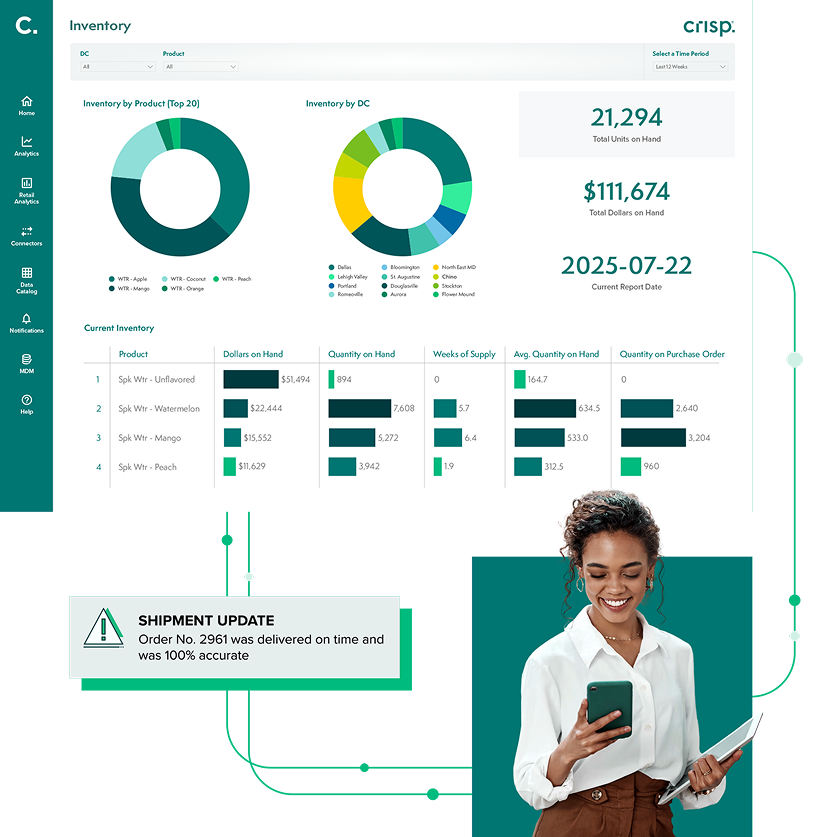
Grow retail revenue with real-time data
Why retail supply chain data is hard to line up
Retail supply chain data usually comes from several places. Retailer reports may show sales or inventory using the retailer’s own product IDs and definitions. Warehouse systems may show available inventory by location. Order and shipment updates may come through EDI, a 3PL, or a shipping system.
Matching retailer product IDs and definitions to internal product catalogs can also create manual reconciliation work. A product may have one name or identifier in a retailer report, another in an internal system, and another in a warehouse or order file. Small differences can slow down reporting when teams need to compare performance across accounts and locations.
Each data source can be useful on its own, but the full picture is harder to see when the data does not connect cleanly. A change in sales velocity may raise one question for the sales team and another for the supply chain team. Before anyone can respond, someone often has to connect the purchase order, shipment status, inventory position, and store-level sales trend.
Much of that comparison work still falls to people. Teams may spend time chasing numbers across spreadsheets, retailer portals, shipment updates, and inbox threads before they can identify what actually needs attention. Instead of helping teams make decisions faster, disconnected reports can turn day-to-day supply chain work into a reconciliation project.
Store-level detail matters because account-level summaries can mask what is happening in individual locations. A product may appear stable across an account while certain stores are out of stock, carrying excess inventory, or missing a promotion window.
Without clean connections between sales, inventory, orders, and fulfillment data, supply chain teams may react later than they need to. Replenishment decisions depend on seeing what changed, where inventory sits, and which locations need action.
Crisp AI Master Data goes beyond classic mapping and manual maintenance, making it easier than ever to uncover strategic insights across your retail portfolio and gain a competitive edge at the shelf.
What CPG teams should look for in retail supply chain data
Useful supply chain data should help teams compare sales, inventory, orders, and fulfillment without relying on manual report comparison.
That data should include:
- Daily POS and inventory updates
- Store-level detail
- Order and shipment status
- Clean, standardized product and store data
- EDI and back-office connections
Strong retail supply chain data helps teams answer three daily questions: what changed, where did it happen, and what needs attention next.
Strong retail supply chain data helps teams answer three daily questions: what changed, where did it happen, and what needs attention next.
How daily retail data helps improve replenishment decisions
Supply chain teams often see replenishment problems after they’ve already affected sales because reports arrive too late. Frequent retail updates give teams a chance to respond before the problem spreads to more stores.
An account-level inventory number may still look healthy while certain stores are selling through faster than replenishment can respond. By the time delayed reports catch up, inventory gaps may already affect more locations.
A low fill rate can start when demand changes faster than the forecast, replenishment plan, or allocation plan can catch up. Without current retail data, teams may continue replenishing inventory based on outdated assumptions instead of current buying patterns.
Daily POS and inventory data shorten the time between seeing a problem and acting on it. Teams can identify changes in sales velocity and product availability earlier, making it easier to adjust replenishment, allocation, or fulfillment plans before inventory problems spread.
Store-level retail data also helps sales, supply chain, and retailer teams work from the same information instead of comparing delayed summaries from different systems.
Safe Catch used Crisp to improve forecasting and fill-rate optimization, recovering $1 million from stockouts. The team also used Crisp retail data to monitor distributors, identify out-of-stocks, and improve supply chain planning.
ZURU used Crisp retail analytics and inventory data to reduce potential markdowns by 50% and improve inventory planning decisions across stores. The team also reduced manual reporting by more than 15 hours each week.
Safe Catch used Crisp to improve forecasting and fill-rate optimization, recovering $1 million from stockouts.
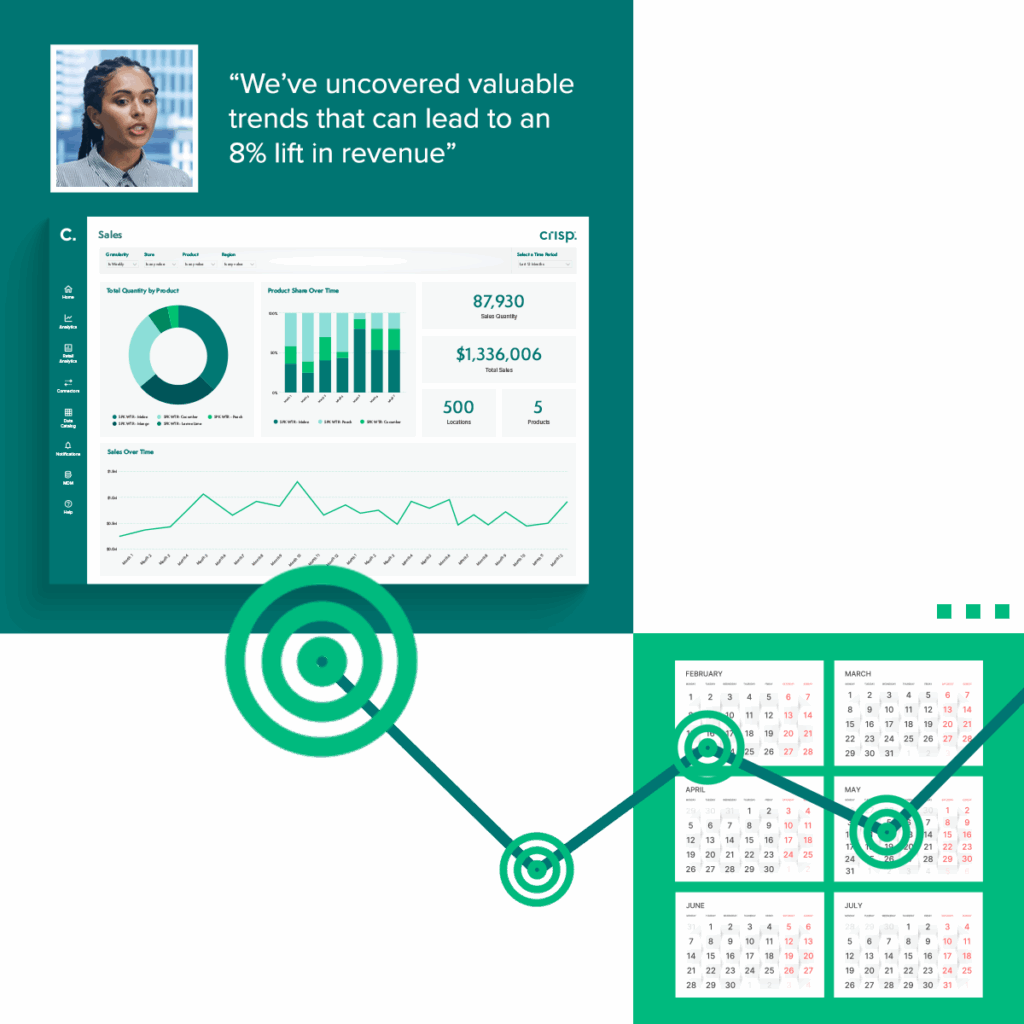
Grow retail revenue with real-time data plus AI
Why EDI still matters in retail supply chain operations
Many retailers still rely on EDI to exchange order information, including purchase orders, shipment notices, invoices, inventory updates, labels, and compliance-related documents. These retailer requirements can affect shipment timing, invoice accuracy, chargeback risk, and account performance.
Order information matters because it shows whether products are moving as planned. A product may look available in inventory reports while an order issue, missing shipment update, or invoice mismatch is already slowing replenishment behind the scenes.
The challenge is that EDI activity often sits apart from the other tools teams use every day. Order updates may live in one place, warehouse activity in another, and shipping details somewhere else. When that happens, teams may have to check retailer portals, EDI systems, warehouse systems, shipping tools, spreadsheets, or emails just to understand what changed.
Missing shipment updates, labeling issues, or fulfillment delays can create compliance problems and increase chargeback risk.
When EDI data connects with the systems teams already use, it becomes easier to follow what was ordered, what shipped, what changed, and what may slow fulfillment.
That makes it easier to answer retailer questions, resolve issues sooner, and keep products moving across accounts and locations. Noka Organics used Crisp EDI to support retailer onboarding and order management across trading partners, helping simplify day-to-day operations as retail complexity increased.
Crisp EDI supports retailer onboarding and order management across trading partners, helping simplify day-to-day operations as retail complexity increased.
Why this matters more in the AI era
CPG retail operations are becoming more automated. Forecasting systems, replenishment tools, inventory planning systems, and AI-driven workflows increasingly depend on current sales, inventory, and store-level data.
That makes delayed, incomplete, or disconnected retail data riskier. Automated workflows can move faster than teams can correct them. A forecast may adjust before inventory data is updated, or a campaign may keep driving demand in stores that cannot support it.
As more decisions become automated, retail data systems need to connect inventory, replenishment, forecasting, marketing, and retail execution. More advanced AI-driven workflows depend on connected retail data to help teams identify risks, prioritize actions, and respond faster across retail operations.
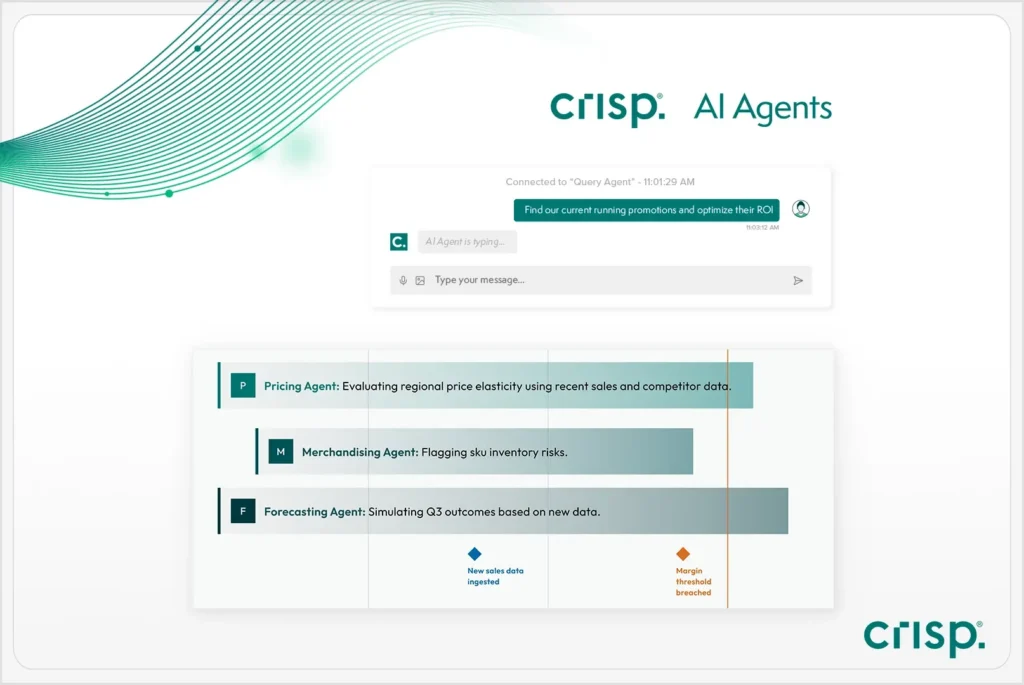
Discover Crisp AI Agents for Retail
How better supply chain decisions reduce out-of-stocks and waste
Better supply chain decisions lead to fewer missed sales, fewer markdowns, and fewer inventory surprises. When teams can compare sales, inventory, order, and fulfillment data more clearly, they have more time to adjust before small issues become broader supply chain problems.
If products are selling faster than expected, supply chain teams need to know early enough to adjust replenishment or allocation. Otherwise, sales may be lost before the next report shows the full impact.
After weeks of stockouts, teams may no longer have a clean recent sales baseline. That makes forecasting harder because reported sales may reflect what was available to buy, not actual shopper demand.
Excess inventory creates a different kind of pressure. Products sitting too long in the wrong stores or regions can lead to markdowns, waste, and tied-up working capital. Store-level data shows where inventory is not matching demand so teams can correct course sooner.These decisions also affect retailer conversations. When CPG teams can explain where products are selling, where inventory is sitting, and what needs attention, they can work with retail partners from a shared set of facts.
What today’s CPG teams need from retail supply chain management
Strong retail supply chain management depends on more than forecasting demand or tracking inventory totals. CPG teams also need to understand how sales, replenishment, fulfillment, orders, and retailer activity connect across the business.
That work becomes harder when retail data updates too slowly or lives in systems that are difficult to compare. Teams may spend more time reconciling reports than responding to inventory movement, retailer questions, or changes in demand.
Current, store-level retail data helps teams operate from what is happening now instead of what happened days or weeks ago. When sales, inventory, orders, and fulfillment updates line up more clearly, supply chain teams can make faster, more confident decisions across retailers, products, and locations.
Strong retail supply chain management gives CPG teams a clearer way to see what is happening and act before small issues become larger account problems.
Get started by reaching out to Crisp today.
FAQs about retail supply chain management
-
What is retail supply chain management?
Retail supply chain management is the work of planning, moving, tracking, and replenishing products from production through retail sale. For CPG brands, it includes demand forecasting, inventory management, fulfillment, logistics, retailer coordination, and product availability.
-
Why is daily retail data important for supply chain management?
Daily retail data shows changes in sales, inventory, and product availability sooner. More frequent updates make replenishment decisions easier and help supply chain teams respond before problems spread across more stores.
-
Why do supply chain reports not always line up?
Supply chain reports may come from different systems, update on different schedules, or use different product IDs and definitions. Teams can have accurate reports that are still hard to compare clearly.
-
How does EDI support retail supply chain management?
Retail EDI helps retailers and suppliers exchange purchase orders, shipment notices, invoices, inventory updates, labels, and compliance-related documents. These documents support order processing, fulfillment, retailer communication, and product movement across the supply chain.
-
Why does store-level data matter?
Store-level data shows what is happening in individual locations. Account-level totals can look stable while certain stores are running low, overstocked, or missing sales opportunities.
-
How can clean, connected retail data help reduce out-of-stocks?
Clean, connected retail data helps teams compare sales, inventory, orders, and fulfillment data across systems and locations. That gives teams more time to adjust replenishment or allocation before products go out of stock.
Get insights from your retail data
Crisp connects, normalizes, and analyzes disparate retail data sources, providing CPG brands with up-to-date, actionable insights to grow their business.