

AI Agents for retail demand planning
- Shelf-aware automation: AI demand planning automates data analysis across thousands of retail locations to move at the speed of the shelf.
- Traceable reasoning: Persistent retail agents use logic chains to process weather patterns, promotional calendars, and POS data simultaneously.
- AI-ready foundation: Transitioning from static spreadsheets to a unified, AI-ready retail data foundation is the prerequisite for reliable decisions.
- Strategic validation: Teams should move from the drudgery of data aggregation to high-level strategic validation, starting with high-volume categories.
Supply chain teams face continuous pressure to predict consumer behavior with surgical precision. Traditionally, analysts have been burdened by the “data janitor” problem – spending 50% of their week downloading reports from disparate retail portals and formatting static spreadsheets. Because these models rely on historical averages, a sudden weather event or a viral social media trend can render a monthly forecast obsolete in days.
For CPG brands, this creates a multi-million dollar capability-deployment gap. While the data exists, the organization’s inability to act on it with high velocity leads to spoilage or costly out-of-stocks (OOS). Crisp AI Agents address this by narrowing the margin of error, evaluating real-time sales trajectories to recommend precise manufacturing adjustments that reflect the reality of the shelf.
The rise of logic chains to move beyond a black box
The primary barrier to AI adoption in the supply chain is trust. A Category Manager cannot walk into a meeting with a major retailer and suggest a $100k inventory shift simply “because the AI said so.”
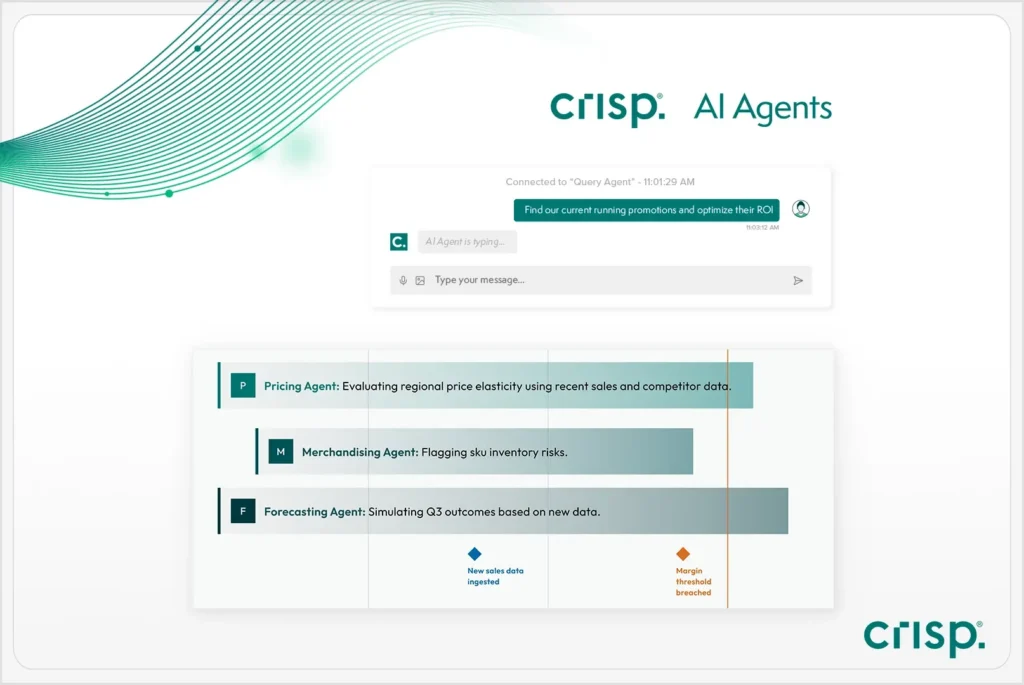
Modern autonomous agents solve this through logic chains (or Chain of Thought reasoning). Instead of delivering a binary alert, these agents “show their work.” They provide a clear, auditable trail of reasoning – cross-referencing distributor inventory, historical fill rates, and lead-time lags – to prove the validity of a recommendation. This allows human experts to move from manual insights production to the power of strategic validation.
Discover Crisp AI Agents for Retail
Logic chains provide a clear, auditable trail of reasoning – cross-referencing distributor inventory, historical fill rates, and lead-time lags – to prove the validity of a recommendation.
Processing multiple data streams concurrently
Demand planners typically manage sales data in isolated systems, creating a “goldfish memory” effect where context is lost between sessions. Crisp AI Agents function as Persistent Retail Agents, pulling information from fragmented portals into a unified Retail Knowledge Graph.
By cross-referencing daily POS movement with external variables like regional heatwaves or local holidays, the agents detect geographic disparities automatically. If sales are surging in coastal cities while dropping in landlocked states, the agent highlights the “why” behind the trend, allowing supply chain directors to redirect shipments before a regional stockout occurs.
Adjusting to sudden market shifts through ‘active interrogation’
Historical data loses relevance during unprecedented disruptions. Unlike static tools, Crisp AI Agents enable Active Interrogation. When an agent flags a $50,000 revenue gap, a user can “drill down” into the logic: “Which specific stores are driving this gap?” or “Does this account for the upcoming promotion in Week 12?”
The agent updates its logic chain in real-time, recording anomalies in sales velocities – such as a competitor’s unannounced price drop – and recalculating expected demand. This “shelf-to-supply chain” feedback loop ensures that production schedules are modified early, preventing excess inventory from building up in regional DCs.
When an agent flags a $50,000 revenue gap, a user can “drill down” into the logic: “Which specific stores are driving this gap?” or “Does this account for the upcoming promotion in Week 12?”
Core benefits of agentic demand planning
- From averages to granularity: Instead of broad national averages, agents build specific predictive models for every store-SKU combination, ensuring Miami’s demand doesn’t dictate Chicago’s inventory.
- Eliminating administrative drudgery: Agents automate the extraction and cleaning of POS metrics, adopting your brand’s “internal dialect” and specific KPIs so analysts can focus on buyer relationships.
- Real-world responsiveness: Traditional cycles run monthly; Crisp AI Agents update projections daily. If a weekend promotion spikes movement, the agent captures the signal by Monday morning to adjust the fulfillment plan.
- Dynamic SOPs: By teaching an agent your internal logic – such as a specific lead-time buffer for a “Northeast Hub” – you capture the “unwritten SOPs” of your senior analysts, ensuring consistent excellence even as teams change.

Grow retail revenue with real-time data plus AI
Crisp AI Agents update projections daily. If a weekend promotion spikes movement, the agent captures the signal by Monday morning to adjust the fulfillment plan.
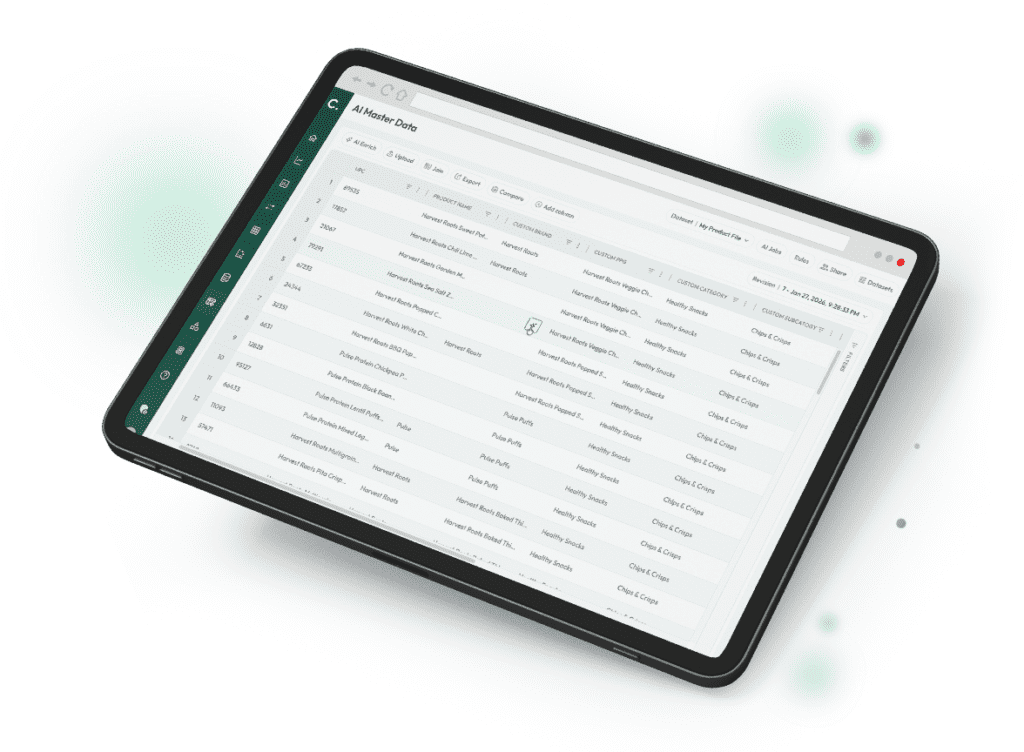
Preparing the foundation with AI Master Data MDM
Machine learning requires “machine-ready” inputs. Poor baseline numbers lead directly to flawed production recommendations.
- Centralizing the data layer: Data fragmentation is the leading cause of “alert fatigue.” Brands must connect distinct sources – retailer portals, 3PL databases, and internal ERPs – into a single warehouse. Crisp AI Master Data unifies these SKUs, ensuring mathematical models evaluate all available market activity without skipping major retail channels.
- Cleaning historical context: Historical datasets often contain “noise,” such as a past stockout appearing as a drop in consumer interest. Planners must tag these anomalies so the agent can establish accurate seasonal baselines and separate supply failures from recurring consumer trends.
Experience Crisp AI Master Data for CPG and Retail
Implementing AI agents: A crawl-walk-run approach
Success in agentic commerce comes from a structured rollout:
- Start with high-volume pilots: Stable, fast-moving goods provide the best data for agents to identify patterns and build internal trust.
- Define guardrails: Set numerical boundaries based on warehouse capacity and shelf life. If an agent recommends a spike that exceeds capacity, the system flags it for human review.
- Side-by-side validation: Run AI models alongside manual spreadsheets for a 90-day period. Documenting where the software successfully identified emerging trends helps teams view the technology as a collaborative “co-pilot” rather than a replacement.
Get started with Vertical AI for demand planning; reach out to learn more.
FAQs about AI demand planning
-
How does automated planning differ from traditional forecasting?
Traditional forecasting relies on manual updates and historical averages. Automated planning uses Persistent Retail Agents that ingest continuous data feeds to adjust projections daily. It moves beyond “what happened” to provide a logic-based narrative of “what is happening now” at the store level.
-
Do companies need to hire data scientists to use these agents?
No. Modern platforms use Vertical AI – systems that arrive with deep retail domain context. Supply chain analysts can operate these systems through natural language, using “Active Interrogation” to challenge and refine insights without writing a single line of code.
-
Can AI agents handle "unwritten" business rules or SOPs?
Yes. Through Memory and Preferences, Crisp AI Agents learn your company’s specific financial rules, terminology, and workflows. This preserves the “expert logic” of your senior team members as a digital asset that stays within the company.
-
How long does it take for a logic chain to become reliable?
While models processing stable POS data can produce reliable projections within four to eight weeks, the “trust” factor grows faster because of traceability. Because the agent can “show its work” from day one, teams can validate the reasoning immediately rather than waiting months to see if the numbers were right.
Get insights from your retail data
Crisp connects, normalizes, and analyzes disparate retail data sources, providing CPG brands with up-to-date, actionable insights to grow their business.