














AI Agents for demand forecasting in retail
- Continuous monitoring: Unlike traditional periodic forecasting, AI Agents continuously monitor retail signals to execute baseline replenishment tasks.
- Orchestration layer: Agentic AI serves as an orchestration layer that automates mundane data prep, freeing planners to focus on supply exceptions.
- Unified data foundation: A centralized, AI-ready data infrastructure is required to eliminate the lag between retail signals and supply chain action.
- Traceable accuracy: Logic chain technology allows teams to validate the reasoning behind every forecasted spike or dip.
Supply chain planners are losing their Monday mornings. They often spend hours pulling CSV files from half a dozen disconnected retail portals just to assemble a baseline inventory picture before actual analysis can even begin. Because teams waste so much time standardizing this basic information, they are forced to act on batch data that is already stale by the time it reaches decision-makers.
Agentic AI fundamentally resolves this, unburdening human teams by automating the mundane preparation of baseline replenishment and allowing planners to move from the drudgery of insight production to the power of strategic validation.
The shelf-to-supply chain feedback loop
Modern retail generates massive amounts of data daily, but access alone doesn’t guarantee impact. CPG brands often face a capability-deployment gap: they have the store-level data, but they lack the velocity to act on it.
Crisp AI Agents close this gap by serving as a 24/7 digital teammate. While traditional models rely on latent, weekly summaries, AI Agents connect directly to raw, daily data feeds. This “shelf-aware” approach means that when an agent detects a regional surge in coastal cities or a dip in landlocked states, it highlights the geographic disparity automatically, allowing teams to redirect shipments before a regional stockout occurs.
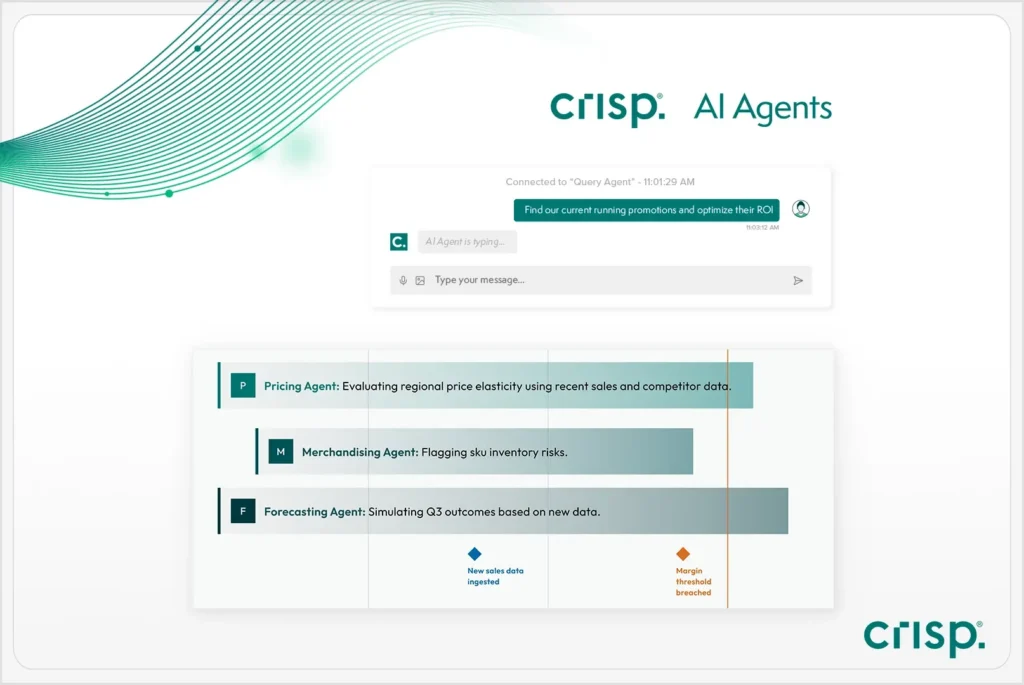
Discover Crisp AI Agents for Retail
CPG brands often face a capability-deployment gap: they have the store-level data, but they lack the velocity to act on it.
Eliminating the black box with logic chains
In the world of CPG, an insight without an explanation is a risk. A Category Manager cannot suggest a major inventory shift to a retail buyer “because the AI said so.”
This is why transparency is the key to ROI. Crisp AI Agents employ Logic Chains (Chain of Thought reasoning) to show their work. When an agent identifies a growth opportunity or a demand spike, it delivers a clear narrative of the reasoning – cross-referencing current distributor inventory with historical fill rates. This traceability builds the trust required to move from data points to shelf-level action.
Dynamic responsiveness through ‘active interrogation’
Static forecasting tools often suffer from a “goldfish memory,” resetting with every new session and losing critical business context. Agentic AI is designed to be persistent, learning your brand’s specific “dialect,” KPIs, and dynamic SOPs over time.
This persistence enables Active Interrogation. If an AI Agent flags a $50,000 revenue gap in a specific region, planners can “drill down” into the logic in real-time: “Which specific stores are driving this gap?” or “Does this account for the upcoming promotion in Week 12?” The AI becomes a dynamic analyst that can be challenged and refined, ensuring the final forecast reflects the operational reality of the business.
If an AI Agent flags a $50,000 revenue gap in a specific region, planners can “drill down” into the logic in real-time: “Which specific stores are driving this gap?” or “Does this account for the upcoming promotion in Week 12?”
Core benefits of agentic forecasting
- Closing the granularity gap: Agents build specific predictive models for every store-SKU combination, ensuring hyper-local demand curves that broad averages miss.
- Reduced administrative workload: By automating the extraction and cleaning of POS metrics, agents eliminate the manual workflows where “time goes to die.”
- Proactive anomaly detection: Agents detect disruptions – like a competitor’s price drop – on the day they happen, recalculating demand immediately to prevent excess inventory buildup.
- Capturing unwritten SOPs: Through Memory and Preferences, agents capture the expert logic of senior analysts (e.g., specific lead-time buffers for a “Northeast Hub”), ensuring consistent excellence even as teams change.
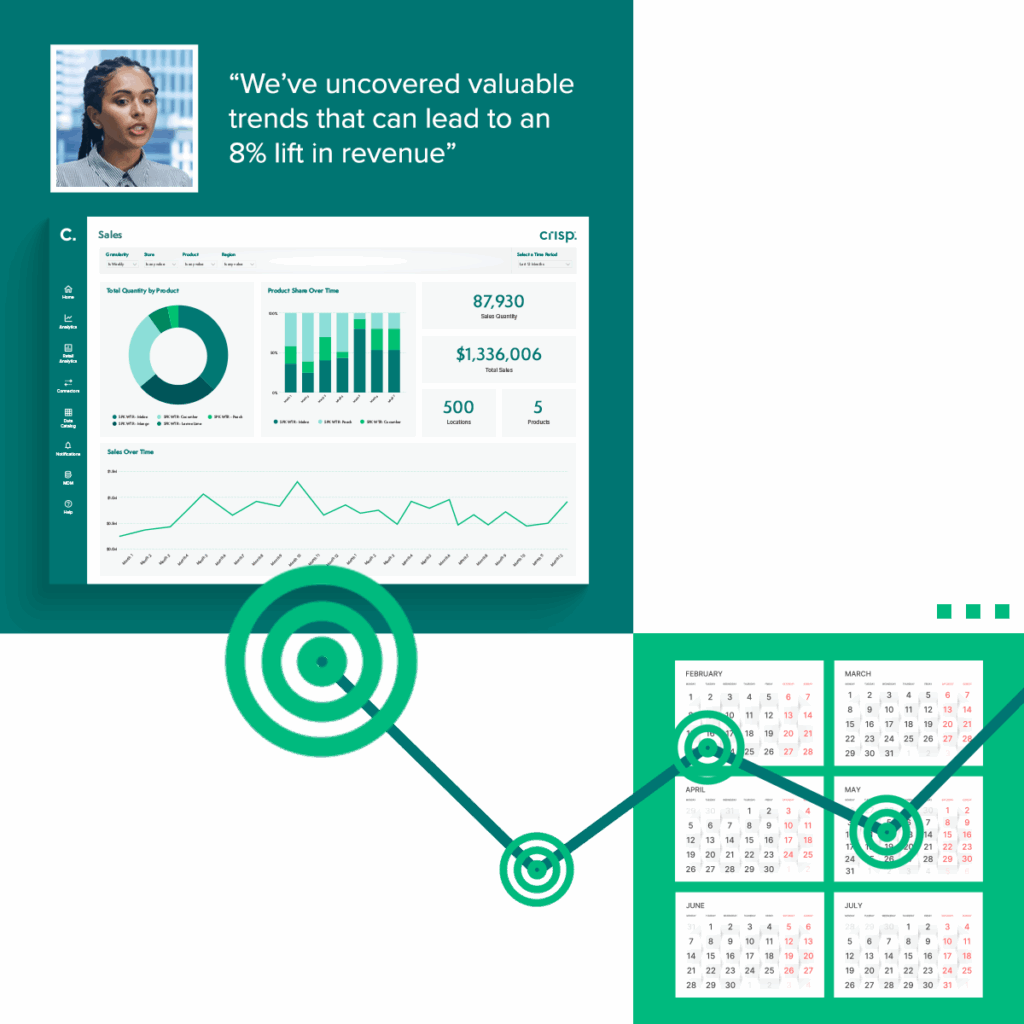
Grow retail revenue with real-time data plus AI
Agents detect disruptions – like a competitor’s price drop – on the day they happen, recalculating demand immediately to prevent excess inventory buildup.
Preparing for the agentic era with AI Master Data
Machine learning requires “machine-ready” inputs. Data fragmentation across retailer portals and internal ERPs is the primary barrier to successful automation.
Crisp AI Master Data unifies these disparate sources into a single, harmonized data layer. This ensures that when the AI Agent recalculates a forecast, it is evaluating all available market activity without skipping major retail channels. Furthermore, by “cleaning” historical records – tagging past out-of-stocks or clearance events – planners ensure the agent establishes an accurate seasonal baseline.
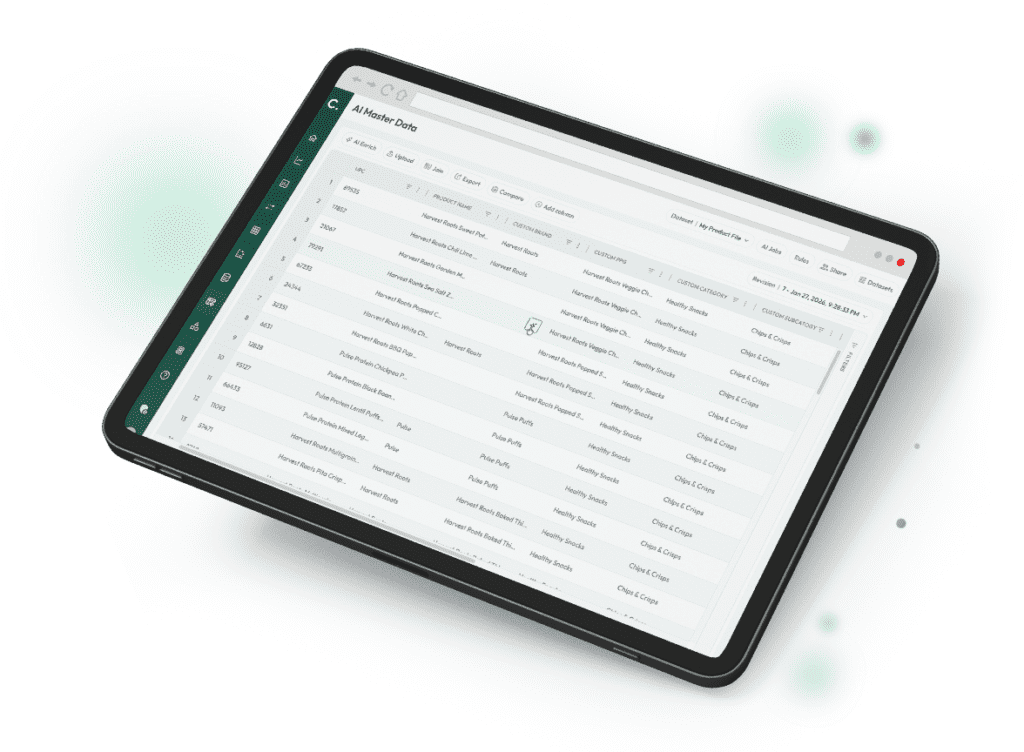
Experience Crisp AI Master Data for CPG and Retail
Structured roll-out for AI Agents in retail
Trusting a system with multi-million dollar inventory decisions requires a gradual operational adjustment:
- Start with high-volume pilots: Use stable, fast-moving items to identify patterns and build internal support for the technology.
- Define logic gates: Set maximum and minimum inventory thresholds (guardrails). If a recommendation exceeds these gates, the system flags it for human review.
- Side-by-side validation: Run automated models alongside manual efforts for 90 days. Documenting where the software successfully identified emerging trends helps analysts view the agent as a force multiplier rather than a replacement.
Implementing autonomous agents gives companies the processing speed required to operate at the speed of the shelf. While humans guide the strategy, the agents handle the complex mathematical forecasting required to keep products available across every touchpoint.
Get started with Vertical AI for demand planning; reach out to learn more.
Frequently asked questions for Retail AI forecasting
-
How does agentic forecasting differ from traditional methods?
Traditional planning relies on manual report downloads and periodic batch updates. Agentic forecasting uses Persistent Retail Agents that ingest daily POS data to adjust projections in real-time, providing a logic-based narrative of “what is happening now” at the store level.
-
What is a "logic chain," and why does it matter?
A logic chain is the step-by-step reasoning an AI Agent follows to reach a conclusion. In high-stakes retail environments, logic chains provide the traceability required for human experts to validate and trust an AI’s recommendation before taking action. Learn more: Retail demand forecasting: Getting started.
-
Can AI Agents adapt to our company's unique terminology?
Yes. Through Memory and Preferences, Crisp AI Agents learn your brand’s specific dialect and financial rules. This preserves the “expert logic” of your team as a digital asset that stays within the company.
-
How do agents help with "alert fatigue"?
Traditional systems often fire binary “low inventory” alerts that create noise. AI Agents use logic gates to cross-reference multiple signals (like case fill rates vs. internal warehouse availability) to ensure that only high-fidelity, actionable insights reach the planning team. See how purchasability signals work in practice →
Get insights from your retail data
Crisp connects, normalizes, and analyzes disparate retail data sources, providing CPG brands with up-to-date, actionable insights to grow their business.